


Sign up for workout ideas, training advice, reviews of the latest gear and more.



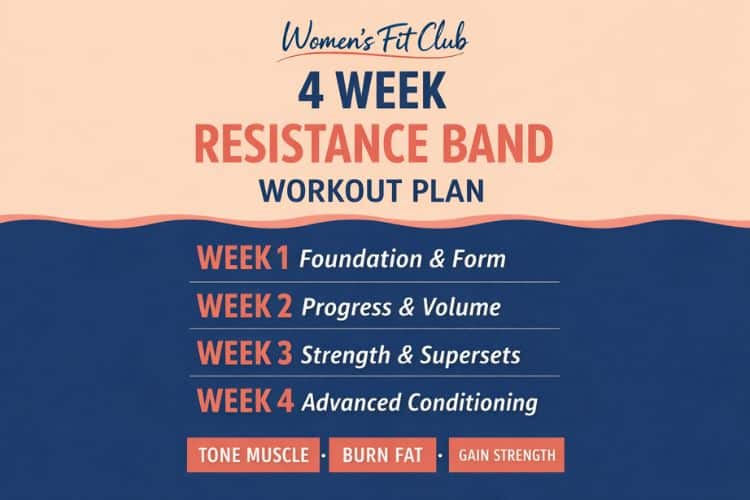

Resistance band workouts have become one of the most effective and accessible ways to build strength, tone muscles, and improve overall fitness without needing heavy gym equipment. A well-designed 4 week resistance band workout plan can deliver impressive results whether you are training at home, traveling, or looking for a joint-friendly alternative to weights. Resistance bands provide constant tension throughout each movement, making every rep effective for muscle engagement, stability, and control.
This 4 week resistance band workout is structured to progressively challenge your muscles while improving endurance, balance, and coordination. It is suitable for beginners and intermediate exercisers, and it can be easily modified to match your fitness level. Over four weeks, you will train your entire body using full-body sessions and targeted splits that promote muscle tone, fat loss, and functional strength.
A resistance band workout program offers unique benefits that traditional weight training sometimes cannot provide. Resistance bands create variable resistance, meaning the tension increases as the band stretches. This improves muscle activation and strengthens stabilizing muscles that are often undertrained.
A 4 week resistance band workout plan allows enough time to build consistency, see measurable progress, and safely increase intensity. Unlike short challenges, four weeks gives your muscles time to adapt, recover, and grow stronger while reducing the risk of overuse injuries.
Resistance band workouts are also extremely versatile. They can be done at home, outdoors, or while traveling. They are ideal for beginners, women over 40, postpartum fitness, and anyone seeking a low-impact strength training option.
Resistance band workouts offer a wide range of physical and functional benefits that go beyond basic strength training.
One of the biggest advantages of resistance bands is joint-friendly resistance. Bands reduce strain on the joints while still challenging muscles effectively. This makes them ideal for people with joint sensitivity, past injuries, or those returning to exercise.
Resistance bands also improve muscle endurance and tone. Because bands keep muscles under tension throughout the movement, they encourage slow, controlled reps that enhance muscle definition.
Another key benefit is improved functional strength. Resistance band exercises often mimic natural movement patterns, helping you build strength that transfers to daily activities like lifting, bending, and reaching.
Finally, resistance band workouts support fat loss and metabolic conditioning. When performed in circuits or supersets, band workouts elevate heart rate while strengthening muscles, making them highly effective for calorie burn.
This 4 week resistance band workout is designed to be inclusive and adaptable. It is suitable for beginners who are new to strength training, as well as experienced exercisers looking for a fresh challenge.
Women who prefer at-home workouts will benefit from the simplicity and efficiency of resistance bands. This program is also ideal for busy schedules, since workouts can be completed in 30 to 45 minutes.
If you are recovering from an injury, easing back into exercise, or looking for a low-impact training option, resistance band workouts provide a safe and effective solution. Athletes can also use resistance bands to improve mobility, stability, and muscle activation.
This program is structured as a four-week progressive training plan, with workouts scheduled four to five days per week. Each week builds on the previous one by increasing resistance, volume, or intensity.
Before each workout, perform a dynamic warm-up to prepare your muscles and joints. After each session, finish with light stretching to promote recovery and flexibility.
Choose resistance bands that allow you to complete each set with proper form while still feeling challenged by the final repetitions. If an exercise feels too easy, increase tension by using a thicker band or shortening the band length.
Each week includes a balanced combination of full-body and targeted workouts. Rest days are built in to allow recovery and prevent burnout.
Week 1 focuses on learning proper form and activating muscles.
Week 2 increases volume and control.
Week 3 introduces intensity through supersets and tempo changes.
Week 4 challenges endurance and strength with advanced band variations.
The first week of this 4 week resistance band workout emphasizes proper movement patterns, muscle activation, and controlled reps. This phase helps you build a strong foundation while reducing soreness and injury risk.
Lower body exercises in week one focus on activating the glutes, quads, and hamstrings. Resistance band squats encourage proper hip hinge mechanics while maintaining constant tension. Band-assisted glute bridges help activate the posterior chain and improve hip stability.
Lateral band walks strengthen the glute medius, which is essential for knee stability and balance. Standing resistance band leg curls target the hamstrings while improving coordination.
Upper body training includes resistance band rows, chest presses, and shoulder presses. These exercises build strength in the back, chest, shoulders, and arms while improving posture and shoulder stability.
Resistance band bicep curls and tricep extensions complete the upper body workout, ensuring balanced arm development without joint strain.
Core exercises such as banded dead bugs and standing band rotations help strengthen the deep core muscles. These movements improve stability, posture, and overall functional strength.
Week two builds on the foundation established in week one by increasing repetitions and adding new movement patterns. This phase encourages muscle endurance and improved control.
Resistance band reverse lunges add unilateral strength, challenging balance and coordination. Banded sumo squats increase inner thigh and glute activation, while standing band kickbacks emphasize glute isolation.
Upper body exercises become more challenging with increased time under tension. Slow resistance band chest presses and rows improve muscle engagement. Lateral raises and face pulls strengthen the shoulders while supporting joint health.
Core exercises include banded plank pull-throughs and standing woodchoppers. These movements enhance rotational strength and core stability.
Week three introduces supersets, where two exercises are performed back-to-back with minimal rest. This training style increases intensity, improves muscular endurance, and boosts calorie burn.
Lower body supersets pair resistance band squats with glute bridges or lunges with lateral walks. These combinations challenge the legs while elevating heart rate.
Upper body supersets combine pulling and pushing movements such as rows with chest presses or shoulder presses with tricep extensions. This approach improves muscle balance and efficiency.
Core supersets may include banded Russian twists followed by plank holds. These exercises challenge the abs from multiple angles.
The final week of the 4 week resistance band workout focuses on endurance, strength, and confidence. Exercises become more dynamic, and rest periods may be reduced.
Resistance band squat pulses and single-leg deadlifts challenge muscular endurance and balance. These movements promote muscle definition and functional strength.
Upper body conditioning includes high-rep band rows, overhead presses, and arm circuits. The constant tension from the bands keeps muscles engaged throughout each set.
Advanced core exercises such as standing band crunches and anti-rotation holds strengthen the core while improving posture and spinal stability.
Once you complete this 4 week resistance band workout, you can continue progressing by increasing band resistance, adding more sets, or combining resistance band training with dumbbells or bodyweight exercises.
You may also repeat the program with heavier bands or slower tempos to increase intensity. Resistance bands are highly adaptable, allowing endless variations and long-term progression.
One common mistake is using too much resistance too soon. Proper form should always come before heavier bands. Another mistake is rushing through reps. Controlled movements maximize muscle engagement and reduce injury risk.
Skipping warm-ups and cool-downs can also limit results. Always prepare your body before training and stretch afterward to support recovery.
A 4 week resistance band workout is a powerful and practical way to build strength, tone muscles, and improve overall fitness at home or on the go. Resistance bands provide constant tension, joint-friendly resistance, and endless versatility, making them suitable for all fitness levels.
By following this structured four-week plan, you will improve muscle definition, enhance functional strength, and build a sustainable workout routine that fits your lifestyle. Whether your goal is toning, fat loss, or overall fitness, resistance band training offers an effective and accessible solution.
To enhance your 4-Week Resistance Band Workout plan and help readers build strength safely and effectively, consider linking to complementary content from Women’s Fit Club. For beginners who want to establish a solid foundation before diving into resistance band training, check out Strength Training for Beginners: Your Essential 10-Minute Start for form cues and basic moves that build confidence and muscle control. To expand on full-body conditioning that pairs well with band circuits, the 10 Best Strength Workouts for Women to Build Muscle & Burn Fat offers a variety of strength routines to keep training fresh and effective. For busy readers looking for time-efficient total-body workouts, the 30-Minute Full Body Metabolic Resistance Training Workout provides an intense, calorie-burning alternative that still incorporates resistance principles. If your audience enjoys quick strength sessions, the 5-Minute Full Body Dumbbell Workout (featured on the homepage) delivers fast, impactful movements that complement longer resistance band days.
Stay up to date on the latest women’s health, fitness and lifestyle trends and tips.
