


Sign up for workout ideas, training advice, reviews of the latest gear and more.



A 4-week body weight workout plan is one of the most effective ways to build strength, burn fat, and improve overall fitness without stepping foot in a gym. Using only your body weight, you can create enough resistance to challenge every major muscle group while improving cardiovascular endurance, balance, and mobility. Whether you are a beginner or returning to exercise after a break, this structured four-week program helps you stay consistent, progress safely, and see real results.
This guide breaks down everything you need to know about following a 4-week bodyweight workout, including weekly progressions, workout structure, benefits, and tips to maximize your results at home.
Bodyweight training removes many of the common barriers that stop people from exercising consistently. There is no equipment to buy, no gym membership required, and no complicated setup. A four-week timeframe is long enough to build habits and short enough to stay motivating.
A well-designed bodyweight workout plan uses progressive overload by increasing reps, time under tension, intensity, or exercise complexity each week. Over four weeks, this approach improves strength, endurance, and muscle tone while supporting fat loss.
Bodyweight exercises train your muscles to work together rather than in isolation. Movements like squats, push-ups, and planks improve real-life strength for daily activities.
When structured into circuits or timed intervals, bodyweight workouts elevate your heart rate, improving cardiovascular endurance and calorie burn.
Many bodyweight movements require stability, coordination, and range of motion, which supports joint health and reduces injury risk.
Exercises can be modified to make them easier or more challenging, making bodyweight workouts ideal for beginners and advanced exercisers alike.
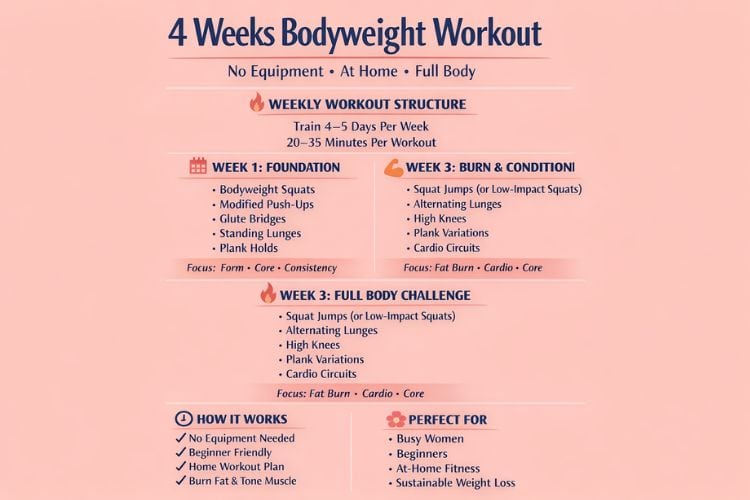
This program follows a progressive weekly format, with 3–5 workouts per week, depending on your fitness level. Each week builds on the last by increasing volume, intensity, or complexity.
Each workout includes:
Week one focuses on learning proper movement patterns and activating major muscle groups. This week is ideal for beginners or anyone returning to exercise.
Bodyweight squats, modified push-ups, glute bridges, wall sits, standing lunges, knee planks, and marching in place are commonly used during this phase.
Week one emphasizes slower reps and proper alignment. The goal is not speed, but consistency and confidence.
By week two, your body is adapting to regular movement. This phase increases volume and introduces longer circuits to improve muscular endurance.
Standard squats, push-ups (knees or full), reverse lunges, plank holds, mountain climbers, and step-backs become more prominent.
During week two, rest periods are slightly shorter, encouraging better cardiovascular conditioning.
Week three is where the workouts begin to feel more challenging. Exercises are combined into circuits with minimal rest to increase calorie burn and improve cardiovascular fitness.
Jump squats (or squat pulses), push-ups, alternating lunges, plank shoulder taps, high knees, and squat holds are introduced or intensified.
This phase challenges both strength and endurance, helping to boost metabolism and overall conditioning.
The final week is designed to push your limits safely. Workouts combine strength, cardio, and core training into efficient sessions that maximize results.
Advanced variations such as squat jumps, decline push-ups, plank variations, alternating lunges with tempo, and cardio intervals are commonly used.
Week four workouts feel demanding but rewarding, showing how far your strength and stamina have progressed in just one month.
A proper warm-up prepares your muscles and joints for movement and reduces injury risk. Spend 5–7 minutes on dynamic movements such as arm circles, hip openers, bodyweight squats, and marching or light jogging in place.
Cooling down helps reduce muscle soreness and improves flexibility. Focus on slow breathing and stretches for the legs, hips, chest, shoulders, and core.
Most workouts in this 4-week bodyweight plan last 20 to 35 minutes, making them ideal for busy schedules. Short, consistent workouts often lead to better long-term adherence than longer, infrequent sessions.
Repeating the same workout every week limits results. Gradually increasing difficulty is key to continued improvement.
Proper form matters more than speed. Controlled movements help activate the right muscles and prevent injury.
Rest days are essential for muscle repair and growth. Overtraining can slow progress and increase fatigue.
While bodyweight workouts are effective on their own, pairing them with balanced nutrition enhances results.
Focus on:
Consistency in eating habits supports strength gains, fat loss, and overall performance throughout the four weeks.
This program is suitable for:
Exercises can always be modified to match individual fitness levels.
With consistent effort, many people notice:
Results depend on effort, recovery, and nutrition, but even four weeks of consistent bodyweight training can create meaningful changes.
Completing a four-week bodyweight workout plan builds a strong fitness foundation. To stay motivated, consider repeating the program with harder variations, increasing workout frequency, or combining bodyweight training with other fitness styles such as low-impact cardio or flexibility workouts.
Tracking progress, celebrating small wins, and staying consistent are the keys to long-term success.
A 4-week bodyweight workout is a powerful, accessible way to improve fitness without equipment or a gym. By focusing on progressive overload, full-body movement, and consistency, this plan helps build strength, burn calories, and improve overall health in a sustainable way.
Whether your goal is fat loss, muscle toning, or building a daily exercise habit, bodyweight training proves that effective workouts do not need to be complicated. Commit to the four weeks, stay consistent, and enjoy the transformation that comes from moving your body with purpose.
To support your 4-week bodyweight workout journey, WomensFitClub.com offers a wealth of additional resources designed to boost strength, endurance, and consistency. For targeted movement inspiration, check out the “Best Full Body Bodyweight Exercise For Women” guide, which breaks down key exercises you can include in your weekly circuits. If you want to expand your routine beyond bodyweight alone, the “Best Workout Programs For Women The Ultimate Guide” provides balanced plans that mix strength and cardio for comprehensive results. When you’re looking for quick workouts between longer sessions, the 30-Minute Full Body HIIT Workout at Home for Beginners delivers a high-intensity calorie burn to complement your weekly schedule. For those starting from scratch or seeking easy-to-follow foundational advice, our Workout For Women New To Fitness Beginner Guide is the perfect launching point.
Stay up to date on the latest women’s health, fitness and lifestyle trends and tips.
