



Sign up for workout ideas, training advice, reviews of the latest gear and more.

A strong back is the foundation of a healthy, athletic body. Whether your goal is improving posture, increasing strength, preventing injuries, burning calories, or building lean muscle, adding kettlebell back exercises to your workout routine can help you reach those goals efficiently. Unlike traditional machines that isolate individual muscles, kettlebells challenge multiple muscle groups simultaneously while improving stability, coordination, and core strength. This combination makes kettlebell training one of the most effective ways to develop a functional and well-balanced back.
The best kettlebell back workout targets every major muscle in your posterior chain, including the latissimus dorsi, trapezius, rhomboids, rear deltoids, erector spinae, and supporting core muscles. By strengthening these muscles together, you’ll improve pulling power, enhance posture, reduce lower back discomfort, and develop the muscular definition many people want.
Whether you’re a beginner looking for an easy home workout or an experienced lifter searching for a new challenge, kettlebells offer incredible versatility. With only one or two kettlebells, you can complete a complete back workout without needing expensive gym equipment. This guide covers the benefits of kettlebell back training, proper technique, the best exercises, workout routines, and expert tips to maximize your results.
Many people focus heavily on chest, arms, and abs while neglecting the muscles on the back of the body. Unfortunately, this imbalance often leads to poor posture, shoulder pain, weak core stability, and decreased athletic performance.
Kettlebell training solves this problem by forcing your entire posterior chain to work together throughout each movement. Because the weight hangs below the handle, the center of gravity constantly shifts during every repetition. Your stabilizing muscles must remain engaged from start to finish, making each exercise far more functional than many machine-based alternatives.
Some of the biggest benefits include:
Unlike traditional bodybuilding workouts, kettlebell training also challenges cardiovascular endurance, making every session both a strength and conditioning workout.
Understanding which muscles are involved helps you perform every movement with better form.
The lats are the largest muscles of the back. They help pull your arms downward and backward while creating the desirable V-shaped torso.
The traps run from the neck to the middle of the back and stabilize the shoulders during pulling movements.
Located between the shoulder blades, the rhomboids retract the scapula and improve posture.
These muscles support shoulder stability and help prevent rounded shoulders caused by excessive pressing exercises.
Running along both sides of the spine, these muscles maintain spinal alignment and support lifting mechanics.
Every kettlebell movement requires strong abdominal engagement to stabilize the body and protect the spine.
Although this is a back workout, many exercises also activate the posterior chain, creating stronger hips and improving overall athletic performance.
Real-life movements rarely isolate one muscle at a time. Kettlebell exercises mimic lifting, carrying, pulling, and rotating movements used daily.
Hours spent sitting often cause rounded shoulders and weakened upper back muscles. Regular kettlebell rows and pulls strengthen the muscles responsible for maintaining proper posture.
When performed correctly, kettlebell exercises strengthen the muscles surrounding the spine, reducing the likelihood of lower back discomfort.
Because multiple muscles work simultaneously, kettlebell workouts elevate heart rate while building strength.
Holding a kettlebell throughout each exercise develops stronger hands and forearms, improving performance during pull-ups, deadlifts, and many other lifts.
The following exercises create a complete back workout suitable for nearly every fitness level.
The single-arm row is arguably the best kettlebell exercise for building back thickness.
Stand beside a bench or place one hand on your thigh for support. Hold the kettlebell with the opposite hand and allow it to hang naturally beneath your shoulder. Pull your elbow toward your hip while squeezing your shoulder blade. Lower the kettlebell slowly under control before repeating.
Sets: 3–4
Reps: 10–15 each side
Primary Muscles: Lats, rhomboids, traps, rear delts
This bilateral rowing movement develops overall back strength.
Hold one kettlebell in each hand. Hinge forward until your torso is nearly parallel to the floor. Pull both elbows backward while squeezing the shoulder blades together. Lower with control.
Sets: 3
Reps: 10–12
This exercise combines core training with upper-back development.
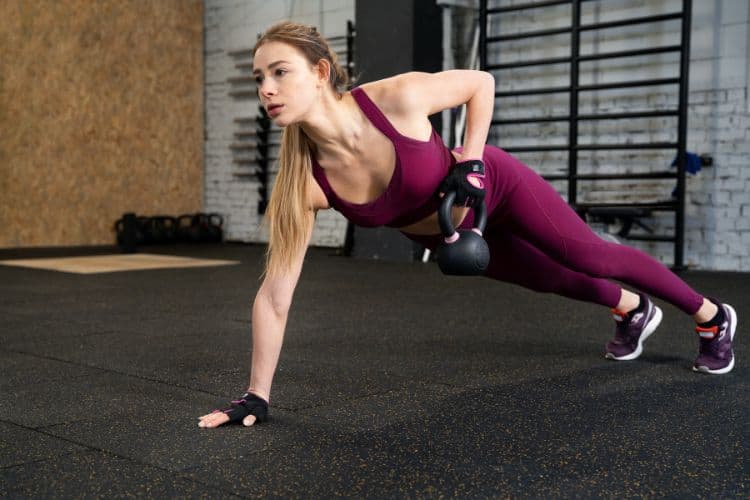
Start in a high plank position with both hands gripping kettlebells. Row one kettlebell while keeping your hips square. Lower slowly before alternating sides.
Avoid twisting your body during the movement.
Sets: 3
Reps: 8–10 each side
Although known primarily as a lower-body exercise, the kettlebell deadlift strengthens the entire posterior chain.
Stand with feet shoulder-width apart and place the kettlebell between your feet. Hinge at the hips while maintaining a neutral spine. Grip the kettlebell firmly and stand tall by driving through your heels.
Focus on squeezing your glutes at the top without leaning backward.
Sets: 4
Reps: 8–12
The gorilla row develops strength, stability, and coordination.
Stand with feet wider than shoulder width while holding two kettlebells between your legs. Hinge at the hips and alternately row one kettlebell while stabilizing your body with the opposite arm.
This movement minimizes momentum while maximizing muscle activation.
Sets: 3
Reps: 10 each side
The high pull develops explosive upper-back power.
Begin with the kettlebell hanging between your legs. Drive your hips forward explosively and pull the kettlebell upward toward chest height using your elbows.
Keep the movement smooth and avoid shrugging excessively.
Sets: 3
Reps: 12–15
Although primarily considered a hip exercise, swings heavily recruit the spinal erectors, traps, lats, and core.
Generate power from your hips rather than lifting with your arms.
Sets: 4
Reps: 20
One of the most underrated back exercises.
Hold one heavy kettlebell beside your body and walk slowly while resisting the urge to lean sideways.
This simple exercise strengthens the core, spinal stabilizers, grip, and upper back simultaneously.
Walk 30–60 seconds per side.
This movement isolates the rear deltoids and upper traps.
Hinge at the hips with light kettlebells. Raise both arms outward until shoulder height before lowering slowly.
Focus on squeezing your shoulder blades throughout each repetition.
Sets: 3
Reps: 12–15
Lie on a bench or the floor while holding one kettlebell above your chest. Slowly lower it behind your head before returning to the starting position.
This movement strengthens the lats while improving shoulder mobility.
Sets: 3
Reps: 12–15
If you’re new to kettlebells, start with this simple routine two or three times per week.
Rest 60–90 seconds between sets and prioritize proper form over heavier weights.
Once you’ve mastered the fundamentals, increasing the intensity of your kettlebell back workouts can help stimulate additional muscle growth, improve endurance, and increase overall strength. Advanced routines typically include heavier kettlebells, higher training volume, supersets, and shorter rest periods to challenge your muscles in new ways.
Complete the following workout one to two times per week while allowing at least 48 hours of recovery before training your back again.
| Exercise | Sets | Reps |
|---|---|---|
| Kettlebell Deadlift | 4 | 8-10 |
| Gorilla Row | 4 | 10 each side |
| Single-Arm Row | 4 | 12 each side |
| Renegade Row | 3 | 10 each side |
| Kettlebell High Pull | 3 | 15 |
| Reverse Fly | 3 | 15 |
| Kettlebell Swing | 4 | 20 |
| Suitcase Carry | 3 | 45-60 seconds each side |
Keep your rest periods between 45 and 75 seconds to maintain workout intensity while allowing enough recovery to perform each exercise with proper form.
Progressive overload is essential for continued improvements in strength and muscle development. If you perform the same exercises with the same weight every week, your progress will eventually plateau.
Here are several effective ways to continue making gains:
The simplest progression method is gradually increasing the kettlebell weight while maintaining excellent technique. Once you can comfortably complete all prescribed repetitions with good form, move up to the next kettlebell size.
Increase each set by one or two repetitions before increasing the weight. This helps improve muscular endurance while preparing your body for heavier loads.
Increasing total training volume is another excellent way to stimulate muscle growth. Add one extra working set to your primary rowing exercises after several weeks of consistent training.
Lower the kettlebell over three to four seconds during each repetition. Slowing the eccentric phase increases time under tension, which can encourage additional muscle growth without changing the weight.
Shortening rest periods improves muscular endurance and increases the cardiovascular challenge of your workout.
Avoiding these common mistakes will improve your results while reducing your risk of injury.
One of the biggest mistakes occurs during deadlifts and bent-over rows. Always maintain a neutral spine by keeping your chest up, shoulders back, and core engaged throughout every repetition.
Swinging the kettlebell excessively during rows shifts the workload away from your back muscles. Control both the lifting and lowering phases to maximize muscle activation.
Many beginners select kettlebells that are too heavy, causing poor technique and unnecessary strain. Start with a manageable weight and prioritize perfect movement patterns before progressing.
Rows should involve more than simply pulling with your arms. Actively retract your shoulder blades at the top of every repetition to fully engage the upper back.
Proper breathing helps stabilize your core and maintain good lifting mechanics. Exhale during the lifting phase and inhale while lowering the kettlebell.
Preparing your muscles before training improves performance and reduces injury risk. Spend five to ten minutes performing dynamic movements such as:
A proper warm-up increases blood flow to your muscles while improving mobility and range of motion.
Cooling down helps gradually lower your heart rate and reduce muscle stiffness after your workout.
Spend five to ten minutes performing gentle stretches, including:
Foam rolling your upper back and lats can also help improve recovery and mobility.
Your workouts are only part of the equation. Proper nutrition provides your muscles with the nutrients they need to recover and grow.
Aim to consume high-quality protein throughout the day from foods such as chicken, turkey, fish, eggs, Greek yogurt, cottage cheese, beans, lentils, tofu, and lean beef. Protein supports muscle repair after intense training sessions.
Whole grains, oats, sweet potatoes, brown rice, quinoa, fruits, and vegetables provide the energy needed for productive workouts while replenishing glycogen stores afterward.
Healthy fats from avocados, nuts, seeds, olive oil, and fatty fish support hormone production and overall health.
Even mild dehydration can negatively affect strength and endurance. Drink water before, during, and after your workouts, especially during high-intensity kettlebell sessions.
Recovery is where muscle growth actually occurs. Give your body time to repair by following these recovery habits:
Yes. Kettlebells can effectively build muscle and strength when you consistently increase resistance, maintain proper technique, and perform compound pulling movements such as rows, deadlifts, swings, and carries.
Most people achieve excellent results by training their back two or three times per week while allowing adequate recovery between sessions.
The ideal starting weight depends on your current fitness level. Beginners often start with lighter kettlebells to master technique before progressing to heavier loads. Choose a weight that allows you to complete every repetition with excellent form.
Absolutely. Strengthening the upper back, lats, rear shoulders, and core helps counteract rounded shoulders caused by prolonged sitting and desk work.
Yes. When performed correctly, kettlebell swings strengthen the posterior chain, including the glutes, hamstrings, spinal erectors, and upper back while improving power and conditioning.
Yes. One of the biggest advantages of kettlebell training is that you only need one or two kettlebells and a small amount of floor space to complete a highly effective back workout at home.
The best kettlebell back workout combines compound movements, controlled technique, and progressive overload to strengthen every major muscle in your posterior chain. Exercises such as kettlebell deadlifts, single-arm rows, gorilla rows, swings, high pulls, and suitcase carries work together to improve posture, build lean muscle, increase grip strength, and enhance athletic performance.
Consistency is the key to long-term success. Focus on mastering proper form before increasing weight, train your back regularly, fuel your body with nutritious foods, and prioritize recovery between workouts. Over time, you’ll notice improved strength, better posture, greater stability, and a stronger, more defined back that supports everything from daily activities to advanced fitness goals.
Whether you’re working out at home or in the gym, kettlebells provide one of the most versatile and effective tools for building a healthier, stronger back. Add these exercises to your weekly routine, stay committed to gradual progression, and you’ll enjoy lasting results in both performance and overall fitness.
Continue building your strength with more expert workout guides on WomensFitClub. If you want a complete full-body routine, check out 30 Minute Full Body Kettlebell Workout Build Strength Burn Fat. Ready for a longer fitness journey? Try the 28 Day Kettlebell Challenge Burn Fat Build Muscle Fast or the 4 Week Kettlebell Workout Challenge Build Strength Burn to progressively improve your strength and endurance. To improve your rowing technique and overall upper-body development, read Best Back Exercises For Women Strength And Posture. You can also complement your kettlebell routine with the 30 Minute Home Strength Workout No Gym No Problem for even more functional strength and muscle-building results.
Stay up to date on the latest women’s health, fitness and lifestyle trends and tips.
