


Sign up for workout ideas, training advice, reviews of the latest gear and more.


When your schedule is packed but you still want an effective strength workout, 10 minute EMOM workouts with dumbbells can deliver a challenging training session without requiring an hour in the gym. EMOM stands for “Every Minute on the Minute,” a workout format that combines resistance training, conditioning, and structured rest into a simple time-based routine. With only a pair of dumbbells and ten minutes, you can train multiple major muscle groups while keeping the workout focused and efficient.
Dumbbell EMOM workouts are especially convenient because they can be performed at home, in a small workout space, or at the gym. Instead of counting long sets and taking loosely timed rest periods, every minute becomes its own training interval. You complete the assigned repetitions at the beginning of the minute and use whatever time remains to recover before the next minute starts.
A well-designed 10 minute dumbbell EMOM workout can include squats, presses, rows, lunges, deadlifts, curls, and other compound movements. The goal isn’t simply to move as quickly as possible. Good EMOM training balances resistance, repetitions, technique, and recovery so you can maintain quality movement throughout all ten minutes.
An EMOM workout divides your training session into one-minute intervals. At the start of each minute, you perform a specific exercise or number of repetitions. Once those repetitions are completed, you rest for the remainder of that minute.
For example, imagine the first minute calls for 10 dumbbell goblet squats. If you complete those squats in 35 seconds, you have approximately 25 seconds to rest. When the next minute begins, you immediately start the next exercise.
A 10 minute workout therefore contains ten one-minute rounds.
The format provides a built-in incentive to work efficiently while still controlling your pace. Finishing your repetitions earlier provides more recovery, but rushing through exercises with poor technique defeats the purpose. Ideally, most working sets should leave enough time to reset your breathing, prepare for the next movement, and maintain consistent form.
Short workouts can still provide meaningful training when the exercises, resistance, and structure are appropriate. A dumbbell EMOM uses limited time efficiently by combining resistance exercises with relatively short recovery periods.
Rather than spending several minutes between sets, you move through a predetermined sequence. Compound exercises can train several muscles simultaneously, allowing a ten-minute session to include significant amounts of total-body work.
Exercises such as dumbbell squats, Romanian deadlifts, rows, lunges, and overhead presses involve multiple muscle groups. This makes them particularly useful when workout time is limited.
A dumbbell squat-to-press, for example, requires the legs, glutes, shoulders, arms, and core to work together. A Romanian deadlift primarily challenges the hamstrings and glutes while also requiring the back and core to maintain a stable position.
Choosing exercises strategically allows you to accomplish considerably more in ten minutes than simply performing isolated movements one at a time.
One advantage of EMOM training is that recovery is automatically incorporated into the workout.
If an exercise takes approximately 30 to 40 seconds, the remaining 20 to 30 seconds becomes your rest period. This can help keep the workout organized without requiring you to separately track every recovery interval.
However, if every round consistently takes 55 to 60 seconds, the workout may be too difficult. Reducing the number of repetitions or using lighter dumbbells can provide enough recovery to maintain better technique.
A 10 minute EMOM dumbbell workout can be adapted for beginners, intermediate exercisers, and experienced lifters.
Beginners can use lighter dumbbells and lower repetitions. Intermediate exercisers can increase the resistance or select more challenging exercises. Advanced lifters can incorporate heavier dumbbells, unilateral exercises, or carefully selected combination movements.
The workout structure stays the same while the difficulty changes according to your fitness level.
Selecting an appropriate dumbbell weight is important because EMOM training provides limited recovery between rounds.
The dumbbells should feel challenging without forcing your technique to deteriorate. Ideally, you should finish the assigned repetitions with control and still have enough time to prepare for the next minute.
For a full-body EMOM, you may discover that different exercises require different weights. Your legs may comfortably handle heavier dumbbells for deadlifts than your shoulders can handle for overhead presses.
If you have several pairs available, place them nearby before starting. You might use heavier dumbbells for lower-body exercises and lighter dumbbells for upper-body movements.
If you only own one pair, choose exercises and repetition ranges that work reasonably well with that weight.
This full-body routine uses five exercises repeated twice for a total of ten minutes. Set a timer for ten one-minute intervals.
At the beginning of each minute, perform the assigned repetitions. Rest during the remaining time.
Perform 10 to 12 repetitions.
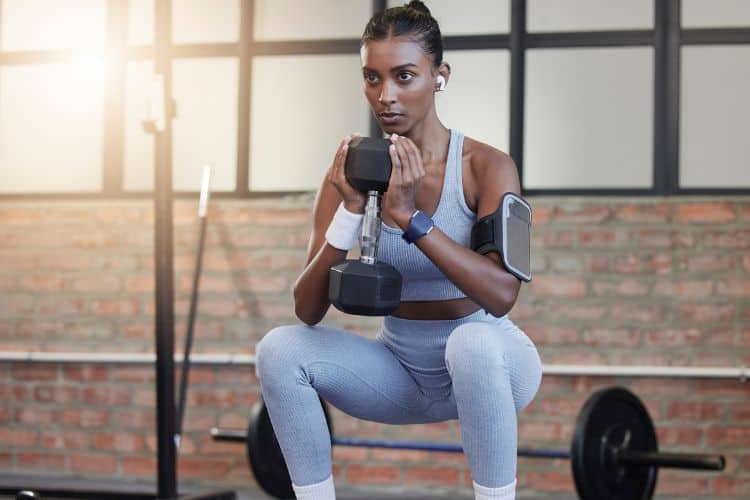
Hold one dumbbell vertically against your chest with both hands. Position your feet approximately shoulder-width apart and keep your chest lifted. Push your hips slightly backward and bend your knees as you lower into the squat.
Descend only as far as you can comfortably maintain good positioning. Drive through your feet to return to standing while contracting your glutes.
Goblet squats primarily train the quadriceps and glutes while requiring the core to stabilize the torso.
Perform 10 to 12 repetitions.
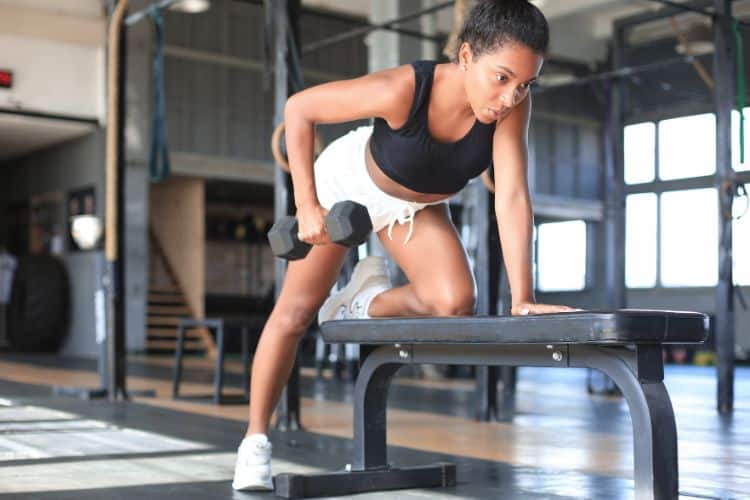
Hold a dumbbell in each hand and hinge forward from your hips. Maintain a neutral spine and keep your abdominal muscles engaged.
Pull the dumbbells toward the sides of your torso while drawing your shoulder blades back. Lower the weights under control rather than allowing them to drop quickly.
Bent-over rows target the upper and middle back while also involving the biceps and posterior shoulders.
Perform 8 to 10 repetitions per side, alternating legs.
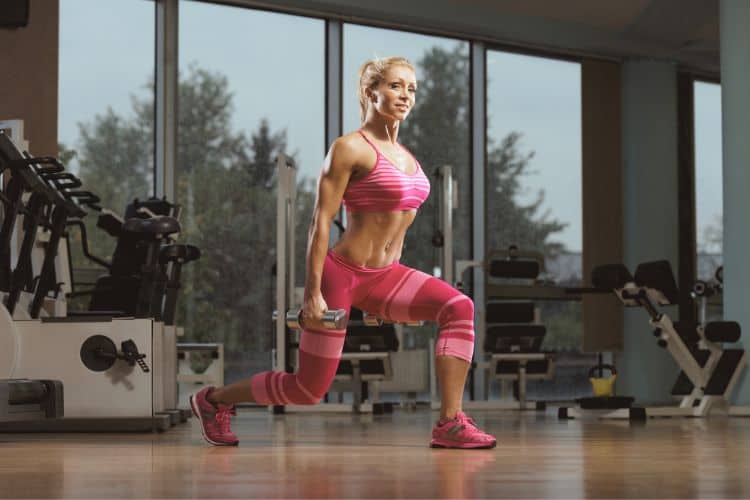
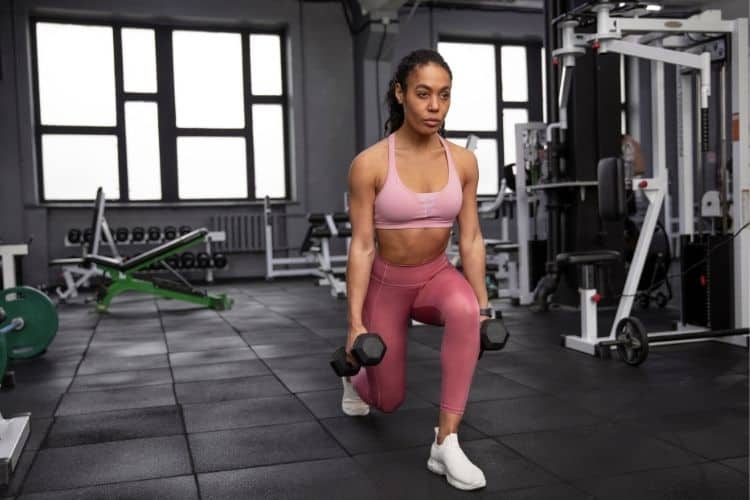
Stand upright while holding the dumbbells at your sides. Step one foot backward and lower your body into a lunge. Push through the front foot to return to standing before switching sides.
Keep your torso controlled and avoid rushing between repetitions.
Reverse lunges train the quadriceps, hamstrings, glutes, and stabilizing muscles around the hips.
Perform 10 to 12 repetitions.
Lie on your back with your knees bent and feet planted on the floor. Hold a dumbbell in each hand with your upper arms resting lightly against the floor.
Press the dumbbells upward until your arms are extended without aggressively locking the elbows. Lower them slowly until your upper arms return to the floor.
The dumbbell floor press primarily targets the chest and triceps while also involving the shoulders.
Perform 10 to 12 repetitions.
Stand with your feet approximately hip-width apart while holding the dumbbells in front of your thighs. Keep a slight bend in your knees and push your hips backward.
Lower the dumbbells along your legs while maintaining a neutral spine. When you feel tension through the hamstrings, drive your hips forward and return to standing.
Avoid turning the exercise into a squat. The movement should primarily come from the hips.
Repeat these five exercises during minutes six through ten to complete the workout.
Beginners can benefit from EMOM training, but the emphasis should be on controlled repetitions rather than maximizing speed.
A beginner routine could use the following sequence for two rounds: 8 goblet squats, 8 dumbbell rows, 6 reverse lunges per side, 8 floor presses, and 8 Romanian deadlifts.
Try to complete each set within approximately 30 to 40 seconds. The remaining portion of the minute provides valuable recovery.
If you’re unable to finish the repetitions while maintaining good technique, reduce the repetitions or choose lighter dumbbells.
The objective is consistency across the entire ten minutes rather than exhausting yourself during the opening rounds.
EMOM workouts can also focus on specific muscle groups. An upper-body dumbbell EMOM can target the chest, back, shoulders, biceps, and triceps in a compact session.
Perform 10 to 12 controlled repetitions. Keep your wrists positioned over your elbows and lower the weights slowly.
Perform 10 to 12 repetitions while maintaining a strong hip hinge and stable torso.
Perform 8 to 10 repetitions. Begin with the dumbbells near shoulder height and press them overhead without excessively arching your lower back.
Perform 10 to 12 repetitions. Keep your elbows close to your body and avoid swinging the weights.
Perform 8 to 12 repetitions using controlled movement. Keep the elbows relatively stable while extending the arms.
This structure provides a simple 10 minute upper body dumbbell workout when you want focused strength training without a lengthy gym session.
A lower-body EMOM can create a challenging leg workout using only dumbbells.
Use goblet squats during minutes one and six, Romanian deadlifts during minutes two and seven, reverse lunges during minutes three and eight, sumo squats during minutes four and nine, and alternating lateral lunges during minutes five and ten.
Aim for approximately 8 to 12 repetitions depending on the exercise and dumbbell weight.
The combination of squatting, hinging, and lunging movements provides balanced training for the quadriceps, hamstrings, glutes, inner thighs, and supporting muscles.
Once the workout becomes comfortable, you need some form of progression if you want to continue challenging your body.
One of the simplest methods is increasing resistance. Moving from lighter dumbbells to a moderately heavier pair increases the muscular challenge without changing the workout duration.
Don’t increase weight so dramatically that you lose control or can no longer complete the prescribed repetitions.
Another option is adding one or two repetitions to selected exercises.
If you’re consistently finishing 10 goblet squats with plenty of time remaining, try performing 11 or 12.
Small increases can significantly change the difficulty over multiple rounds.
You don’t always need heavier weights.
Lowering the dumbbells more slowly increases the amount of time your muscles spend under tension. For example, take approximately three seconds to lower into a squat before standing normally.
This technique can make relatively light dumbbells feel considerably more demanding.
Single-arm and single-leg exercises can increase the stability and coordination requirements of your workout.
Examples include single-arm rows, single-arm presses, split squats, staggered-stance Romanian deadlifts, and alternating lunges.
Unilateral training can also help you identify differences in strength or control between sides.
One common mistake is selecting too many repetitions. If each round requires almost the entire minute, there is little opportunity to recover. Fatigue quickly accumulates, making it increasingly difficult to maintain proper technique.
Another mistake is choosing dumbbells that are too heavy. EMOM training is not usually the ideal setting for repeated near-maximal lifting because the short recovery periods can cause technique to break down.
Rushing is another issue. The purpose of finishing before the minute ends is not to perform repetitions as quickly as physically possible. Smooth, controlled movement should remain the priority.
Finally, avoid creating an EMOM with several consecutive exercises that heavily fatigue the same muscles unless that is specifically your training goal. Alternating lower-body pushing, upper-body pulling, lower-body hinging, and upper-body pushing exercises can help distribute fatigue more effectively.
How frequently you perform EMOM workouts depends on their intensity, your overall training program, and your recovery.
A short dumbbell EMOM can be used as a standalone workout on busy days or incorporated into a longer strength session. Some people may perform short EMOM workouts several times per week, while others may use them occasionally as conditioning finishers.
If your EMOM includes challenging full-body resistance exercises, allow adequate recovery before intensely training the same muscle groups again.
Remember that ten minutes can still create significant muscular fatigue when the resistance and training density are high.
Although the workout itself lasts only ten minutes, jumping directly into demanding exercises without preparation isn’t ideal.
Spend a few minutes performing movements such as bodyweight squats, arm circles, hip hinges, alternating lunges, shoulder movements, and light repetitions of the exercises included in your EMOM.
The warm-up doesn’t need to be long. Its purpose is to increase your readiness for the movements you’re about to perform.
If you’re using heavier dumbbells, perform one lighter practice set before beginning the timer.
Muscle growth depends on multiple factors, including resistance, training volume, effort, nutrition, recovery, and progression over time.
A ten-minute workout isn’t automatically ineffective because it is short. If the exercises provide sufficient muscular challenge and are part of a consistent progressive training program, short sessions can contribute useful training volume.
However, ten minutes may not provide enough weekly volume by itself for every muscle group, particularly for experienced lifters pursuing significant muscle growth.
You can solve this by performing different short workouts throughout the week or gradually progressing to longer sessions.
For example, you could perform a lower-body EMOM one day, upper-body training another day, and a full-body workout later in the week.
Progressive overload means gradually increasing the demands placed on your muscles.
EMOM workouts make progress relatively easy to measure because the workout structure remains consistent.
Suppose you initially perform 10 goblet squats with a 20-pound dumbbell and finish each round in approximately 35 seconds. After several weeks, those same sets may feel much easier.
You could progress by using a heavier dumbbell, adding repetitions, slowing the eccentric portion of each repetition, improving your range of motion, or selecting a more challenging exercise variation.
Change one variable at a time whenever possible. This makes it easier to determine whether you’re actually improving.
One of the biggest advantages of dumbbell EMOM training is convenience.
You don’t need machines, a squat rack, or a large workout area. A small open space, a pair of dumbbells, and a timer can be enough for an effective training session.
Prepare your workout before starting so you aren’t deciding which exercise to perform while the clock is running. Place your dumbbells within easy reach, keep water nearby, and make sure your workout area is clear.
Set your timer for ten one-minute intervals and begin.
The simplicity of this approach removes many common barriers to exercise. Instead of waiting until you have enough time for a long training session, you can use a short window in your day for focused movement.
10 minute EMOM workouts with dumbbells provide a practical way to combine strength training and conditioning in a short, structured session. By performing a predetermined number of repetitions at the beginning of every minute and resting for the remaining time, you can create an efficient workout that is easy to follow and simple to modify.
A balanced dumbbell EMOM can include squats, Romanian deadlifts, rows, presses, and lunges to train the major muscle groups. Beginners can start with lighter dumbbells and fewer repetitions, while more experienced exercisers can increase resistance, repetitions, range of motion, or exercise complexity.
The key is to avoid treating EMOM training as a race. Choose a workload that gives you enough time to perform controlled repetitions while preserving a short recovery period before the next minute begins.
Whether you need a 10 minute full body dumbbell workout at home, a quick strength session on a busy day, or a compact addition to your regular fitness program, the EMOM format offers a straightforward solution. Consistency and gradual progression can turn those ten-minute workouts into a valuable part of a sustainable strength-training routine.
For more dumbbell training ideas to complement this 10-minute EMOM workout, explore the 30-Minute Full Body EMOM Workout for a longer strength-and-conditioning session, or try the 15-Minute Full Body Dumbbell Workout when you have a few extra minutes. You can also increase training volume with this 30-Minute Full Body Dumbbell Workout, add variety with a Full-Body Dumbbell Superset Workout, and learn how to keep getting stronger with the Progressive Overload Dumbbell Workout Plan. These workouts give you several ways to progress from quick EMOM sessions to longer strength routines while continuing to challenge your entire body.
Stay up to date on the latest women’s health, fitness and lifestyle trends and tips.
