


Sign up for workout ideas, training advice, reviews of the latest gear and more.

A good strength workout should make life outside the workout feel easier. Carrying groceries, rising from a low chair, climbing stairs, reaching a shelf, and moving confidently across uneven ground all require strength working together with coordination and balance. This 30-minute functional strength workout for women over 50 trains those familiar movements in a practical full-body session you can do at home or in a gym.
You need a sturdy chair or bench, a pair of dumbbells, and a little open floor space. A countertop or stable rail can provide balance support. If you are new to resistance training, you can begin with bodyweight and add weights as the movements become comfortable. The goal is controlled effort and repeatable technique, not racing a clock or lifting the heaviest weight in the room.
The workout includes a five-minute warm-up, two ten-minute strength circuits, and a five-minute cool-down. Each circuit blends lower-body work with pulling, pressing, and core stability. You can repeat it twice a week on nonconsecutive days, with walking or other activity on additional days. That makes it easier to build a routine you can maintain after the first session.
Functional training is a way to organize exercise around movement patterns you actually use. A chair squat resembles sitting down and standing up. A hip hinge teaches you to bend at the hips when lifting something from a lower surface. A loaded carry asks your trunk and grip to steady a weight while you walk. None of these movements has to copy a chore perfectly to be useful. They simply build capacity in patterns that show up often.
Strength work also gives you a way to keep challenging your muscles as you age. The National Institute on Aging describes resistance training as a tool for improving strength and maintaining mobility. Balance deserves attention alongside it: a strong leg helps with a step, but the ability to control your weight over that leg matters too. For adults 65 and older, the CDC recommends a weekly mix of aerobic activity, muscle-strengthening work, and balance activity. Women in their 50s can use the same broad mix as a useful planning framework, while adjusting it to their health and training history.
This workout does not require jumping, sprinting, or getting down on the floor. You can make it challenging with careful weight selection, a full comfortable range of motion, and consistent practice. If a movement causes sharp pain, dizziness, or an unusual symptom, stop and seek appropriate medical guidance. If you have a recent injury, significant balance difficulty, or a condition that changes how you exercise, ask your clinician or physical therapist how to adapt the plan.
Choose dumbbells you can control for about eight to twelve deliberate repetitions. The final few reps should feel like work, but you should still be able to keep your posture and breathing steady. You may need a heavier pair for squats and carries and a lighter pair for overhead pressing. One pair is enough to begin; bodyweight works for the lower-body moves if that is your current level.
Minutes 0–5: Gradual warm-up.
Minutes 5–15: Circuit A, two rounds. Perform three exercises for 40 seconds each, allowing 20 seconds to transition. After the third exercise, rest for two minutes before repeating the round. Each round therefore takes five minutes.
Minutes 15–25: Circuit B, two rounds with the same 40-second work, 20-second transition, and two-minute rest structure. Alternate sides halfway through a timed single-leg exercise, or complete roughly equal repetitions on each side.
Minutes 25–30: Gentle cool-down and breathing.
Start with one minute of easy marching or walking, followed by one minute of gentle shoulder rolls and arm reaches within a comfortable range. During the second minute, practice shoulder rolls and gentle arm reaches, moving only within a comfortable range. If overhead movement feels restricted, reach forward or diagonally instead.
Spend the third minute on supported hip hinges. Place your fingertips on your hips, soften the knees, and move your hips backward as your chest tips forward. Stand tall by pressing the floor away. During the fourth minute, do slow chair sit-to-stands or partial squats, using the chair arms or countertop if needed. Finish with a minute of alternating backward toe taps beside a support. Keep the steps small and steady. By the end of five minutes, you should feel ready to move, not tired.
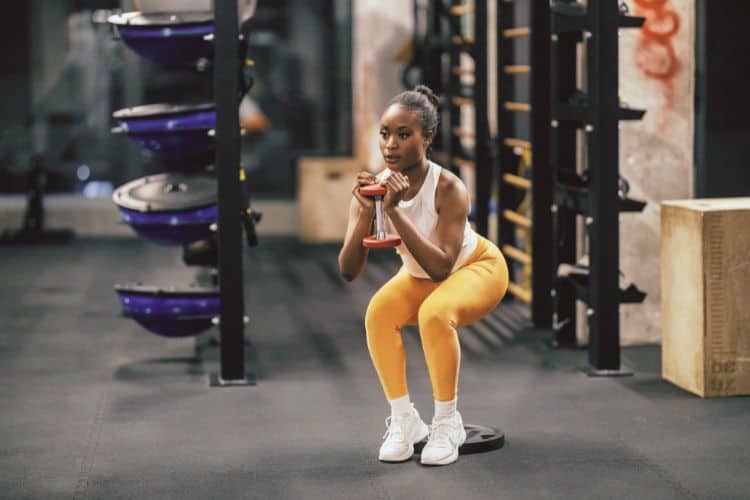
Stand in front of a sturdy chair with feet around hip to shoulder width apart. Hold a dumbbell vertically at your chest, hold one weight in each hand at your sides, or begin without weight. Reach your hips back and bend your knees to lower toward the chair. Touch it lightly, then press through your whole feet to stand. You may sit fully and stand again if that lets you move with more control.
Aim for about eight to twelve repetitions in the interval. Keep your knees moving generally in the same direction as your toes and let your torso lean forward naturally without rounding sharply. Exhale as you stand. If the chair is too low, place a firm cushion on it or use a higher bench. If standing without using your hands is difficult, push lightly from the chair arms and gradually reduce that help. If the move feels easy, increase the dumbbell weight before trying to move faster.
Place one hand on a stable bench or countertop and step the opposite foot back slightly. Hold a dumbbell in your free hand with the arm hanging below the shoulder. Bend at the hips until your torso is angled forward, keeping your back long. Draw the elbow toward your back pocket, pause briefly, and lower the weight slowly. Switch arms at the 20-second mark, allowing about 20 seconds per side.
Think about moving your elbow rather than shrugging your shoulder. Keep the trunk quiet as the weight rises. If leaning forward bothers your back, stand more upright and brace the free hand higher on a countertop. You can also perform a standing resistance-band row if available. Choose a load that lets both sides move through a similar comfortable range; it is fine to give your less coordinated side the first turn.
Hold one dumbbell at your side like a suitcase, with your shoulders level and your free arm relaxed. Walk at a normal, controlled pace for 20 seconds, then switch hands for the remaining 20 seconds. Keep your ribs over your hips and avoid leaning away from the weight. A modest load held well is more useful than a heavy load that pulls you off balance.
Choose a low, stable step that allows you to step up without having to push off hard from the trailing foot. Stand near a rail or countertop. Place one foot fully on the step, press through it to rise, then lower slowly. Alternate legs as your balance allows. A lower step and smooth descent are better starting points than a high step performed with momentum.
For a floor-based version, stand tall beside a support and tap one foot backward while the front knee bends slightly, then return to standing. Alternate sides. This resembles the first part of a reverse lunge without requiring a deep bend or precarious balance. Aim for controlled, even work on each side during the 40 seconds. Keep your gaze forward and stop the set if fatigue makes your foot placement unreliable.
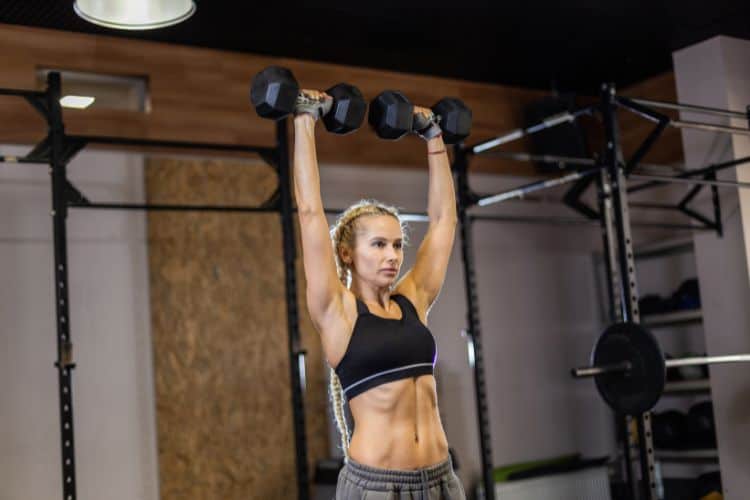
For the standing press, hold light dumbbells near shoulder height with palms facing each other. Stand with feet comfortably apart, gently brace your midsection, and press the weights upward through a pain-free range. Lower them with control. Avoid leaning far backward to get the weights overhead. If overhead pressing does not feel comfortable, perform an incline push-up against a wall or sturdy countertop instead.
Stand with a dumbbell in each hand at the front of your thighs, or hold one dumbbell with both hands. Soften your knees, then send your hips backward as the weights travel close to your legs. Stop when you feel a comfortable stretch in the back of your thighs or when you can no longer keep your back position steady. Drive through your feet and bring your hips forward to stand tall.
The weights do not need to reach the floor. Picture closing a car door with your hips while your hands are full. Keep your neck in line with your torso rather than craning to look in a mirror. Exhale as you rise. If the hinge feels unfamiliar, put the weights down and practice touching a wall behind you with your hips. When you can repeat the movement without rounding or squatting excessively, add a light load for eight to twelve repetitions.
Walk slowly for one minute so your breathing settles. Then spend about a minute gently stretching each calf by placing one foot back with the heel down. Use a countertop for support and avoid forcing the stretch. For the next minute, stand tall and bring one arm across your chest at a time, keeping the shoulder relaxed. Follow with a minute of comfortable hip flexor stretching: take a small staggered stance, gently tuck the pelvis, and shift forward slightly without arching the low back.
Use the last minute for slow breathing while standing or sitting. Inhale naturally through the nose if comfortable and allow a longer, easy exhale. Notice whether one exercise felt less steady than the others. That observation can help you choose a lighter weight, different support, or slightly slower pace next time. The cool-down is also a chance to finish the session without abruptly stopping after a demanding set.
If you are returning to exercise after a long break, complete one round of each circuit and use the remaining time for easy walking and mobility. Another option is to retain two rounds but make each work interval 30 seconds. Both approaches let you practice the movement patterns while limiting fatigue. You can build toward the full format over several sessions rather than expecting the first workout to be your hardest.
For balance concerns, keep a support within reach during step-ups and carries. Replace the step-up with a supported backward toe tap, and replace the walking carry with a stationary suitcase hold. A chair sit-to-stand can begin with hands on the armrests. Your setup should make it possible to concentrate on deliberate movement instead of worrying about falling. If balance problems are persistent or new, seek individualized assessment before adding a demanding stepping exercise.
For sensitive knees, adjust the depth of the chair squat and use a higher seat. Try the toe-tap variation rather than stepping onto a platform. For a sensitive lower back, practice the hip hinge without a load and use a countertop-supported row. These are options for comfort and control, not diagnoses or treatment. Pain that worsens during exercise is a reason to stop the movement and get specific guidance.
In week one, learn the order and choose manageable weights. Record your repetitions, loads, and balance support. In week two, aim for smoother movement or one or two more controlled repetitions within the same interval. A steadier descent or less reliance on the chair arms counts as progress.
In week three, add a small amount of weight to an exercise that has become easy, or make one variation more challenging, such as moving from a stationary suitcase hold to a short carry. Change one variable at a time. In week four, repeat the workout and compare it with your first session. Look for improved control, more comfortable repetitions, or less need for support. If you feel run down, keep the load easy and prioritize clean movement.
Two or three full-body strength sessions each week can be a practical schedule, with recovery time between sessions that challenge the same muscles. This particular workout fits well twice weekly, such as Monday and Thursday. On other days, walking, cycling, swimming, or another enjoyable aerobic activity can round out your routine. Short balance practice beside a stable support can also fit into the week.
For context, current U.S. guidance recommends muscle-strengthening activity at least two days weekly for adults, with aerobic activity spread through the week. Adults 65 and older are additionally advised to include balance work. A single 30-minute strength session is a useful piece of the week, but it is not the entire activity plan. Start from what you can do now and build gradually.
Yes, provided you choose the supported options and an effort level suited to your current ability. Start with bodyweight chair sit-to-stands, a light row, a stationary carry hold, backward toe taps, wall push-ups, and an unloaded hip hinge. One round of each circuit may be plenty at first. If you have an injury, recurrent falls, or a medical condition that affects exercise, get individual guidance for the movements you need to change.
You can perform the squat, step or toe tap, wall push-up, and hip hinge without weights. For pulling, a resistance band anchored securely at chest height can replace the row. For a carry, use a light household item that you can grip safely, or practice walking tall without a load until you have appropriate equipment. Dumbbells make progression easier to measure, but learning the patterns is a worthwhile first step.
First make the current version feel consistent. If you can complete the upper end of the suggested repetition range with steady form and still feel you could do several more, a small weight increase may be appropriate. If the movement remains challenging, add a controlled repetition or improve your range before adding load. Track one or two simple measures so progress is visible without turning the session into a test every time.
A 30-minute functional strength workout for women over 50 can be straightforward: warm up, practice the big movement patterns, rest enough to perform them well, and repeat consistently. Chair squats, rows, carries, supported steps, presses, and hip hinges cover a useful range of everyday demands without complicated equipment or high-impact exercise.
Begin with a version that feels stable and repeatable. Write down your weights and any modifications, then look for small improvements over the next month. The reward is not a perfect score on the timer. It is a growing ability to move with strength and confidence in the activities that fill your day.
For another session built around practical movement, try the 20-Minute Full Body Functional Strength Workout. If you want more at-home dumbbell options for this age group, explore the Full Body Dumbbell Workout for Women Over 50 at Home and the Best Dumbbell Workout for Women Over 50 to Build Strength. New to weights? The Beginner Dumbbell Workout Plan for Women offers a starting framework, while the Best Strength Training Plan for Women Over 50 shows how to organize full-body, upper-body, and balance work across the week.
Stay up to date on the latest women’s health, fitness and lifestyle trends and tips.
