


Sign up for workout ideas, training advice, reviews of the latest gear and more.

Finding time to exercise can feel harder than the workout itself. Between work, family responsibilities, appointments, and everyday demands, a complicated training schedule often becomes another unfinished task. A 2-day minimum dose strength workout plan gives you a manageable starting point: two purposeful sessions that train your whole body without requiring daily gym visits.
The goal is to make a small, repeatable commitment productive. You will practice fundamental movements, choose resistance that challenges you, and gradually improve your performance. Each workout includes exercises for your legs, hips, chest, back, shoulders, and core. With a pair of dumbbells and a stable exercise space, you can complete the program at home.
This plan is especially useful for women beginning strength training, returning after a break, or simplifying an overcrowded routine. It also offers a framework for maintaining consistency during demanding seasons. Your results will depend on your starting fitness, effort, recovery, and ability to progress, but two well-planned sessions provide something valuable: a realistic routine you can keep doing.
Minimum dose strength training means using a relatively small amount of resistance exercise to produce a useful training response. The dose includes how often you train, how many challenging sets you complete, the resistance you use, and how close each set comes to your current limit.
There is no single minimum that works equally well for everyone. A beginner may improve with less training than someone who has lifted consistently for years. Maintaining an existing level of strength may also require a different approach from building new muscle or preparing for a heavy lifting competition.
For this article, “minimum dose” describes a practical, low-volume starting plan. The standard version uses two working sets per exercise, twice weekly. A shorter fallback uses one working set per exercise. Neither version is presented as the scientifically established minimum for every person.
Twice-weekly training can support strength improvements when the exercises, effort, and progression match the person. Frequency alone does not determine effectiveness. Two sessions of consistently challenging work can be more useful than a more ambitious schedule you rarely complete.
The CDC recommends muscle-strengthening activity on at least two days each week, alongside aerobic activity. This plan addresses the strength portion of a weekly routine; it does not replace aerobic exercise. Walking, cycling, swimming, or another suitable activity can complement your lifting days.
It is also important to separate sufficient training from optimal training. In a small trial involving women with basic lifting experience, three-set training produced better strength outcomes than single-set training. That finding supports a realistic expectation: a modest dose may be useful, while additional recoverable work can sometimes produce greater progress.
Complete Workout A and Workout B on nonconsecutive days. Monday and Thursday, Tuesday and Friday, or Wednesday and Saturday are practical options. Choose days you can protect most weeks, leaving at least one day without strength training between sessions.
Both workouts train the full body. This gives your major muscle groups two weekly exposures and avoids making one missed session equivalent to skipping an entire body region. The exercises remain similar enough to practice useful skills, with a few variations to keep the program balanced.
Allow approximately 30–40 minutes for each standard session, including preparation and transitions. You may need longer while learning the movements. The fallback version can take around 20–25 minutes, depending on rest needs and equipment setup. Treat these as estimates rather than deadlines.
Use dumbbells that allow you to adjust the challenge between exercises. Your legs and hips may need heavier weights than your shoulders. Adjustable dumbbells are convenient, but separate light and heavier pairs also work.
You will also need a mat and a stable support for rows, incline push-ups, or supported split squats. Avoid furniture that rolls, folds unexpectedly, or slides. Before starting, clear enough floor space to lower and pick up your weights safely.
For the standard plan, perform two working sets of each exercise. A working set is a deliberately challenging set completed after any easier practice repetitions. Most exercises use 8–12 repetitions; smaller movements and bodyweight variations may use 10–15.
Rest approximately 90–120 seconds between demanding sets, extending that interval when you still feel breathless or unsteady. For core exercises, 45–75 seconds may be enough. The purpose of resting is to make the next set productive.
Finish most sets feeling you could perform about two more controlled repetitions. This is called two repetitions in reserve. During your first week, leaving three or four repetitions available is reasonable while you learn technique.
The final repetitions should require concentration without changing the movement. If you could easily complete another eight repetitions, the set is probably too light for the intended effort. If your technique changes before reaching the bottom of the range, reduce the resistance or choose an easier variation.
Spend about five minutes preparing to move. Begin with easy marching or walking, then practice a few bodyweight squats, gentle hip hinges, comfortable arm movements, and wall push-ups. Keep the movements smooth and within a comfortable range.
Before your first loaded squat or hinge, complete a light practice set. Do the same before your first pressing exercise if needed. Warm-up sets prepare you for the working sets and do not count toward the prescribed two sets.
You should finish the warm-up feeling more coordinated and ready to lift. Avoid turning it into a tiring circuit. If an exercise causes sharp pain, adjust or stop it rather than trying to warm your way through the problem.
Workout A combines a squat, hinge, press, row, shoulder exercise, and core movement. Complete the exercises in the order below, finishing both sets of one exercise before moving on.
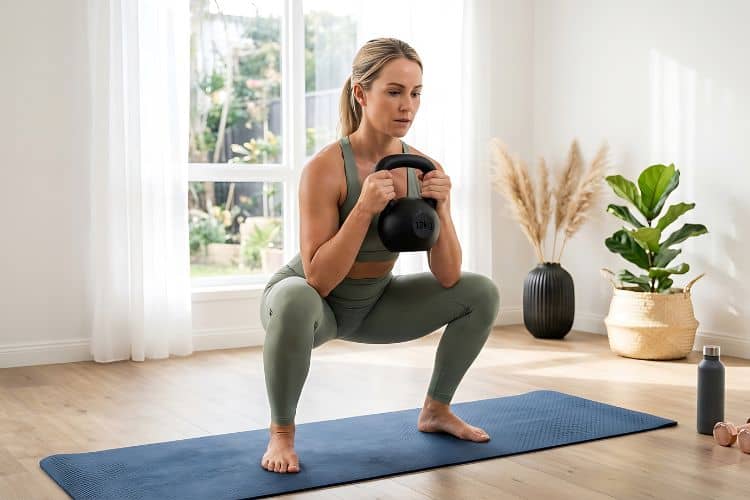
Hold one dumbbell close to your chest, with your feet in a comfortable stance. Bend your knees and hips together, lowering between your legs as far as you can control without discomfort. Stand by pushing through your whole foot.
Keep the weight close and let your knees follow the direction of your toes. You do not need to force a particular depth. If balance or confidence is limiting, squat toward a stable chair and stand again without dropping onto the seat.
Choose a load that makes the final repetitions challenging while your torso remains controlled. Record the dumbbell weight and completed repetitions after each set.
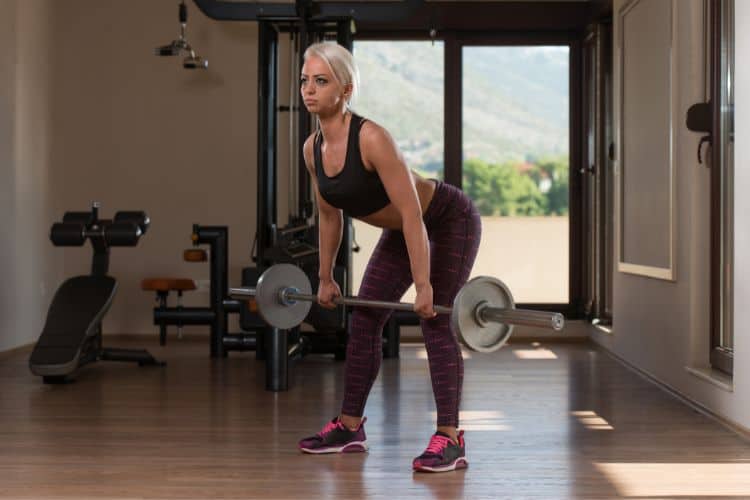
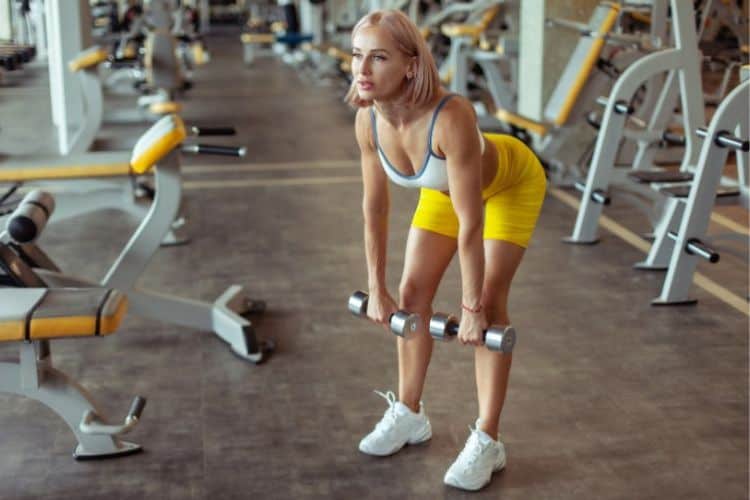
Stand with dumbbells beside the front of your thighs and your knees slightly bent. Move your hips backward while keeping the weights close to your legs. Lower only as far as you can maintain a steady trunk and feel tension through the backs of your thighs.
Push through your feet and bring your hips forward to stand tall. Finish upright without leaning backward. The movement should come mainly from your hips rather than repeated bending through your lower back.
If the pattern feels unfamiliar, practice reaching your hips toward a wall behind you without weights. Add resistance once the movement feels repeatable.
Lie on your back with your knees bent and feet planted. Hold the dumbbells above your chest with palms facing forward or slightly inward. Lower your upper arms gently toward the floor, then press the weights upward.
Keep your wrists aligned over your forearms. Avoid bouncing your arms against the floor or forcing your elbows wide. Use a comfortable arm angle and a controlled lowering phase.
If getting onto the floor is difficult, perform incline push-ups against a secure counter instead. Choose a height that allows a challenging set without losing body alignment.
Place one hand on a sturdy support and step your feet into a stable position. Hold a dumbbell in the opposite hand and hinge forward comfortably. Pull your elbow toward your hip, then lower the weight under control.
Keep your torso mostly still rather than twisting to lift the dumbbell. Allow a natural reach at the bottom without collapsing through the supporting shoulder.
Complete both sides for each set, beginning with the side that feels less capable. Use the same weight and match its repetitions on the stronger side.
Sit on a sturdy seat with your feet supported. Begin with light dumbbells near shoulder height and press upward through a comfortable range. Lower slowly, keeping your ribs and pelvis reasonably aligned.
Avoid leaning backward to finish a repetition. If overhead pressing feels uncomfortable, replace it with another comfortable pressing variation, such as a light incline push-up. Do not force a movement simply because it appears in the program.
Lie on your back with your arms reaching upward and your hips and knees bent. Gently brace your abdomen, then slowly extend one arm and the opposite leg. Return to the starting position and alternate sides.
Move only as far as you can without your lower back arching noticeably. Shorter reaches are appropriate. Breathe throughout each repetition and avoid rushing to accumulate more repetitions.
Workout B keeps the hinge and upper-body push-pull patterns while introducing supported single-leg work and a carrying exercise. Continue using the same effort target and rest guidelines as Workout A.
Stand in a staggered stance beside a stable support. Keep your feet separated sideways enough to balance comfortably. Bend both knees and lower straight down through a manageable range, then press through your front foot to rise.
Use the support as much as necessary to stay steady. Begin with bodyweight, adding a dumbbell in your free hand only when you can control the movement. Complete both legs before resting for the next set.
If split squats are uncomfortable or too demanding, repeat the chair squat from Workout A. A suitable substitution helps you train consistently.
Repeat the same hinge used in Workout A. Keeping this exercise in both sessions gives you more practice and makes progress easier to measure. You can use the same load or adjust it according to how you feel that day.
Focus on a controlled lowering phase and a smooth return to standing. Stop the set when you can no longer maintain the movement, even if you have not reached the target repetitions.
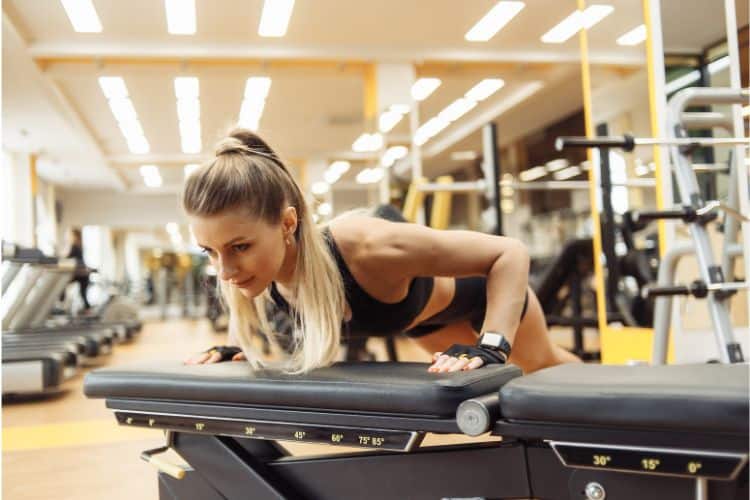
Place your hands on a secure counter or another stable elevated surface. Walk your feet back until your body forms a comfortable straight line. Bend your elbows, bring your chest toward the support, and press away.
Choose a height that allows the intended repetitions with control. A wall is a suitable starting point. A lower support increases the challenge, so progress gradually rather than moving straight to the floor.
Keep your head aligned with your torso and avoid letting your hips sag as fatigue develops.
Repeat the supported row from Workout A. Familiar exercises are useful in a minimalist program because you spend less time learning new movements and more time practicing productive sets.
Check that the weight remains challenging without encouraging torso rotation. When both sets reach the top of the range with the intended effort, use the progression method below.
Stand or sit tall with light dumbbells beside your body. With a small bend in your elbows, raise your arms outward and slightly forward to a comfortable height, no higher than necessary. Lower slowly.
Use lighter weights than you use for rows. Keep the movement smooth without swinging your torso or shrugging forcefully. If the exercise irritates your shoulders, omit it temporarily and seek an appropriate alternative if discomfort persists.
Hold one dumbbell beside your body while standing tall. Keep your shoulders reasonably level and avoid leaning toward or away from the weight. Maintain normal breathing.
If you have a clear, safe path, walk slowly while holding the dumbbell. Otherwise, stay in place for a suitcase hold. Complete both sides for each set, stopping before your grip or posture breaks down.
The exercises stay consistent, but your performance should gradually develop. Progress may mean more controlled repetitions, a slightly heavier dumbbell, better stability, or a more challenging exercise variation.
Use the first two weeks to find suitable loads and practice the exercises. Begin with one working set per movement if you are new or returning after a long break. Move toward the standard two sets as your recovery allows.
Write down what you actually complete. A useful log includes the exercise, load, repetitions, and estimated repetitions in reserve. For unilateral exercises, record repetitions per side.
Keep the same weights and work toward the upper end of each repetition range. If your goblet squat sets were eight and eight, aim for nine and eight or nine and nine at a later session.
Progress does not need to happen every workout. Maintain technique, and avoid turning an extra repetition into a shortened or rushed movement. Repeat a previous performance when that is the appropriate challenge.
When both sets reach the top of the range with about two repetitions still available, try the smallest practical weight increase. Expect repetitions to drop toward the lower end of the range.
For example, after completing two controlled sets of 12 goblet squats, increase the dumbbell slightly and return to approximately eight repetitions. Build upward again. If the new load prevents clean repetitions at the bottom of the range, the increase is too large.
For incline push-ups, lower the support slightly. For carries, build to 30 seconds with control before increasing weight and returning to 20 seconds.
Compare your current training log with your starting point. Look for stronger lifts, improved control, and a routine that fits your schedule. If you are progressing, continue rather than adding work automatically.
If performance has stalled across several sessions, check effort, attendance, rest intervals, and recovery. You may need a smaller weight increment or an additional set for a priority exercise. Increase one variable at a time so you can judge its effect.
When time is especially limited, complete one working set of each exercise after warming up. Keep the same repetition ranges and effort target. This reduces volume while preserving the main movements and your twice-weekly habit.
Do not make up for fewer sets by using unfamiliar heavy weights or forcing every set to failure. The fallback is a shorter version of familiar training. It is not a reason to sacrifice control.
If you miss one session, complete the next available workout and resume your schedule. Avoid cramming both workouts into one exhausting session. If only one day is available in an unusual week, one full-body session still keeps you engaged with the routine.
Recovery supports your ability to repeat productive training. Keep a reasonably consistent sleep schedule, eat enough to support your activity, and include protein-containing foods across your meals. You do not need a complicated supplement routine to begin.
On nonlifting days, choose activity you enjoy and can recover from. Walking is a convenient option. Avoid filling every free day with intense exercise if the purpose of this plan is to reduce your training burden.
Mild muscle soreness may occur when exercises are new. Soreness is not a score for workout quality, and you do not need to chase it. Persistent pain, worsening symptoms, or unusual exhaustion call for adjustment. People managing an injury or chronic condition should get individualized guidance on suitable exercises and effort.
Light resistance can be appropriate while learning, but continuing indefinitely with effortless sets may limit progress. Reassess your weights as your skill improves. The goal is a controlled challenge that matches your current ability.
Short rests can make a session feel intense while reducing the quality of subsequent sets. If you are too breathless to brace or move steadily, take longer. Save time by preparing equipment and removing distractions.
Constant exercise changes make it difficult to compare performance. Keep suitable movements consistent for several weeks. Change an exercise when equipment, comfort, or a specific goal gives you a useful reason.
This plan prioritizes manageable training. Someone seeking maximum muscle growth or advanced lifting performance may eventually need more weekly work. Let your goals and recorded response determine when the program should expand.
It can be adapted for many women in these age groups. Choose exercises according to your strength, balance, comfort, and health rather than age alone. Start conservatively and use support where useful.
Yes. A leg press can replace squats, a chest-press machine can replace floor presses, and a seated row can replace dumbbell rows. Keep the two-session structure, suitable effort, and gradual progression.
Early improvements may include better coordination and confidence. Evaluate strength trends across several weeks rather than judging one workout. Visible muscle changes vary and are influenced by training history, nutrition, and total training volume.
Weight loss is not guaranteed by two lifting sessions. Changes in body weight depend on overall energy balance and other factors. Use the plan primarily to develop strength and a consistent resistance-training habit.
A 2-day minimum dose strength workout plan works best when it becomes a dependable part of your week. Choose your days, prepare your equipment, and record your starting performance. Complete controlled sets and increase the challenge when your results show you are ready.
Begin with a dose you can recover from and repeat. Over time, let your progress guide whether you maintain the routine or add more work. Two consistent strength days can become a useful foundation for a stronger, more active life.
Make your 2-day minimum dose strength workout plan easier to follow with our Beginner Dumbbell Workout Plan For Women for exercise guidance, or explore our 2 Day Full Body Dumbbell Workout Plan for another twice-weekly routine. When time is tight, try this 15 Minute Beginner Full Body Dumbbell Workout. Keep your sessions challenging with our guide to Progressive Overload With Light Weights, and learn when to reduce training stress with our Deload Week Guide For Women.
Stay up to date on the latest women’s health, fitness and lifestyle trends and tips.
