


Sign up for workout ideas, training advice, reviews of the latest gear and more.

Finding time to train does not always mean clearing an hour, driving to the gym, or following a complicated exercise schedule. Sometimes the most useful workout is the one you can complete in your living room with a single kettlebell and a clear plan. This 30-minute SplitLean kettlebell home workout brings lower-body strength, upper-body training, and core stability into one manageable session.
The routine uses separate training blocks so you can concentrate on a small group of movements before moving on. You will squat and hinge, row and press, then finish with controlled core work. Rather than racing through unfamiliar combinations, you will practice repeatable exercises, use purposeful rest periods, and choose a resistance that allows strong technique.
In this article, SplitLean describes the organization of this original routine: a full-body workout divided into focused blocks. It is a programming label, not a promise of a particular body shape or a standardized exercise method. The goal is to give women a practical home workout that can become more challenging as their strength and confidence improve.
A SplitLean kettlebell home workout separates the session into lower-body, upper-body, and core blocks while training all three within the same day. That distinction matters because a traditional training split usually assigns different muscle groups to different days. Here, the split happens inside one 30-minute session, making the routine useful when you prefer full-body training but enjoy a more organized flow.
You need one kettlebell, enough room to stand and lie down comfortably, and an interval timer. A second, lighter kettlebell is helpful for pressing but optional. The routine uses controlled strength exercises instead of requiring swings, cleans, snatches, or other movements that demand additional technical practice.
Focused blocks reduce the number of decisions you need to make during a workout. Once the lower-body block begins, you alternate between just two exercises. You can pay attention to how your feet contact the floor, how your hips move, and whether your final repetition looks like your first.
The same structure also makes progress easier to measure. Instead of remembering a long circuit, you record your squat repetitions, deadlift repetitions, row repetitions, and press repetitions. Those numbers create a useful baseline for future sessions without turning every workout into a competition against the clock.
The session contains five minutes of warming up, eight minutes of lower-body work, eight minutes of upper-body work, six minutes of core and carry work, and three minutes of cooling down. Together, those sections total exactly 30 minutes. Set out your equipment before starting so setup time does not interrupt the exercise blocks.
During both eight-minute strength blocks, each exercise receives one minute: up to 40 seconds for repetitions followed by at least 20 seconds for rest and setup. Stop when you reach the suggested repetition range, even if time remains. Alternate the two exercises for four rounds, producing four sets of each movement.
Choose an effort that feels around six or seven out of ten during your first session. Finish most strength sets feeling that you could perform another two or three controlled repetitions. This leaves room to practice technique and manage the accumulating fatigue of a timed workout.
The timer organizes your session; it does not require continuous lifting. If your repetitions slow sharply, your grip weakens, or you need more recovery, stop early and use the remaining interval to rest. If more than a minute is needed, skip the next work interval instead of compressing rest or extending the workout beyond your available time.
The best starting kettlebell is one you can control during the most demanding exercise in the routine. Your legs may tolerate more resistance than your pressing muscles. If you have only one weight, test the floor press first and adjust the lower-body exercises through controlled repetitions rather than choosing a bell that is too heavy for your upper body.
There is no single correct starting weight for every woman. Training experience, grip strength, exercise familiarity, and individual comfort matter more than a universal number. ACE’s introductory kettlebell guidance similarly emphasizes learning technique rather than prioritizing a heavy starting weight.
Clear furniture, loose rugs, cords, and other obstacles from your training area. Keep pets and children outside your lifting space. Use stable, nonslip footing, and place a mat nearby for the floor exercises without positioning it underneath standing movements if it slides or bunches.
Before starting, practice getting down to the floor and returning to standing without holding the kettlebell. For the floor press, rehearse positioning and removing the weight with both hands. If that transition feels awkward or unsafe, use the suggested bodyweight pressing alternative. Arrange your timer where you can hear it without turning your head during repetitions.
Use the first minute for an easy march with relaxed arm movements. Gradually increase your pace while keeping your steps quiet and controlled. During the second minute, perform slow bodyweight squats to a comfortable depth, pausing between repetitions if needed.
Spend the third minute practicing hip hinges. Soften your knees, move your hips backward, and keep your torso long as you lean forward. Stand by pressing through your feet and bringing your hips forward. During the fourth minute, alternate gentle backward steps with shoulder circles. Finish the fifth minute with a few light kettlebell deadlifts and unloaded rowing movements.
The warm-up is also a chance to decide how you will train today. Notice whether one movement feels unusually stiff or uncomfortable. You can reduce your squat depth, replace backward steps with marching, or use a lighter kettlebell before the main workout begins.
Avoid forcing movement through sharp pain or trying to stretch aggressively into a difficult position. If you cannot perform an exercise comfortably with reduced range or less resistance, choose its alternative. Stop the workout if you experience dizziness, chest pain, or an unusual symptom that makes continuing feel unsafe.
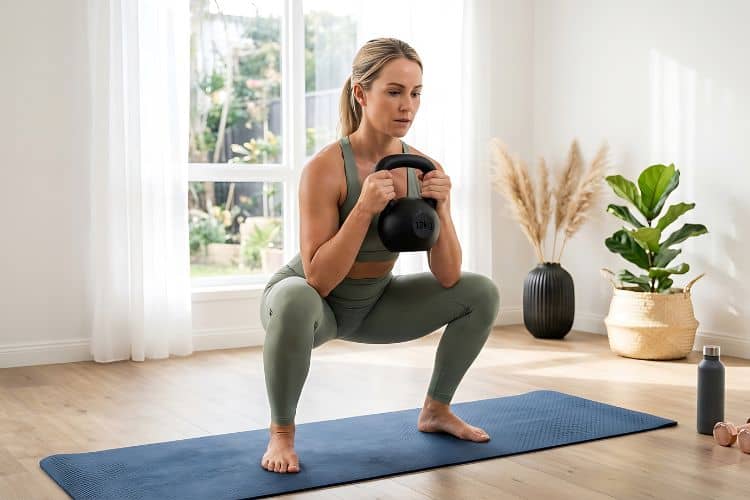
Alternate kettlebell goblet squats and kettlebell deadlifts for eight one-minute intervals. That means squats during the first minute, deadlifts during the second, and the same sequence repeated four times. Aim for six to ten squats and eight to twelve deadlifts per set, provided those repetitions fit comfortably within the work window.
These two movements give the lower-body block distinct jobs. The squat emphasizes bending the knees and hips to lower your body, while the deadlift emphasizes moving the hips backward and forward. Keeping the exercises separate helps you practice both patterns without blending them into a rushed combination.
Hold the kettlebell securely by the sides of its handle near your chest. Stand with your feet at a comfortable width and let your toes turn outward slightly if that helps your squat. Brace your trunk, bend your hips and knees, and lower only as far as you can control while keeping your feet firmly grounded.
Stand by pushing through the floor, keeping the kettlebell close to your body. Let your knees move in line with your toes rather than forcing them to stay behind your feet. Use an even pace, taking roughly two seconds to lower and standing without bouncing. Avoid leaning backward at the top or holding the bell away from your chest.
If a loaded squat feels too difficult, perform bodyweight squats to a stable chair. Touch the chair gently rather than dropping into it. A shallower, controlled squat is a useful starting point, and you can gradually increase depth as the movement becomes more comfortable.
Place the kettlebell on the floor between your feet. Move your hips backward, bend your knees enough to reach the handle, and maintain a comfortable, steady spinal position. Grip with both hands, brace your trunk, and stand tall with the kettlebell close to your legs.
Lower by reversing the movement: hips back first, then enough knee bend to return the bell to the floor. Reset briefly between repetitions if needed. Avoid jerking the weight upward or leaning back when you stand. If reaching the floor requires losing your position, elevate the bell on a secure, purpose-built platform or practice unloaded hinges instead.
Alternate a supported one-arm kettlebell row with a single-arm kettlebell floor press. Use the same one-minute format and complete four rounds. During rounds one and three, train the left arm for both movements. During rounds two and four, train the right arm. Each arm therefore receives two rowing sets and two pressing sets.
Aim for six to ten controlled repetitions per interval. Use the rest period to change position safely, especially when moving between standing and lying down. If that transition takes longer than 20 seconds, begin the next set late and perform fewer repetitions. The session should remain orderly even as fatigue increases.
Take a staggered stance and support your free hand on your own front thigh or a sturdy, nonmoving surface. Hinge forward while keeping your shoulders and hips approximately square. Let the kettlebell hang beneath your working shoulder, then draw your elbow toward your hip.
Lower the weight smoothly instead of letting it pull your shoulder downward abruptly. Keep your neck comfortable and avoid rotating your torso to lift a heavier bell. The movement should come primarily from your arm and upper back while your trunk maintains its position. Pause briefly at the top if you can do so without shrugging.
For a beginner modification, use a more upright torso and a lighter weight. If your lower back tires before your rowing muscles, improve your support position or shorten the set. Record repetitions for each side separately so you can identify differences without forcing the less confident side to match extra repetitions.
Lie on your back with knees bent and feet planted. Position the kettlebell carefully using both hands, then hold it in one hand with the bell resting against the outside of your forearm. Keep your wrist steady and your upper arm at a comfortable angle from your torso, often around 30 to 45 degrees.
Press upward until your arm is comfortably extended. Lower slowly until your upper arm touches the floor gently, then press again. Avoid bouncing your elbow, letting your wrist bend backward, or twisting your body. Return the kettlebell to a secure position with both hands before sitting up.
If the bell is too heavy or uncomfortable against your forearm, replace the floor press with wall push-ups or incline push-ups against a secure surface. Complete those with both arms during every pressing interval. Use the same six-to-ten-repetition target and keep your body aligned throughout the movement.
Finish the training portion with six one-minute intervals alternating suitcase marches and bodyweight dead bugs. Complete three rounds. During each marching interval, hold the kettlebell on one side for 15 seconds, take ten seconds to set it down and switch hands, then march for 15 seconds on the other side. Rest for the final 20 seconds.
During each dead bug interval, perform up to 40 seconds of slow repetitions and rest for at least 20 seconds. This block emphasizes controlling your trunk while your limbs move. Keep the pace deliberate; faster movements make it harder to notice whether you are leaning, twisting, or losing your position.
Hold the kettlebell beside one hip and stand tall without pulling that shoulder upward. Begin lifting one foot at a time in a small march. Keep your steps low and your torso steady, resisting the tendency to lean toward or away from the weight.
Choose a marching height that feels stable. You do not need to raise your knees to hip level. If balance becomes difficult, replace marching with a stationary suitcase hold and keep both feet planted. You can also lower the weight or use a shorter hold while preserving the same scheduled switching and rest periods.
Lie on your back and raise your arms toward the ceiling. Bring your knees over your hips with knees bent. Gently brace your abdomen, then slowly extend one arm and the opposite leg only as far as you can while maintaining a steady trunk position. Return and switch sides.
Exhale during the extension and avoid letting your ribs lift or your lower back arch farther as your limbs move. Four to six slow repetitions per side may be enough for the interval. For an easier version, keep your arms still and lower one heel toward the floor at a time. Reduce the range whenever control becomes difficult.
Spend the first cooldown minute walking slowly around your space or marching gently. Let your breathing settle instead of dropping immediately into a deep stretch. Use the second minute for comfortable standing calf and hip-flexor stretches, dividing the time between sides.
During the final minute, relax your shoulders and take several easy breaths while standing or sitting. Stretching should feel mild and manageable. You do not need to force a larger range because your muscles are warm, and the cooldown should not become another demanding exercise block.
After the timer ends, note your kettlebell weight, approximate repetitions, and overall effort. Add a short observation such as “rows felt controlled” or “needed bodyweight squats in round four.” These details are more useful for planning your next session than judging success by sweat or soreness.
If you are new to resistance training, use 30 seconds of work and 30 seconds of rest throughout the strength blocks. The workout still lasts 30 minutes, but the extra recovery gives you more time to set up and maintain control. Start near the lower end of each repetition range.
You can also complete only the first two rounds of each eight-minute block, using the remaining minutes for easy walking and recovery. Keep the warm-up and cooldown. Building tolerance gradually is more useful than forcing all four rounds during your first attempt and feeling unable to repeat the session.
Women returning after a long break may benefit from lighter resistance, bodyweight pressing, and stationary carries. Experienced exercisers may use separate weights for lower-body and upper-body movements. Age alone does not determine which version you need; choose based on your current movement control, training history, and recovery.
If a health condition or recent injury affects your exercise choices, use individualized guidance from an appropriate professional. A general home workout cannot account for every restriction. Adapt the plan so each exercise fits your situation instead of assuming every movement is suitable because it appears in a beginner-friendly routine.
During week one, learn the sequence and choose manageable weights. During week two, add one controlled repetition to selected sets when you can do so without rushing. During week three, build toward the upper end of the repetition ranges while preserving the scheduled rest.
In week four, consider a slightly heavier kettlebell for one or two movements if you have consistently completed the upper repetition targets with good control and spare effort. Return toward the lower end of the range with the new load. If your available weight jump is too large, continue practicing with the current bell rather than forcing an increase.
When your equipment is limited, a controlled three-second lowering phase on squats or rows can make an existing weight more demanding. Reduce the repetition target so the set still fits within 40 seconds. Change only one variable at a time, and keep the deadlift and floor-press setup especially deliberate.
Do not assume that less rest always means better strength progress. Shorter recovery may simply make the workout harder to complete. Compare sessions using movement quality, repetitions, resistance, and perceived effort together. If fatigue is accumulating, repeat an easier week or reduce the number of working sets before increasing difficulty.
Begin with two sessions on nonconsecutive days, such as Monday and Thursday. On other days, choose comfortable walking, easy mobility, or another activity that fits your energy and goals. A third session can be added later if you recover well and your other training does not already create substantial fatigue.
Because this routine includes lower-body and upper-body work, consider the overlap with your existing workouts. A hard leg session immediately before this workout may affect your squat and deadlift performance. Plan enough recovery that you can repeat the movements with control rather than repeatedly training the same muscles while unusually sore.
Regular meals, adequate fluids, and consistent sleep make it easier to approach workouts with energy. You do not need a special supplement or complicated pre-workout routine to complete this session. If you prefer eating beforehand, choose a familiar meal or snack that sits comfortably during exercise.
Yes, it can be adapted for beginners who can perform the basic movements comfortably. Start with lighter resistance, use the 30-second work option, and replace floor presses with wall push-ups when necessary. Learning the setup comes before increasing speed, repetitions, or load.
Yes. Choose a bell you can handle during the upper-body exercises and accept that it may feel lighter during squats and deadlifts. You can progress those movements gradually through repetitions or tempo. A second kettlebell becomes useful when different exercises need substantially different loads.
Progressive resistance training can contribute to stronger muscles and changes in muscular appearance over time. Visible results also depend on nutrition, overall activity, genetics, and consistency. This routine does not target fat loss from a particular body part or guarantee a specific appearance within four weeks.
No. This workout is complete without swings. If you later want to learn them, practice separately with qualified instruction before adding them to timed training. They should not replace deadlifts automatically, because a controlled hinge and a ballistic swing have different technical and programming demands.
A useful 30-minute SplitLean kettlebell home workout gives you a clear starting point and a practical way to improve. Warm up, complete the focused lower-body and upper-body blocks, practice core control, and cool down. Repeat the session consistently, adjust it to your ability, and increase the challenge when your performance supports the change.
The most valuable result is a routine you can return to with confidence. One kettlebell, deliberate repetitions, and a realistic schedule can make home strength training a dependable part of your week.
To complement this 30-minute SplitLean kettlebell home workout, explore our Beginner Kettlebell Workout For Women for foundational exercises and modifications, refine your technique with our Kettlebell Goblet Squat Workout, and discover more home training options in our Single Kettlebell Full-Body Workout. Add variety with our Kettlebell Strength And Mobility Workout For Women Over 40, or follow our SplitLean 4-Day Strength Plan for a structured weekly upper- and lower-body schedule.
Stay up to date on the latest women’s health, fitness and lifestyle trends and tips.
