



Sign up for workout ideas, training advice, reviews of the latest gear and more.


A four-day workout can be the sweet spot when you want enough structure to get stronger without planning every hour of the week around the gym. This SplitLean workout 4-day plan pairs two upper-body sessions with two lower-body sessions. Each session has a distinct emphasis, but every major muscle group gets repeated practice across the week. The result is a practical schedule for building strength and muscle while leaving room for walking, other activities, and recovery.
Here, “SplitLean” describes the structure and goal of the plan: split your strength work across four days and support a lean, capable body through steady training habits. It is not a promise that particular exercises will burn fat from a chosen body part. Body composition also depends on food intake, sleep, activity outside the gym, and time. The workouts give you a repeatable way to train; your nutrition and recovery determine how well you can sustain them.
You can perform the plan in a gym or adapt it for home with dumbbells and a sturdy bench or chair. Allow about 45 to 60 minutes per workout, including a warm-up. If you are completely new to lifting, begin with fewer sets and lighter weights. Keep a training log so the next week has a clear starting point.
The week alternates upper- and lower-body training. A useful schedule is Monday for Upper A, Tuesday for Lower A, Thursday for Upper B, and Friday for Lower B. Wednesday, Saturday, and Sunday can be rest days or easy movement days. Shift the calendar to fit your life while keeping a rest day between the two pairs of workouts when possible. If you miss Thursday, perform Upper B on Friday and Lower B over the weekend rather than doubling up to catch up.
Upper A emphasizes horizontal pressing and rowing. Lower A emphasizes squat patterns. Upper B brings in more overhead pressing and vertical pulling, while Lower B emphasizes the hip hinge and posterior chain. These are emphases, not rigid boundaries: both lower days include some work for the glutes, quads, and hamstrings, and both upper days train pushing and pulling. That balance helps you practice core movement patterns twice weekly without requiring marathon sessions.
Most main exercises use three working sets, while smaller accessory exercises use two. Choose a resistance that lets you finish each set with roughly one to three good repetitions left in reserve. The first week should feel controlled enough to learn the movements. Rest about 90 to 150 seconds after demanding compound lifts and 45 to 90 seconds after smaller exercises. If breathing or form has not recovered, take longer; the timer is a guide rather than a test.
At minimum, have a pair of dumbbells, a resistance band, and a stable surface for supported rows or elevated push-ups. In a gym, you can use barbells, cables, machines, or a bench. None of those tools is required for the plan to work. A heavier pair of dumbbells may be helpful for lower-body lifts, and lighter ones may suit raises and curls.
Before each workout, spend five to eight minutes walking, cycling, or moving at an easy pace. Then rehearse the movements you are about to train: controlled bodyweight squats and hip hinges on lower days; shoulder circles, light rows, and an easy set of presses on upper days. Do one or two lighter practice sets before your first challenging lift. A warm-up should prepare you to move well without tiring you out.
Start with a dumbbell bench press or floor press for three sets of six to ten repetitions. Keep your feet planted, wrists stacked above your forearms, and shoulder blades comfortably set against the bench or floor. Lower the weights with control, then press without bouncing. If you have no dumbbells, use a push-up against a counter, bench, or floor at an angle that lets you maintain a straight body line. Record the weight and repetitions from each set.
Next, perform a one-arm dumbbell row for three sets of eight to twelve per side. Support your free hand on a bench, pull the dumbbell toward your hip, and lower it slowly without twisting your torso. Follow it with an incline dumbbell press or another push-up variation for two sets of eight to twelve. The incline changes the pressing angle and adds useful work without needing a maximal load.
Complete a seated cable row, band row, or chest-supported dumbbell row for two sets of ten to fifteen. On each repetition, move your elbows back and pause briefly while keeping your ribs down. Finish with two sets of twelve to fifteen lateral raises and two sets of ten to fifteen triceps pressdowns or overhead dumbbell extensions. The smaller exercises should challenge your shoulders and arms without making you swing the weight.
If you have only 30 minutes, do the first press, the one-arm row, and one additional push or pull exercise. Those movements cover the main work. Add the accessory exercises when time and energy allow, and avoid rushing every set just to complete the entire list.
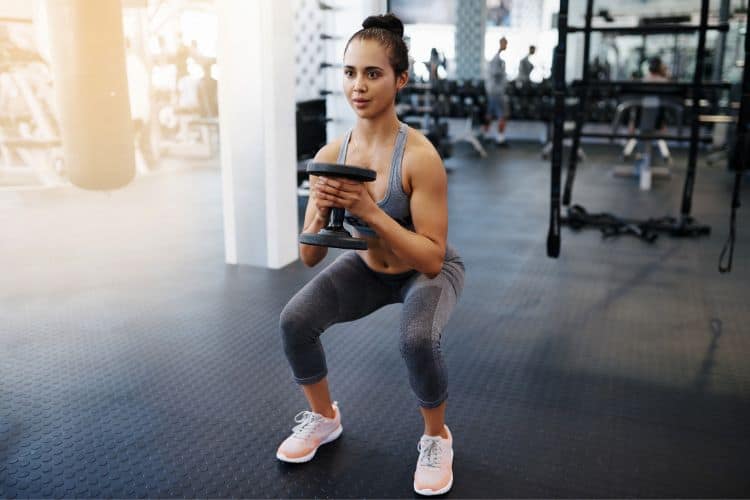
Begin with a goblet squat for three sets of eight to twelve repetitions. Hold one dumbbell close to your chest, stand with feet at a comfortable width, and sit down between your hips as far as you can while keeping your heels grounded. Stand by pushing through your whole foot. A box or bench can provide a repeatable depth; choose a height that lets you move comfortably. Gym lifters can use a barbell squat or leg press if they know the setup and can control the range of motion.
Next, perform a dumbbell Romanian deadlift for three sets of eight to twelve. Soften your knees, move your hips backward, and lower the weights along your legs until you feel a comfortable stretch through the backs of your thighs. Stand tall by driving your hips forward. The goal is a controlled hip hinge, not touching the floor or rounding your back to reach a lower position.
Add a reverse lunge or supported split squat for two sets of eight to ten repetitions per leg. Taking a step backward often makes it easier to keep your balance, but holding a sturdy support is fine. Perform two sets of twelve to fifteen calf raises, pausing at the top and lowering with control. Finish with a dead bug for two sets of six to ten slow repetitions per side. Keep your lower back in a comfortable, steady position and shorten the reach if your ribs flare.
The first two lifts carry most of the session’s workload. If your legs are still sore from starting the plan, use just two sets of squats, Romanian deadlifts, and lunges for the first week. Increase the number of sets when you can complete the session with sound form and recover before Lower B.
After your rest or easy movement day, begin Upper B with a seated or standing dumbbell overhead press for three sets of six to ten repetitions. Press in a comfortable path, keep your rib cage stacked above your pelvis, and avoid leaning far backward to get the weights overhead. If pressing overhead bothers your shoulders, use a neutral-grip press in a comfortable range or repeat a flat dumbbell press instead.
Perform an assisted pull-up, lat pulldown, or band-assisted vertical pull for three sets of eight to twelve. Think about drawing your elbows down toward your sides and lowering under control. If your setup does not allow a vertical pull, substitute a strong band row or another dumbbell row. Next, do a dumbbell chest press or push-up for two sets of eight to twelve, followed by a chest-supported row or cable row for two sets of eight to twelve. This second push-and-pull pairing ensures the chest and mid-back still receive attention on this day.
Finish with a rear-delt fly or band pull-apart for two sets of twelve to fifteen and a dumbbell curl for two sets of ten to fifteen. Use a lighter resistance for the rear-delt movement than you think you need; aim to feel your upper back working without shrugging hard toward your ears. If time allows, include a suitcase carry for two walks of 20 to 40 seconds per side, carrying one dumbbell and staying upright instead of leaning toward or away from it.
Start with a dumbbell or barbell deadlift variation for three sets of six to ten repetitions. For home training, hold two dumbbells at your sides and hinge until the weights reach a height you can control. Keep them close, brace gently around your trunk, and stand tall without leaning backward at the top. A Romanian deadlift is an acceptable alternative if lifting from a lower position does not feel comfortable.
Next, perform a step-up or split squat for three sets of eight to ten per leg. Pick a step height that lets you drive through the leading leg rather than launching off the trailing foot. A stationary split squat removes the step entirely if balance or setup is an issue. Follow with a dumbbell hip thrust or glute bridge for two sets of ten to fifteen. Pause briefly when your hips rise and keep your ribs from lifting excessively. A folded mat can make the floor version more comfortable.
Complete two sets of ten to fifteen hamstring curls using a machine, sliders, or a resistance band. If no setup works, add a second controlled set of Romanian deadlifts instead. Then perform two sets of twelve to twenty calf raises and two sets of a side plank held for 20 to 40 seconds per side. Keep your hips lifted and make the hold shorter if you lose position. This day should challenge you, but you should be able to leave the session knowing you can recover over the weekend.
Follow this schedule for at least six weeks so you can compare like with like. In week one, choose manageable weights and write down every working set. Use the lower end of each repetition range as a target. For example, if a press calls for three sets of six to ten, you might complete eight, eight, and seven controlled reps. On the next Upper A session, aim for one more good repetition somewhere across those sets. When all three sets reach ten with consistent technique and the intended effort, increase the weight by the smallest available amount. Your repetitions may drop toward six again; build them back up.
This method is called double progression. It gives you a straightforward way to make a workout harder without changing exercises constantly. If your dumbbells jump by too much weight, add repetitions within the range, use a slower lowering phase, or improve range and control first. A larger number on the dumbbell is useful only when the reps remain honest. Record how challenging each last set felt, especially if sleep, work stress, or soreness changes from week to week.
During weeks one and two, many beginners will benefit from two sets on most exercises. In weeks three and four, add a third set to the main lifts if recovery is good. In weeks five and six, keep the set count stable and progress repetitions or load. If performance drops across several sessions and you feel unusually run down, take an easier week by using fewer sets or lighter weights, then resume. More work is not automatically better; a plan works when you can repeat it.
Strength work is the anchor of this SplitLean plan, but easy movement between sessions can support general fitness. Try a comfortable walk on one or two nonlifting days, or add ten to twenty minutes of easy cycling after an upper-body workout if you enjoy it. If you want harder intervals, begin with one short session per week and assess whether it affects the next day’s lifting. Your conditioning should fit around the strength work you want to progress.
A leaner appearance generally involves maintaining or gaining muscle while reducing body fat over time, if fat loss is your goal. No four-day split guarantees that result by itself. Eating enough protein across regular meals, choosing satisfying foods, and using an appropriate overall energy intake can support training. Aggressive dieting often makes it harder to recover and lift well. If you are aiming to maintain weight or build muscle, the same plan can work with a different nutrition approach. Choose the goal that fits your needs instead of treating “lean” as a mandatory body type.
Recovery is part of the schedule, not a reward for finishing it. Sleep, food, hydration, and lighter days affect how each session feels. Some muscle soreness can happen after a new exercise, but soreness is not proof that a workout was effective. Watch your performance, movement quality, and consistency over several weeks. Those signals tell you more than how wiped out you feel after any one day.
You can adjust the calendar occasionally, but four hard lifting days in a row are harder to recover from for many people. A two-days-on, one-day-off, two-days-on pattern is a practical starting point. If your schedule forces consecutive sessions, alternate upper and lower days, keep the accessory volume modest, and pay attention to fatigue. You can also spread the four workouts across eight or nine days rather than squeezing them into one calendar week.
Use a weight that makes the final few repetitions challenging while allowing steady form and approximately one to three repetitions in reserve. The number will differ by exercise and person. You might use heavier weights for a hinge or squat than for a lateral raise, and the right load can change as you improve. Start conservatively, especially with unfamiliar exercises, and let completed reps guide your next increase.
Yes, if the total work matches your current capacity and you learn the movements at a manageable pace. Use two sets of each main exercise and one or two accessory movements per day to start. A beginner who can train only twice a week can still make progress; consistency matters more than forcing four sessions onto a crowded schedule. Ask a qualified coach to check technique if you are unsure about a movement.
No. Dumbbell presses, rows, goblet squats, Romanian deadlifts, step-ups, glute bridges, and band pulls cover nearly the entire plan. A sturdy chair or bench helps with support and step-ups, but choose a stable setup and avoid surfaces that shift under load. At home, progress may come from more controlled repetitions or a heavier pair of dumbbells before you need a larger collection of equipment.
The best SplitLean workout 4-day plan is one you can actually follow. Put your four sessions on the calendar, prepare the weights or equipment you need, and log a few details after each workout. Start with manageable effort, make small improvements in repetitions or load, and let rest days do their job. Over six or more weeks, those repeated sessions build a clearer picture of your strength than any single intense workout can provide.
If you want to tailor the plan, keep its structure: two upper-body days, two lower-body days, one main movement pattern to prioritize each session, and enough recovery to return ready to train. Whether your goal is strength, more muscle, or simply a routine you can sustain, this framework gives you a place to begin and a way to keep progressing.
If you are building up to this four-day split, start with the Beginner Dumbbell Workout Plan For Women to practice the main lifts. For a different multiweek schedule, see the 4 Week Strength Training Plan. When you are ready to increase your training challenge, the Progressive Overload Guide For Women Over 40 explains how to advance your lifts. You can also use the 30 Minute Dumbbell Density Workout for a shorter strength session, or the 15 Minute Full Body Dumbbell Workout when time is tight.
Stay up to date on the latest women’s health, fitness and lifestyle trends and tips.
