


Sign up for workout ideas, training advice, reviews of the latest gear and more.
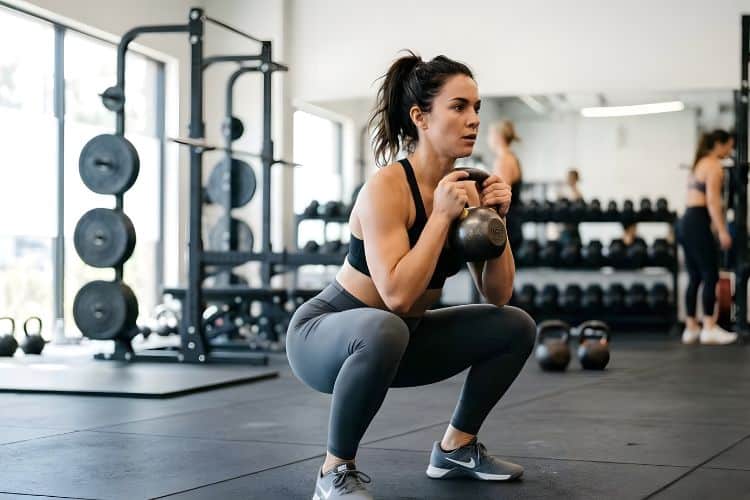

The kettlebell goblet squat looks simple: hold a weight at your chest, sit down between your legs, and stand back up. Yet this single movement can anchor an effective lower-body workout. It trains your thighs and glutes while asking your midsection and upper back to keep the kettlebell steady. Because the weight sits in front of your body, it also gives you a useful reference point for learning to squat with control.
This kettlebell goblet squat workout combines a practical form lesson with a 30-minute session you can complete at home or in the gym. You will start with a warm-up, work through three manageable blocks, and finish with a short cool-down. The plan includes options for newer lifters and ways to make the exercise more demanding once the basic movement feels familiar. You need one kettlebell and enough floor space to take a few steps in each direction.
A goblet squat is a squat performed while holding a kettlebell close to the front of your chest. The name comes from the way you hold the weight, as if you were supporting a large cup. You can grip the horns, the curved sides of the handle, with the bell facing down. Some people prefer to hold the round body of the bell with both hands. Either grip is acceptable if you can maintain secure control, relaxed shoulders, and a comfortable wrist position.
The movement begins with your feet planted, your knees and hips bending together, and your torso staying relatively upright. You descend only as far as you can while keeping your balance and a comfortable position through your feet and back. Then you push the floor away to stand. Your natural foot angle, stance width, and comfortable depth may differ from someone else’s. The goal is a repeatable squat that feels stable, not a particular pose for a photograph.
The front of your thighs, or quadriceps, helps extend your knees as you rise. Your glutes help extend your hips, while the muscles around your trunk resist the kettlebell pulling you forward. Your upper back and arms support the bell in place. The goblet squat is therefore a useful lower-body exercise with a meaningful bracing component, although it does not replace every other pattern in a balanced strength program.
You may feel the squat in different places depending on your proportions, stance, range of motion, and weight. Feeling your quads strongly does not mean your glutes are absent from the exercise. If your aim is broader lower-body strength, pair goblet squats with a hinge such as a kettlebell deadlift, plus a single-leg movement. That combination trains the legs through more than one pattern without demanding a large equipment collection.
The kettlebell is convenient when you want a compact, accessible workout. Holding it in front gives many lifters a helpful counterweight and makes the movement easier to learn than balancing a bar across the shoulders. It is also easy to set down between sets. The trade-off is that your grip and ability to support a heavy bell may limit the load before your legs reach their maximum potential. Goblet squats can remain valuable even when you eventually add heavier squat variations.
Place the kettlebell on the floor in front of you. Hinge at your hips and bend your knees to pick it up with both hands. Bring it close to your chest before you begin the set. Stand with your feet roughly hip to shoulder width apart and turn your toes out slightly if that feels natural. Adjust your stance after a few unloaded practice reps rather than forcing a fixed width.
Take a comfortable breath and gently brace your abdomen as though you were preparing to lift a moderately heavy object. Keep the bell near your upper chest instead of reaching it forward. Bend your hips and knees together, allowing your knees to travel in the direction of your toes. Keep your whole foot in contact with the floor. At the bottom, pause briefly if you can maintain control. Push through your feet, straighten your hips and knees, and exhale as you stand. Reset your breath before the next repetition.
Squat to the depth you can control without pain, losing your balance, or lifting your heels. For some people that is a deep position with the hips below the knees. Others will work at a shallower depth while building mobility and strength. A lower squat is not automatically a better squat when you have to collapse into it or shift onto your toes. Try a lighter bell, a slightly different stance, or a chair as a depth target if you are unsure where to stop.
A brief pause at a comfortable bottom position can help you notice whether you are balanced over your feet. If the squat feels smooth and stable, you can gradually explore more range. If it feels uncomfortable in a joint, reduce the range and choose a variation that feels better. Stop the set if you experience sharp pain, dizziness, or a feeling that you cannot control the weight.
Inhale before you descend and keep your trunk firm through the hardest part of the lift. Exhale as you return to standing, then take another breath before the next rep. A long breath hold can be unnecessary for a moderate goblet squat workout. If you have a condition that affects how you tolerate exertion, follow guidance from your clinician or qualified exercise professional about appropriate loading and breathing.
Start with a bell that lets you complete eight controlled repetitions while feeling that you could do two or three more with the same quality. The exact number printed on the bell matters less than your balance, posture, and ability to finish the planned sets. If the weight pulls your elbows away from your body, makes your wrists uncomfortable, or forces you to rush through the bottom position, choose a lighter bell. If you finish every set easily and your technique remains consistent, consider increasing the load later.
If you are new to squats, practice bodyweight repetitions first. Next, try a light kettlebell for a small number of reps. Experienced lifters can use a heavier bell but should still treat each rep as deliberate. When the kettlebell available to you is too light to challenge your legs, add a slow descent or a short pause before chasing very high repetitions. When it is too heavy to hold safely at your chest, do not force the goblet position; use an appropriate lighter option or another exercise.
This session has a five-minute warm-up, three seven-minute working blocks, and a four-minute cool-down. Use a timer, but do not let it dictate your technique. Each block contains two exercises. Alternate them for three rounds, resting approximately 30 to 60 seconds after each pair. The time includes transitions; take longer if you need it and allow the workout to run a few minutes over. Complete the plan once or twice a week at first, with recovery between challenging lower-body sessions.
Begin with one minute of comfortable marching or walking. Spend another minute performing bodyweight squats to a chair or bench, lightly touching the seat before standing. Follow with a minute of standing hip hinges: move your hips backward with softly bent knees, then stand tall. Spend a minute stepping one foot backward into a short reverse lunge or performing gentle alternating backward steps. For the final minute, make small ankle rocks with your heels down, then practice several slow, unloaded squats.
The warm-up should make you feel ready to move, not tired before the first working set. If a particular drill feels awkward, replace it with easy walking and a few comfortable squat repetitions. You can use the first working round as an additional practice round with a lighter bell.
Perform eight to ten kettlebell goblet squats. Lower over roughly two seconds, pause just long enough to feel your balance, and stand with purpose. Put the bell down safely. Then perform eight to ten kettlebell deadlifts, with the bell between your feet and your hips moving backward as you lower it. Alternate the two exercises for three rounds. Rest after each pair until you can begin the next squat set with steady breathing and dependable form.
This block pairs a knee-dominant squat with a hip hinge. Keep the kettlebell close to your body in both exercises, but notice the difference: in the squat, your hips and knees bend substantially together; in the deadlift, your hips travel farther backward. Do not turn the deadlift into another squat. If you have only one bell and it is too heavy for goblet squats, use bodyweight for the squat and reserve the bell for the deadlift.
Perform six to eight goblet squats with a three-second descent. Count quietly as you lower, then rise at a comfortable speed. Set down the bell and perform six to eight reverse lunges per leg using bodyweight. Alternate for three rounds. If balance is a challenge, hold a sturdy support during the lunges or replace them with backward step taps. Rest about 45 to 60 seconds after each pair, adding time if your form begins to change.
The slow squat increases the time your legs spend working without requiring another kettlebell. Keep the same comfortable squat depth on every repetition. For the reverse lunge, step back far enough that you can bend both legs without falling forward. Press through the front foot to return to standing. The lunge is a supporting movement, so reduce its range if it distracts from the quality of your goblet squats.
Perform eight goblet squats followed by eight to twelve standing calf raises. Then hold the kettlebell in one hand at your side and walk for 20 to 30 seconds, or march in place if space is limited. Switch hands for another 20 to 30 seconds. Repeat the sequence for two or three rounds, depending on your pace. Rest between rounds as needed. If holding a bell at your side changes your posture or bothers your grip, set it down and finish with an unloaded march.
This final block keeps the squat at the center of the session while adding a simple carry. During the carry, stand tall and resist leaning toward the kettlebell. Walk slowly enough to keep your steps smooth. Avoid turning the block into a race; a few well-controlled rounds provide a more useful training signal than squeezing in extra repetitions with a collapsing torso.
Walk at an easy pace until your breathing settles. Then gently move through a standing quad stretch, an easy hip flexor stretch, and a calf stretch, spending roughly 20 to 30 seconds on each side. Finish with a few unloaded squats in a comfortable range if they feel good. Stretching is optional; the main purpose of these final minutes is to transition out of the workout and notice how your legs feel.
If you are just starting, shorten the session to the warm-up and the first two blocks. Perform two rounds per block instead of three, and use six to eight squat repetitions in each set. Rest 60 to 90 seconds whenever necessary. Replace reverse lunges with supported backward steps and omit the carry if your grip tires quickly. This gives you a useful introductory session without demanding that you keep pace with a timer.
A chair squat is another effective entry point. Place a sturdy chair behind you, descend until you lightly touch it, and stand without dropping your full weight onto the seat. Begin without the kettlebell if needed. Once you can repeat the movement smoothly, hold a light bell close to your chest. The chair provides a consistent target, but your hips do not have to touch it if reaching it requires an uncomfortable depth.
Progress gradually rather than changing everything in one session. First, bring each squat set to the top of its suggested rep range with reliable form. Next, add a round to one block, add a one- or two-second pause at the bottom, or increase the kettlebell weight by a sensible increment. Choose one of these changes at a time. If you increase the load, return to the low end of the rep range and rebuild from there.
A useful four-week progression is straightforward. In week one, learn the routine and record the kettlebell weight and reps you completed. In week two, add one rep to selected sets if technique permits. In week three, add a brief pause to the first block or move to a slightly heavier bell while reducing reps. In week four, repeat the strongest version you can perform cleanly, or use an easier week if fatigue has accumulated. Your goal is a sustainable training pattern, not a personal best every time you squat.
Goblet squats can contribute to muscle growth when sets provide enough challenge and your training progresses over time. They are particularly practical when you are new to resistance training or have limited equipment. As your legs become stronger, the bell you can comfortably hold at your chest may become the limiting factor. At that point, keep goblet squats as a warm-up or accessory exercise and consider adding other appropriately loaded lower-body movements to continue challenging your legs.
Yes. One well-chosen kettlebell is enough for this session. You can use the same bell for squats, deadlifts, and carries, and perform the lunges and calf raises with bodyweight. If that single bell is much better suited to deadlifts than to squats, reduce the squat reps or use a bodyweight variation. Equipment should serve the movement rather than dictate a load you cannot handle comfortably.
If your heels lift, try a slightly wider stance, a small outward toe angle, and a shallower depth. Check that you are not reaching the kettlebell away from your chest. If your back rounds sharply at the bottom, shorten the descent and focus on maintaining a stable torso rather than forcing a deeper rep. A small amount of natural movement in the spine can occur, but a sudden loss of control under load is your cue to reset.
If your knees cave inward, slow down and let them track generally in the direction your toes point. You do not need to exaggerate pushing them outward. If your elbows flare and your shoulders tire before your legs, bring the bell closer to your chest, relax your shoulders as much as the grip allows, or choose a lighter weight. If you rush your reps to finish a timed block, stop using the timer as a target and count well-executed sets instead.
Another common mistake is treating the squat as a single-purpose calorie challenge. Fast repetitions can make you breathless, but speed alone does not guarantee better strength results. Choose a load and pace that let you control the descent and stand strongly. Your workout can feel demanding while still leaving room for proper movement and recovery.
For many people, one or two goblet squat sessions per week fit comfortably into a broader routine. If you are new to lifting, start with one session, see how you recover, and add another when your legs feel ready. Place at least a day of recovery or easier activity between hard lower-body sessions. A balanced week can include upper-body pushing and pulling, hip hinges, walking, and other activities you enjoy. You do not need to repeat this exact workout every day to improve.
Track a few simple details after each session: your kettlebell weight, squat reps, perceived effort, and any form adjustment that helped. Compare sessions over several weeks instead of judging progress by one hard day. Better control, a steadier bottom position, and more consistent repetitions are useful signs of improvement even before you move to a heavier bell.
Your knees may travel past your toes during a squat, depending on your build and how deep you move. The important questions are whether your feet stay grounded, your knees follow a comfortable path, and the movement feels controlled. Trying to keep the knees behind the toes at all costs may cause you to lean excessively or lose your balance. Adjust stance and depth based on your own comfortable movement.
They can be an approachable first loaded squat because the kettlebell stays close to your chest and is easy to set down. Begin with bodyweight squats if you need to establish balance and range first. Add the kettlebell only when you can manage the starting and finishing positions as well as the squat itself. Beginners often benefit from fewer high-quality reps and more rest.
Experiment with holding the sides of the handle or the bell itself, keeping your wrists as comfortable and neutral as possible. Avoid letting the bell pull your hands sharply backward. A lighter kettlebell or a dumbbell held vertically may provide a better grip. If discomfort persists, choose another squat variation rather than working through wrist pain.
Yes. Hold a dumbbell vertically at your chest, or begin with an unloaded squat. The central idea is to learn and train a controlled squat pattern. A kettlebell is convenient, but it is not required to make the workout worthwhile. When substituting equipment, make sure you can hold it securely and set it down safely.
Goblet squats strengthen muscles and contribute to overall activity, but no squat variation selectively removes fat from one area. Changes in body composition depend on your broader nutrition, activity, recovery, and consistency over time. Use this workout for its clear training benefits and combine it with a routine you can maintain.
A good kettlebell goblet squat workout does not need complicated choreography. Hold the bell securely, choose a squat depth you can control, and let the work build across consistent sets. The 30-minute routine gives you a clear starting point, while its shorter and harder versions let the same basic movement grow with you. Save your workout details, repeat the session regularly, and make your next change small enough that your form stays strong.
For more ways to build on this workout, explore The Best Squats For Women to compare squat variations, then try these Kettlebell Leg Exercises For Stronger Glutes And Quads to expand your lower-body routine. When you are ready for a longer plan, the 4 Week Kettlebell Workout Challenge offers a way to practice consistently. You can also use the 30 Minute Full Body Kettlebell Workout to train beyond leg day or browse the Best 30 Minute Leg Workout for another short lower-body session.
Stay up to date on the latest women’s health, fitness and lifestyle trends and tips.
