


Sign up for workout ideas, training advice, reviews of the latest gear and more.

Building strong bones is important at every stage of life, but it becomes especially valuable as we age. Bone mineral density naturally changes over time, and factors such as menopause, inactivity, nutrition, certain medications, and family history can accelerate bone loss. Fortunately, resistance training can provide the mechanical stimulus bones need to remain strong. Barbell exercises for bone density.
Barbell exercises are particularly effective because they allow you to train multiple muscle groups while gradually increasing resistance. This progressive loading challenges the muscles, tendons, and bones together. According to the National Institute of Arthritis and Musculoskeletal and Skin Diseases, resistance exercises such as lifting free weights place stress on bones and may help make them stronger. Resistance training can also improve muscular strength, coordination, posture, and balance—all of which can help reduce fall risk.
The following 12 barbell exercises target the hips, legs, spine, shoulders, arms, and upper back. Together, they can form the foundation of an effective strength-training program designed to support bone health.
Before beginning, remember that exercise cannot guarantee an increase in bone density or replace medical osteoporosis treatment. Anyone diagnosed with osteoporosis, osteopenia, a previous fragility fracture, significant joint problems, or a condition affecting balance should consult a qualified healthcare professional before performing loaded barbell exercises.
Bone is living tissue that continually adapts to the demands placed upon it. When muscles pull against bones during resistance training, the bones receive a mechanical-loading signal. Over time, an appropriately challenging and progressive training program may encourage the body to maintain or build stronger bone tissue.
The International Osteoporosis Foundation explains that bones and muscles respond to the stress created by weight-bearing and impact activities. Regular exercise can help maintain bone and muscle strength while improving balance and reducing the likelihood of falls. International Osteoporosis Foundation
Barbells make progressive overload relatively easy to measure. Once you can perform an exercise with good form and the current weight no longer feels challenging, you can add a small amount of weight. This controlled progression is one of the primary advantages of barbell training.
The greatest benefits usually come from consistency rather than performing one extremely demanding workout. A balanced program should challenge the body while allowing sufficient recovery between sessions.
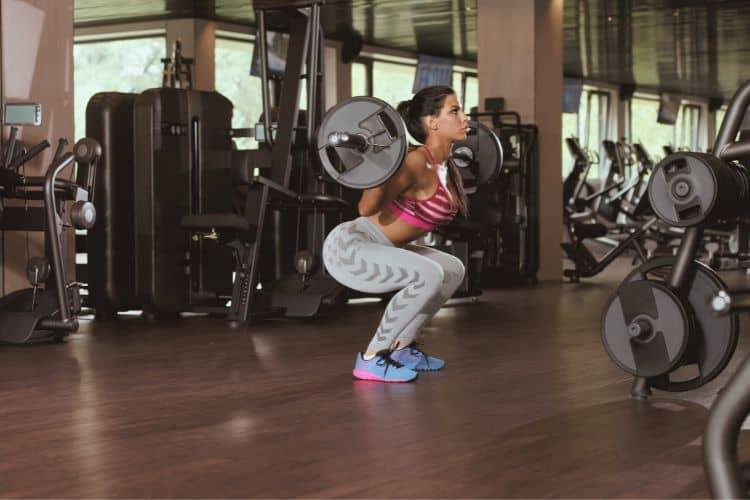
The barbell back squat is a foundational exercise for developing strength throughout the lower body. It primarily works the quadriceps, glutes, hamstrings, core, and spinal-supporting muscles. Because the bar rests across the upper back, the movement creates a significant load through the hips, legs, and spine.
Position the bar across the muscular part of your upper back rather than directly on your neck. Stand with your feet approximately shoulder-width apart and keep your chest lifted. Brace your abdominal muscles, push your hips back, and bend your knees as you lower into the squat. Descend only as far as you can while maintaining a neutral spine and stable feet. Drive through the floor to return to standing.
Beginners can start with a light training bar or perform box squats, in which they lower toward a sturdy bench before standing again. A squat rack with properly positioned safety bars is strongly recommended.
The front squat shifts the bar to the front of the shoulders and places greater emphasis on the quadriceps and upper back. It can also encourage a more upright torso than the traditional back squat.
Rest the bar across the front of your shoulders, keeping your elbows lifted. You can use a clean-style grip or cross your arms over the bar if wrist mobility is limited. Brace your core and lower your hips between your feet. Keep your knees tracking in the same direction as your toes before pushing through your entire foot to stand.
Because the front squat demands upper-back strength and postural control, it can be valuable for maintaining a strong, upright position. Begin with a very light load until the bar position feels secure and comfortable.
The conventional deadlift strengthens the glutes, hamstrings, quadriceps, grip, core, and back muscles. It teaches you how to lift an object from the floor using the hips and legs instead of placing unnecessary strain on the lower back.
Stand with the bar over the middle of your feet. Push your hips backward, bend your knees, and grip the bar just outside your legs. Brace your core, keep the bar close, and push the floor away as you extend your knees and hips. Finish in a tall standing position without leaning backward.
Lower the bar by pushing your hips behind you and maintaining control. Avoid rounding your back or jerking the weight from the floor. If reaching a barbell on the floor causes your back to round, elevate the bar on secure blocks or use a rack-pull variation.
The Romanian deadlift emphasizes the hamstrings, glutes, hips, and muscles supporting the spine. Unlike a conventional deadlift, the movement begins from a standing position and uses only a slight bend in the knees.
Hold the bar against the front of your thighs. Brace your core and push your hips backward while allowing the bar to travel close to your legs. Lower it until you feel tension through the hamstrings or until maintaining a neutral spine becomes difficult. Squeeze your glutes and drive your hips forward to return to standing.
The goal is not to lower the bar as far as possible. The correct depth depends on your hamstring flexibility and ability to control your spine. A slow lowering phase can help you develop better technique without immediately adding more weight.
The barbell hip thrust strengthens the glutes and supporting muscles around the hips. Hip strength is important for everyday activities such as standing, climbing stairs, and walking. Strong glutes may also help stabilize the pelvis and support better lower-body mechanics.
Sit on the floor with your upper back resting against a secure bench. Position a padded barbell across the crease of your hips. Plant your feet firmly, brace your abdomen, and drive through your heels as you lift your hips. Stop when your torso and thighs form a relatively straight line.
Avoid excessively arching your lower back at the top. Your ribs should remain controlled while your glutes complete the movement. Use a bar pad for comfort and make sure the bench cannot slide.
The reverse lunge trains one leg at a time, helping improve strength, coordination, and balance. It targets the glutes, quadriceps, hamstrings, calves, and core while challenging the hips from a different position than squats.
Place the bar securely across your upper back. Step one foot behind you and lower your back knee toward the floor. Keep most of your weight through the front foot and maintain an upright torso. Push through the front foot to return to the starting position.
Use shorter steps if you feel unstable and begin with an empty bar. People who are still developing balance can perform the movement with dumbbells or body weight before progressing to a barbell.
Step-ups develop unilateral leg strength and replicate movements used when climbing stairs. They engage the glutes, quadriceps, hamstrings, calves, and stabilizing muscles surrounding the hips.
Set up a stable box or platform at a manageable height. Place the bar across your upper back and put one entire foot on the platform. Drive through that foot to lift your body, bringing the other foot onto the box. Step down slowly and repeat before switching sides.
Avoid pushing excessively from the foot that remains on the floor. Choose a platform low enough that you can remain balanced and control both the upward and downward portions. Because this exercise requires coordination, use conservative weights and clear the area around the platform.
The standing overhead press targets the shoulders, triceps, upper chest, and core. It also requires full-body stability as the bar travels overhead.
Begin with the bar near your upper chest and position your hands slightly wider than shoulder-width apart. Squeeze your glutes, brace your abdomen, and press the bar upward without leaning backward. Move your head slightly out of the bar’s path, then bring it forward once the bar passes your forehead. Lower the bar under control.
A standing overhead press places a different loading demand on the upper body than lower-body exercises. However, people with shoulder restrictions, balance problems, or certain spinal conditions may require a seated or landmine-press alternative.
The bench press strengthens the chest, shoulders, triceps, and upper-body pushing muscles. It complements pulling exercises and can help develop the strength needed for everyday tasks involving pushing or supporting your body.
Lie on a bench with your feet firmly planted. Grip the bar slightly wider than shoulder-width and keep your shoulder blades gently drawn back. Lower the bar toward your mid-to-lower chest while keeping your wrists aligned above your elbows. Press it back up without bouncing it off your chest.
Always use a competent spotter or safety arms when bench pressing. The bar should remain under control throughout every repetition. Beginners can start with a lighter fixed-weight barbell if a standard Olympic bar is too heavy.
The bent-over row targets the upper back, shoulders, arms, grip, and muscles that help stabilize the spine. Developing these areas can support posture and balance the upper-body pressing work performed in exercises such as the bench press.
Hold the bar with your hands slightly wider than shoulder-width. Push your hips back and lean forward while maintaining a neutral spine. Brace your core and pull the bar toward your lower ribs. Pause briefly before lowering it with control.
Do not use momentum to throw the weight upward. If holding the bent-over position causes discomfort, reduce the weight, elevate your torso, or perform a chest-supported row instead.
The floor press is an upper-body pushing exercise that works the chest, triceps, and shoulders. Because the floor limits how far the elbows can travel, it may feel more comfortable than a full-range bench press for some lifters.
Lie on the floor with your knees bent and feet planted. A training partner or a rack set close to the floor can help you position the bar safely. Lower the bar until your upper arms gently contact the floor, pause, and then press it upward.
Do not bounce your elbows against the ground. The pause should be controlled and brief. Although the range of motion is shorter, proper spotting and safety supports are still necessary.
A barbell farmer hold uses one barbell in each hand, making it most appropriate for experienced lifters with adequate space and matching equipment. It strengthens the grip, arms, shoulders, core, hips, and postural muscles. A static hold is usually easier to organize than walking with the bars.
Place two lightly loaded barbells parallel to each other, ideally elevated on secure rack supports. Stand between them, grip each bar at its center, and carefully lift both. Stand tall with your shoulders level, abdomen braced, and ribs controlled. Hold the position briefly before returning the bars to the supports.
Because balancing two long bars can be difficult, trap-bar carries, dumbbell farmer carries, or a single barbell suitcase hold may be more practical. Do not attempt this movement in a crowded area.
You do not need to perform all 12 exercises in the same session. Instead, choose movements that collectively train the major muscle groups. A balanced workout might include one squat, one hip-hinge exercise, one upper-body press, one pulling movement, and one unilateral or carrying exercise.
For example, you could perform back squats, Romanian deadlifts, bench presses, bent-over rows, and reverse lunges during one session. A second weekly workout might include deadlifts, step-ups, overhead presses, floor presses, and hip thrusts.
Beginners can start with one or two sets of approximately 8 to 12 controlled repetitions per exercise. More experienced lifters might perform two to four sets using a load that makes the final repetitions challenging without compromising form. Rest for approximately one to three minutes between sets, depending on the exercise and the weight being used.
Train on nonconsecutive days when possible so your muscles and joints have time to recover. Two or three full-body strength sessions per week may be enough for many people, although the appropriate frequency depends on health, training experience, and recovery capacity.
Progressive overload means gradually increasing the challenge placed on your body. Adding weight is one method, but it is not the only option. You can also improve your technique, perform an additional repetition, add a set, slow the lowering phase, or increase your range of motion.
Begin with a weight you can control comfortably. Once you can complete every planned repetition while maintaining stable posture and consistent technique, consider adding a small amount of weight. For upper-body exercises, even a two- to five-pound increase can be meaningful. Lower-body movements may allow slightly larger increases.
Avoid adding weight simply because a schedule says it is time to progress. Your form, comfort, and recovery should determine whether you are ready.
People with osteoporosis or a history of spinal fractures may need to avoid or modify movements involving loaded spinal flexion, forceful twisting, rapid transitions, or heavy overhead loading. Mayo Clinic advises tailoring strength training to individual ability and notes that certain movements may need to be avoided when fracture risk is elevated. Mayo Clinic
A physician or physical therapist can help determine which exercises are appropriate based on your diagnosis, bone-density results, fracture history, and balance. Working with a qualified strength professional can also help you learn proper barbell technique.
Stop exercising and seek medical guidance if you experience sharp pain, sudden back pain, chest pain, faintness, unusual shortness of breath, or new numbness or weakness. Normal muscular effort is different from sudden or persistent joint and bone pain.
Exercise works best as part of a complete bone-health strategy. Adequate protein supports muscle repair, while calcium and vitamin D are important for bone health. Your individual needs may depend on age, diet, health history, sun exposure, medications, and laboratory results.
Sleep and recovery also matter. Training creates the stimulus for adaptation, but the body needs rest and proper nutrition to recover. Avoid attempting a demanding barbell program while consistently under-eating, especially if weight loss is also a goal.
Smoking, excessive alcohol intake, prolonged inactivity, and certain health conditions can affect bone health. Discuss personal risk factors with a healthcare professional rather than relying on exercise alone.
Barbell training provides a practical way to challenge the hips, legs, spine, and upper body through progressive resistance. Squats, deadlifts, presses, rows, lunges, step-ups, and loaded holds can strengthen the muscles that support daily movement while delivering the mechanical loading associated with healthier bones.
The ideal program is not necessarily the one using the heaviest weights. It is the program you can perform consistently, progressively, and safely. Start with manageable loads, prioritize technique, use appropriate safety equipment, and allow enough recovery between workouts.
When combined with weight-bearing activity, balanced nutrition, and professional medical care when needed, these 12 barbell exercises can become a valuable part of a long-term plan to support bone density, physical confidence, and full-body strength.
To continue building stronger bones and total-body strength, explore this Strength Training Plan For Women for a practical introduction to resistance exercise. You can also use the Strong Lifts 5×5 Program For Women to practice foundational barbell lifts with gradual progression. Learn how to safely increase training demands with this 30 Day Progressive Overload Workout Plan, or discover additional multi-joint movements in the guide to the 12 Best Compound Lifts For Strength And Muscle. Women approaching or beyond menopause may also benefit from this 30 Minute Strength Workout For Women After 50, which emphasizes bone health, balance, safe progression, and functional strength.
Stay up to date on the latest women’s health, fitness and lifestyle trends and tips.
