


Sign up for workout ideas, training advice, reviews of the latest gear and more.



A 30 minute burpee workout is a challenging and efficient way to combine cardiovascular exercise, muscular endurance, core training, and full-body movement into one workout. Burpees require little to no equipment, can be performed almost anywhere, and are easy to modify based on your current fitness level. Whether you want to improve conditioning, increase workout intensity, build endurance, or simply add variety to your exercise routine, dedicating 30 minutes to different burpee variations can create a surprisingly complete workout.
The traditional burpee combines several movements into one continuous exercise. You move from standing into a squat, place your hands on the floor, transition into a plank, return your feet toward your hands, and stand or jump back up. Because so many muscle groups work together, your heart rate can rise quickly. The result is an exercise that challenges the legs, glutes, shoulders, chest, arms, and core while simultaneously testing cardiovascular fitness.
However, doing burpees continuously for 30 minutes is unnecessary for most people. A better approach is to alternate short periods of burpees with recovery intervals and use several burpee variations throughout the workout. This makes the routine easier to pace while allowing you to maintain better exercise form.
Burpees are popular because they combine several fundamental movement patterns into a single exercise. Instead of isolating one muscle group, the body must repeatedly transition between standing, squatting, plank, and jumping positions.
One of the biggest advantages of a 30 minute burpee workout is cardiovascular conditioning. Performing repeated burpees quickly increases breathing and heart rate. Interval-style burpee workouts can therefore provide a vigorous cardio challenge without requiring a treadmill, stationary bike, rowing machine, or other cardio equipment.
Burpees also train muscular endurance. Your quadriceps and glutes help you squat and stand, your core stabilizes your body during the plank portion, and your shoulders and arms support your upper body. Variations that include push-ups create an additional challenge for the chest, shoulders, and triceps.
Another advantage is convenience. A burpee workout requires very little space and can be completed at home, in a hotel room, outdoors, or at the gym. For busy days when traveling to a gym is inconvenient, a structured 30-minute bodyweight workout can provide an accessible training option.
Although burpees are usually classified as a cardio or conditioning exercise, they recruit muscles throughout the entire body.
The squat and standing portions primarily involve the quadriceps, hamstrings, glutes, and calves. Jumping burpees increase the demand on the lower body because the legs must generate enough force to propel the body upward.
Repeated transitions between the floor and standing position can also challenge lower-body muscular endurance.
Your shoulders and arms support your upper body when you enter the plank position. Adding a push-up increases involvement of the chest, shoulders, and triceps.
As fatigue increases, maintaining strong shoulder positioning becomes particularly important. Avoid allowing your shoulders or lower back to collapse while performing the plank portion.
The abdominal muscles, obliques, and other trunk stabilizers work to keep your body controlled as you transition into and out of the plank.
Keeping your core engaged helps prevent excessive arching of the lower back and allows you to move more efficiently between positions.
Learning proper burpee technique should come before attempting a high-volume 30 minute burpee workout.
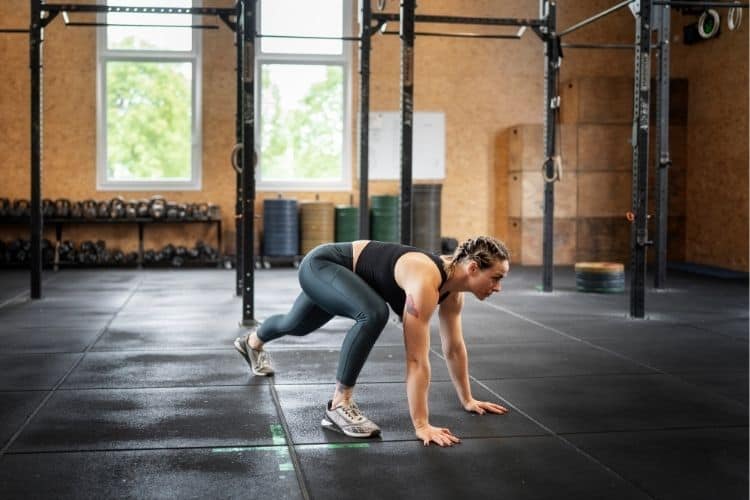
Begin standing with your feet approximately shoulder-width apart. Bend your knees and hips as you lower into a squat. Place both hands firmly on the floor in front of you.
Step or jump your feet backward until you reach a strong plank position. Your body should form a relatively straight line from your shoulders through your hips to your heels.
Jump or step your feet back toward your hands. Lift your chest, stand up, and either reach overhead or perform a controlled vertical jump.
Land softly with slightly bent knees before beginning the next repetition.
You do not have to perform every repetition as quickly as possible. A controlled pace that allows you to maintain good technique is generally more sustainable, particularly during longer workouts.
This 30 minute burpee workout uses six five-minute sections. Each section introduces a different burpee variation to keep the routine interesting while changing the muscular and cardiovascular demands.
For each five-minute section, perform the designated burpee variation for approximately 30 seconds, followed by 30 seconds of recovery or light movement. Repeat this sequence five times before moving to the next section.
Beginners can shorten the working interval to 15–20 seconds and use the remainder of the minute for recovery. More experienced exercisers can increase the working interval to 40–45 seconds while keeping enough recovery time to maintain good technique.
Begin with standard burpees to establish your rhythm.
Perform controlled repetitions for 30 seconds and recover for 30 seconds. Repeat for five rounds.
During the first five minutes, resist the temptation to sprint. The workout becomes significantly more demanding as it progresses. Starting at a sustainable pace can help you maintain better form during later sections.
Focus on smooth transitions. Lower into the squat, establish your plank, return your feet underneath your body, and stand or jump.
For the second section, perform step-back burpees.
Instead of jumping both feet backward simultaneously, step one foot back followed by the other. Establish your plank, then step each foot forward before standing.
This variation reduces impact while still training the same general movement pattern. It can also serve as an active recovery variation after the standard burpees.
Continue with 30 seconds of work followed by 30 seconds of recovery for five rounds.
Now increase the upper-body challenge by adding a push-up.
Perform the normal burpee transition into a plank. Once you reach the plank position, lower your chest toward the floor with a controlled push-up. Press back to the top position before bringing your feet forward and standing or jumping.
Because this variation is more demanding, you may need to slow your pace.
If full push-ups become difficult, perform the burpee without the push-up or use a modified elevated version with your hands on a stable bench or platform.
During this section, remove the vertical jump and concentrate on faster but controlled transitions between the squat and plank.
Lower down, place your hands on the floor, jump or step into the plank, return your feet forward, and stand tall.
Eliminating the jump can decrease impact while allowing you to concentrate on consistent movement.
Continue alternating 30 seconds of work with 30 seconds of recovery.
Lateral burpees introduce side-to-side movement.
Perform a regular burpee, then make a small controlled lateral movement before beginning the next repetition. Alternate directions as space allows.
You can also place a line on the floor and step or lightly jump across it between repetitions.
Keep lateral movements controlled, especially as fatigue begins to accumulate.
The final five minutes combine the variations you have already performed.
During each 30-second work period, choose one burpee variation. For example, perform standard burpees during the first round, step-back burpees during the second, push-up burpees during the third, squat-thrust burpees during the fourth, and your preferred variation during the final round.
The goal is not necessarily to complete the greatest possible number of repetitions. Concentrate on finishing the workout with consistent technique.
During the final minute, choose a pace you can maintain safely through the end of the interval.
If you are new to burpees, completing the full jumping variation repeatedly for 30 minutes may be too demanding. Fortunately, the movement can be modified considerably.
Start by removing the jump. Instead of jumping backward into the plank, step one leg backward at a time. Step forward again and stand without performing a vertical jump.
Another beginner-friendly option is an elevated burpee. Place your hands on a sturdy bench, step, platform, or other stable elevated surface rather than reaching all the way to the floor. Step your feet backward into an inclined plank, return forward, and stand.
Elevating the hands reduces the range of motion and can make the transition easier.
Beginners may also use shorter intervals. Try 15 seconds of burpees followed by 45 seconds of rest or gentle walking. As conditioning improves, gradually increase the work period.
Experienced exercisers who are comfortable with standard burpees can introduce more difficult variations.
Adding a push-up increases upper-body involvement and makes every repetition more demanding. Maintain a stable core throughout the push-up instead of allowing your hips to drop.
A tuck jump can replace the standard vertical jump for a more explosive variation. This dramatically increases intensity and should generally be reserved for exercisers with appropriate jumping experience.
Instead of jumping vertically, jump forward after returning to the standing position. Turn around and repeat in the opposite direction.
This variation requires additional space and emphasizes lower-body power.
After entering the plank position, perform several mountain climbers before returning your feet forward and standing.
This adds extra core and cardiovascular work while increasing the time spent in the plank position.
There is no universal number of burpees that everyone should complete during a 30-minute workout.
Your total depends on your fitness level, chosen variations, work-to-rest ratio, bodyweight, movement speed, and how strictly each repetition is performed.
Instead of focusing entirely on the number of repetitions, consider tracking the number of technically sound burpees completed during each work interval.
For example, if you consistently perform six burpees during a 30-second interval, you can use that as a baseline. Over time, you might complete seven repetitions with equally good technique or maintain six repetitions while feeling more controlled.
Progress does not always mean moving faster. Improved recovery, better movement quality, and the ability to maintain a consistent pace can also indicate improving fitness.
Burpees can be included in a fitness program designed to support fat loss because they involve large muscle groups and can create a vigorous cardiovascular demand. However, no single exercise guarantees fat loss.
Long-term changes in body composition depend on factors including overall calorie intake, activity levels, resistance training, sleep, recovery, and consistency.
A 30 minute burpee workout for fat loss can be one component of a broader exercise routine. Combining conditioning workouts with progressive resistance training and regular daily activity creates a more balanced approach than relying exclusively on burpees.
Burpees are particularly useful when you want a high-effort bodyweight exercise that does not require specialized equipment.
The appropriate frequency depends on the intensity of your workouts and the rest of your training schedule.
Because burpees involve repeated jumping, squatting, planking, and floor-to-standing transitions, performing intense burpee workouts every day may not provide adequate recovery for everyone.
Many people may prefer using a challenging burpee workout one or two times per week while including strength training, walking, mobility work, and other forms of cardio on different days.
If your legs, shoulders, wrists, or other joints remain unusually fatigued, additional recovery may be appropriate.
One common mistake is beginning too quickly. Burpees can elevate your heart rate rapidly, and sprinting through the opening minutes can make the remainder of a 30-minute workout extremely difficult.
Another mistake is allowing the hips to sag during the plank. Brace your core and maintain a stable trunk before transitioning back toward the squat.
Landing with stiff legs is another issue. When performing jumping variations, land softly and allow your knees and hips to absorb the landing.
Finally, avoid sacrificing technique simply to increase your repetition count. Once your movement quality begins deteriorating significantly, slow down, switch to a lower-impact variation, or take additional recovery.
Improving burpee performance requires more than simply doing hundreds of repetitions.
Strengthening your legs with squats, lunges, and other lower-body exercises can improve the standing and jumping portions. Push-ups, planks, and upper-body resistance exercises can help improve control during the floor portion.
Cardiovascular training can also help because much of the difficulty associated with high-repetition burpees comes from maintaining repeated efforts while breathing heavily.
Practice the individual components of the burpee if necessary. You can work separately on squats, planks, squat thrusts, push-ups, and controlled jumps before combining them into faster repetitions.
A brief warm-up can help prepare your muscles and joints for repeated full-body movement.
Spend approximately five minutes performing movements such as marching in place, bodyweight squats, alternating reverse lunges, arm circles, gentle jumping jacks, and plank walkouts.
Gradually increase your movement speed rather than immediately beginning with maximum-effort burpees.
Perform a few slow practice burpees near the end of your warm-up to prepare for the transitions you will use during the workout.
After completing the workout, avoid immediately sitting or lying down if you are breathing heavily. Walk slowly for several minutes and allow your breathing and heart rate to gradually settle.
You can then perform gentle stretches targeting the quadriceps, hamstrings, hip flexors, calves, chest, shoulders, and upper back.
The cool-down does not need to be complicated. The main objective is to transition from intense exercise back toward your normal resting state.
A 30 minute burpee workout can deliver an efficient combination of cardio, muscular endurance, core stability, and full-body conditioning without requiring gym equipment. By using intervals and rotating through different burpee variations, you can create a workout that is challenging without attempting to perform nonstop repetitions for the entire 30 minutes.
The six-part workout outlined above begins with standard burpees before progressing through step-back burpees, push-up burpees, squat-thrust variations, lateral burpees, and a final mixed burpee finisher. Beginners can remove jumps, use elevated burpees, or shorten work intervals, while experienced exercisers can increase difficulty with push-ups, mountain climbers, broad jumps, or other advanced variations.
Most importantly, focus on consistency and movement quality. Burpees are demanding enough without turning every workout into a race. Use controlled repetitions, choose variations appropriate for your fitness level, and allow adequate recovery between challenging training sessions.
When combined with strength training, regular cardio, daily movement, balanced nutrition, and sufficient recovery, a 30-minute burpee routine can become a versatile addition to a well-rounded fitness program.
Want to build on this 30-minute burpee workout? Try our 30-Minute Full Body HIIT Circuit Workout for another fast-paced combination of cardio and strength, or scale things back with the 30-Minute HIIT Workout for Beginners when you need a more approachable no-equipment session. You can also add variety with our 30-Minute Bodyweight Beginner Workout, follow the 30 Day Bodyweight Workout Plan for Women for a longer-term training challenge, or increase the intensity with our 45-Minute Full Body HIIT Workout when you have extra time for a full-body sweat session.
Stay up to date on the latest women’s health, fitness and lifestyle trends and tips.
