


Sign up for workout ideas, training advice, reviews of the latest gear and more.



A strong core does much more than create defined abs. It supports your spine, helps you maintain good posture, improves balance, and allows your upper and lower body to work together efficiently. Whether you lift weights, run, play sports, or simply want everyday movements to feel easier, focused core training can make a noticeable difference. This 30-minute core superset workout trains your midsection from multiple angles without requiring a long gym session.
The workout pairs two exercises back to back in each superset. This structure keeps the session moving, challenges the abdominal muscles efficiently, and combines stability exercises with controlled movement. You will train the rectus abdominis, transverse abdominis, obliques, lower back, hips, and glutes. Together, these muscles form a supportive system around the trunk rather than functioning as isolated body parts.
You can perform this workout at home or in the gym. Most exercises require only a mat, although one moderate dumbbell is useful for adding resistance. Beginners can complete every movement with body weight, while experienced exercisers can use the suggested progressions. Work at a controlled pace, prioritize good form, and stop if you feel sharp pain rather than normal muscular fatigue.
A superset combines two exercises performed consecutively with little or no rest between them. After completing both movements, you take a planned recovery period before repeating the pair. Traditional supersets often target opposing muscle groups, but this workout uses complementary core exercises. One movement may involve spinal control or trunk flexion, while the next emphasizes resisting rotation, extension, or side bending.
This format is especially useful when you have limited time. Instead of resting after every set, you move directly into a second exercise that challenges the core in a different way. The session feels energetic, but it should never become so rushed that technique breaks down. Core exercises reward control more than speed. A slower repetition performed with steady breathing and proper alignment is usually more productive than several fast, careless repetitions.
Your core has several important jobs. It creates movement, but it also prevents unwanted movement. When you carry groceries, lift a weight, climb stairs, or reach overhead, the muscles around your trunk stabilize the spine and transfer force between your hips and shoulders. This workout includes anti-extension, anti-rotation, and lateral-stability exercises to develop strength that carries over to daily life and full-body training.
Crunches can train the front abdominal wall, but a complete core workout should do more. Side planks challenge the obliques, bird dogs develop cross-body coordination, glute bridges support pelvic control, and dead bugs teach you to keep the trunk stable while the limbs move. Training these patterns creates a more balanced program and avoids relying on endless repetitions of one exercise.
The superset structure allows you to fit a warm-up, four exercise pairings, and a short cooldown into about 30 minutes. There is enough volume to challenge your muscles without turning core training into an unnecessarily long session. It can stand alone on a light training day or be scheduled separately from demanding strength workouts.
Core training cannot correct every postural issue, but improved trunk strength and body awareness may help you maintain a more comfortable position during work, exercise, and everyday activity. Exercises such as the dead bug and bird dog teach you to recognize the difference between moving through the hips and shoulders and compensating through the lower back.
You need an exercise mat or another comfortable surface. Keep one light-to-moderate dumbbell nearby if you plan to perform the weighted options. Choose a load that allows you to move smoothly without holding your breath or losing control of your spine. A timer is also helpful for keeping the session on schedule.
The workout contains a four-minute warm-up, four five-minute supersets, short transitions, and a cooldown. Perform each exercise for 40 seconds, transition for 10 seconds, and complete the second exercise for 40 seconds. Rest for 30 seconds, then repeat the same pairing. After the second round, use the remaining time to reset before beginning the next superset. If you are a beginner, use 30 seconds of work and extend the rest period as needed.
Begin with one minute of relaxed marching while swinging your arms. Stand tall, keep your ribs stacked over your pelvis, and gradually increase the height of each knee lift. Follow with 30 seconds of standing side bends in each direction. Move gently rather than forcing a deep stretch.
Next, move to your hands and knees for one minute of cat-cow. Alternate between gently rounding and extending your spine while coordinating the motion with your breath. Finish with one minute of alternating bird-dog reaches at an easy pace. Extend one arm and the opposite leg, pause briefly, return to the starting position, and change sides. This final drill prepares your core to stabilize before the harder working sets begin.
The first pairing teaches you to resist excessive arching through the lower back. Begin with the dead bug. Lie on your back with your hips and knees bent to approximately 90 degrees and your arms reaching toward the ceiling. Gently tighten your abdominal muscles and maintain light contact between your lower back and the mat. Slowly lower your right arm and left leg toward the floor. Return to the starting position and repeat on the opposite side.
Only lower your limbs as far as you can while maintaining control. If your back begins to arch, shorten the range of motion. Beginners can move one limb at a time or keep their knees more deeply bent. For an advanced option, hold a light dumbbell above your chest or extend both limbs farther from the body.
Move into a forearm plank for the second exercise. Position your elbows beneath your shoulders and extend your legs behind you. Create a straight, strong line from your head through your heels. Squeeze your glutes, brace your abdomen, and press the floor away with your forearms. Avoid allowing your hips to sag or lifting them excessively.
If a full plank is too demanding, place your knees on the floor while keeping a straight line from your head to your knees. To increase the challenge, alternate slowly lifting one foot without rotating your pelvis. Complete two rounds of the pairing.
Start the second superset with reverse crunches. Lie on your back, place your arms alongside your body, and bring your knees above your hips. Use your abdominal muscles to gently curl your pelvis away from the floor. Think about drawing your knees toward your ribs rather than swinging your legs toward your face. Lower slowly until your pelvis returns to the mat.
The movement should be small and deliberate. Momentum reduces the challenge to the abs and may make the exercise uncomfortable. To make it easier, bend your knees more and pause between repetitions. To make it harder, straighten your legs slightly as you lower them, provided you can keep the motion controlled.
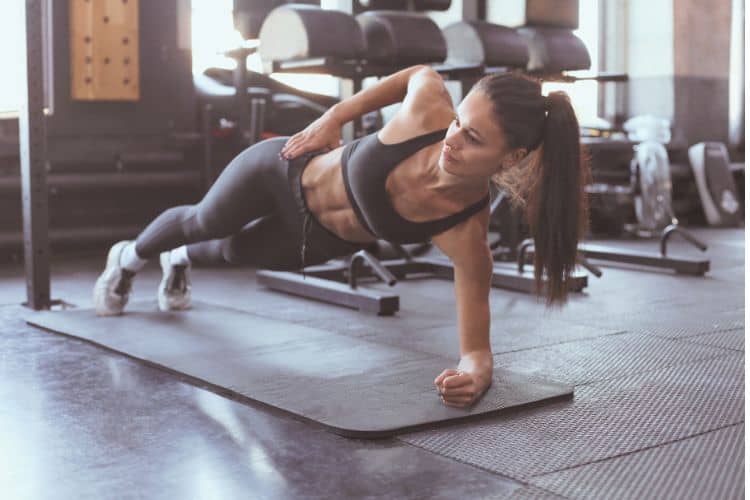
Next, perform a side plank. Place your elbow directly beneath your shoulder and stack your legs, then lift your hips until your body forms a straight line. During the first round, hold the plank on your right side. During the second round, use your left side. Keep your chest open and avoid rolling forward.
For a beginner variation, bend your bottom knee and keep it on the mat. You can also stagger your feet for a wider base. For more intensity, reach your top arm overhead, raise the top leg, or hold a light dumbbell at your hip. The goal is to feel the side of your waist working while the shoulder remains stable and comfortable.
The bird dog row combines core stability with an upper-body pulling action. Begin on your hands and knees with a dumbbell on the floor beneath one hand. Hold the weight in your right hand and extend your left leg behind you. Keep your hips square to the floor as you pull the dumbbell toward your ribs. Lower it slowly and continue for the interval. Switch the working arm and extended leg during the second round.
If the weighted variation disrupts your balance, perform a standard bird dog instead. Reach one arm forward and the opposite leg backward, pause, and return with control. Experienced exercisers can use a slightly heavier dumbbell, but the weight should never force the torso to twist. Imagine balancing a glass of water across the back of your pelvis.
Follow with slow mountain climbers. Begin in a high plank with your hands beneath your shoulders. Draw one knee toward your chest without rounding excessively through your upper back or bouncing your hips. Return the foot to the floor and switch sides. Move slowly enough to keep your shoulders, ribs, and hips controlled.
This is not a sprint. The purpose is to challenge the core while your legs move, not simply to raise your heart rate. Place your hands on a sturdy bench or elevated surface if maintaining a floor plank is difficult. For a harder variation, bring each knee toward the opposite elbow to increase the rotational demand.
Begin the final pairing with a glute bridge march. Lie on your back with your knees bent and feet flat. Press through your feet to lift your hips, then brace your core. Without allowing your pelvis to drop or rotate, lift one foot a few inches from the floor. Set it down gently and switch sides.
Keep the movement small. Your hamstrings, glutes, and deep abdominal muscles should cooperate to hold the pelvis steady. If marching is too challenging, maintain a regular glute bridge hold or perform controlled bridge repetitions. To progress, extend one leg farther from the body before returning it to the floor.
For seated dumbbell rotations, sit with your knees bent and heels resting on the floor. Hold one dumbbell close to your chest. Lean back slightly while keeping your spine long and rotate your rib cage toward one side. Return through the center and rotate to the other side. Move from the torso rather than swinging the weight with your arms.
You can perform this exercise without a dumbbell or sit more upright to reduce the intensity. For a greater challenge, lift your feet only if you can avoid rounding your lower back. Many people benefit more from keeping their heels grounded and using a slow, controlled range than from choosing the most difficult-looking variation. Complete two rounds and then prepare to cool down.
Begin in a child’s pose for approximately 45 seconds. Sit your hips toward your heels, reach your arms forward, and breathe into the sides and back of your rib cage. Move into a gentle prone press-up or sphinx position for 30 seconds, keeping the stretch comfortable through the front of the body.
Lie on your back and bring your knees toward your chest. Allow both knees to fall gently to one side for 30 seconds, then change sides. Finish with several slow breaths on your back. Inhale through your nose, allowing your ribs to expand, and exhale fully without forcing your lower back into the floor.
Core engagement does not mean pulling your stomach in as hard as possible or holding your breath for every repetition. Think about gently tightening the muscles around your midsection as though preparing for a light bump. Exhale through the hardest portion of a dynamic exercise, then inhale during the easier phase. During planks and holds, continue taking controlled breaths.
Fast repetitions can hide compensation. Slow down if your hips twist during bird dogs, your back arches during dead bugs, or your shoulders collapse during planks. A smaller range of motion with good alignment is more effective than forcing a difficult version you cannot yet control.
Repeat this workout two or three times per week with at least one recovery day between demanding core sessions. To create progressive overload, add five seconds to each work interval, reduce rest slightly, increase the dumbbell weight, or choose a harder exercise variation. Change only one variable at a time so you can tell whether your technique remains solid.
You can also track the quality of your performance. Record how long you maintain a plank with proper alignment, how far you can extend your limbs during dead bugs, or whether your hips remain level during bridge marches. Better control is genuine progress, even when the weight and repetition count remain the same.
A stronger midsection develops through consistent training, but visible abdominal definition also depends on factors such as body composition, genetics, sleep, nutrition, and stress. No core exercise can selectively remove fat from the stomach. Combine this routine with total-body strength training, regular cardiovascular activity, balanced nutrition, and sufficient recovery for well-rounded results.
One common mistake is treating every exercise as a race. Supersets shorten the time between movements, but they do not require frantic repetitions. Another is choosing resistance that causes the lower back to arch or the torso to twist. Reduce the load or range immediately when you lose the intended position.
Avoid pulling on your neck during floor exercises, shrugging your shoulders toward your ears during planks, or allowing your breath to become strained. Fatigue is expected near the end of an interval, but pain is not. Stop and seek guidance from a qualified healthcare or fitness professional if an exercise causes sharp, persistent, or radiating discomfort. Anyone who is pregnant, recently postpartum, recovering from surgery, or managing a back or pelvic-floor condition should obtain personalized clearance and modifications before beginning.
Yes. Thirty focused minutes can provide a complete core session when the workout includes several movement patterns and an appropriate level of difficulty. More time is not automatically better. Consistency, technique, and gradual progression matter more than adding unnecessary exercises.
Beginners can use the modified versions, perform 30-second intervals, and rest for 30 to 45 seconds after each exercise if needed. It is also reasonable to complete one round of each superset during the first week. Add the second round once you can maintain good form throughout the shorter session.
Daily intense core training is usually unnecessary. The core muscles need recovery like other trained muscles. Two or three sessions per week is a practical starting point, especially if your other workouts already include squats, hinges, carries, presses, and rows that require trunk stability.
It will strengthen and condition your core, but it cannot target fat loss from one area. Overall fat loss occurs through a sustainable energy deficit supported by nutrition, activity, sleep, and consistent habits. Use this workout to build strength and movement quality rather than treating it as a spot-reduction solution.
This 30-minute core superset workout delivers a balanced mix of abdominal strength, spinal stability, hip control, and cross-body coordination. By pairing dead bugs with planks, reverse crunches with side planks, bird dog rows with mountain climbers, and bridge marches with seated rotations, you challenge the core in several important ways without relying on repetitive crunches.
Perform the routine consistently, use modifications when needed, and progress gradually. The best version of any core exercise is the one you can perform with steady breathing and reliable control. Over time, those small improvements can support stronger lifts, better balance, more confident movement, and a core that works effectively both in workouts and in everyday life.
Continue building a stronger, more stable midsection with this 30 Minute Anti Rotation Abs Workout, or train at home without equipment using the 30 Minute Bodyweight Core Workout. You can also improve everyday movement with our 30 Minute Functional Core Workout and challenge your entire midsection with these 30 Minute Full Core Workouts. If you enjoy pairing exercises together, try this 30 Minute Superset Workout for an efficient full-body strength session.
Stay up to date on the latest women’s health, fitness and lifestyle trends and tips.
