


Sign up for workout ideas, training advice, reviews of the latest gear and more.

A 30-minute full-body dumbbell tempo workout can make moderate weights feel significantly more challenging without requiring long training sessions or complicated equipment. By intentionally slowing down portions of each exercise, you increase the amount of time your muscles remain under tension. This controlled training method can help improve strength, muscle tone, stability, coordination, and exercise technique.
Tempo training is especially useful when you exercise at home and have a limited selection of dumbbells. Instead of immediately buying heavier weights, you can increase the difficulty of familiar exercises by controlling how quickly you lower, pause, and lift each repetition. A slow squat, for example, demands more muscular control than a squat performed quickly with the same weight.
This full-body workout targets the legs, glutes, back, chest, shoulders, arms, and core in approximately 30 minutes. It includes compound dumbbell exercises that train several muscle groups at once, making it an efficient routine for busy days. Whether you are a beginner learning proper movement patterns or an experienced exerciser looking for a new strength challenge, tempo training can bring purpose and intensity to every repetition.
A dumbbell tempo workout uses a specific lifting speed for each phase of an exercise. Rather than moving the weights as quickly as possible, you follow a count that controls the lowering phase, the pause, the lifting phase, and sometimes the pause at the top.
Tempo is commonly written as four numbers. A tempo of 3-1-1-0, for example, means you lower the weight for three seconds, pause for one second, lift it in one second, and immediately begin the next repetition without pausing at the top.
For a dumbbell squat, this would mean taking three seconds to lower your hips, holding the bottom position for one second, standing up in one second, and then beginning the next squat. For a chest press, you would lower the dumbbells toward your chest for three seconds, pause briefly, press them upward in one second, and continue.
The first number usually describes the eccentric or lowering phase of the exercise. The second represents the pause at the bottom. The third describes the concentric or lifting phase, while the fourth represents the pause at the top. The exact direction may look different depending on the exercise, but the goal remains the same: perform every repetition with control.
Time under tension refers to how long a muscle works during a set. Slowing down your repetitions increases this time even if you perform fewer total repetitions. A set of eight controlled squats can challenge your muscles more effectively than a rushed set of fifteen.
The additional tension encourages your muscles to work throughout the entire range of motion. It also reduces the opportunity to rely on momentum, bouncing, or swinging the weights.
Moving slowly makes it easier to notice your position during each exercise. You have more time to check whether your knees are tracking correctly, your spine remains neutral, your shoulders stay controlled, and your core is engaged.
This makes tempo workouts valuable for beginners who are developing proper technique. Experienced lifters can also use tempo training to identify weak points that may be hidden during faster repetitions.
Not everyone has access to a complete rack of weights. Tempo training creates a greater challenge without requiring dramatically heavier dumbbells. Extending the lowering phase and adding pauses can make a familiar weight feel much heavier.
This is particularly helpful for home workouts, travel training, or situations in which joint comfort makes heavier lifting less appropriate.
Many exercises feel more difficult in a particular position. You may struggle near the bottom of a squat, when the dumbbells reach your chest during a press, or when your arms reach the top of a lateral raise.
Tempo exercises allow you to spend more time in these challenging positions. Pausing briefly prevents you from bouncing through the weakest part of the movement and teaches you to generate force with control.
Muscles need sufficient resistance, tension, and recovery to grow. A tempo workout provides a meaningful strength stimulus by making the muscles work harder during each repetition.
Although no workout can reduce fat from one specific area, full-body strength training can help build lean muscle while supporting overall body-composition goals. When combined with adequate protein, balanced nutrition, daily activity, and consistent sleep, tempo workouts can contribute to a stronger and more defined physique.
You need one or two pairs of dumbbells and enough floor space to move comfortably. An exercise mat is optional but useful for floor presses and core exercises.
Select weights that allow you to maintain the assigned tempo without losing your form. Your final few repetitions should feel challenging, but you should still be able to move smoothly and complete each count. Because the repetitions are slow, you may need lighter dumbbells than you would normally use.
Beginners may use one lighter pair for the entire workout. More experienced exercisers may want heavier dumbbells for squats, deadlifts, and rows and lighter dumbbells for shoulder exercises.
Keep water nearby and wear supportive athletic shoes. Make sure the floor is clear of objects that could interfere with your movement.
Choose a weight you can control for approximately eight to twelve repetitions. The correct weight should challenge your muscles without forcing you to shorten the range of motion, rush the lowering phase, or hold your breath.
If you cannot maintain the prescribed tempo, reduce the weight. If you finish every set comfortably and feel as though you could perform many additional repetitions, increase the dumbbell weight slightly during your next workout.
You can also progress without changing weights. Add one or two repetitions, extend a pause, slow the lowering phase, or complete an additional round. Change only one variable at a time so you can monitor how your body responds.
Use the first five minutes to raise your body temperature and prepare your muscles and joints. Perform each warm-up movement for approximately 45 seconds, allowing a short transition between exercises.
Begin with a march in place while swinging your arms naturally. Gradually raise your knees and increase the pace. Continue with bodyweight good mornings by placing your hands behind your head, softening your knees, and pushing your hips backward while keeping your back neutral.
Next, perform alternating reverse lunges or supported split squats. Move through a comfortable range and use a wall or chair for balance if necessary. Follow with arm circles, gradually making the circles larger while keeping your shoulders relaxed.
Finish with slow bodyweight squats and standing torso rotations. The warm-up should leave you feeling mobile and prepared, not exhausted.
After completing the warm-up, perform the following workout in three circuits. Complete each exercise for eight to twelve repetitions unless another range is listed. Rest for approximately 20 to 30 seconds between exercises and 45 to 60 seconds after each circuit.
Complete two rounds of each circuit. Each strength section should take approximately seven minutes, giving you about 21 minutes of lifting. Finish with a four-minute cool-down to complete the 30-minute session.
The primary tempo for this workout is 3-1-1-0: lower for three seconds, pause for one second, and lift for one second. Move carefully and never sacrifice technique simply to stay on schedule.
Hold one dumbbell vertically against your chest with both hands. Stand with your feet approximately shoulder-width apart and point your toes slightly outward. Brace your core and keep your chest lifted.
Lower into the squat for three seconds by bending your knees and pushing your hips down and back. Pause for one second at the bottom without relaxing. Drive through your feet and stand in one second, squeezing your glutes at the top.
Perform 8 to 12 repetitions. Keep your knees aligned with your toes and use a range of motion you can control. If holding the dumbbell at your chest feels uncomfortable, hold one dumbbell in each hand beside your body.
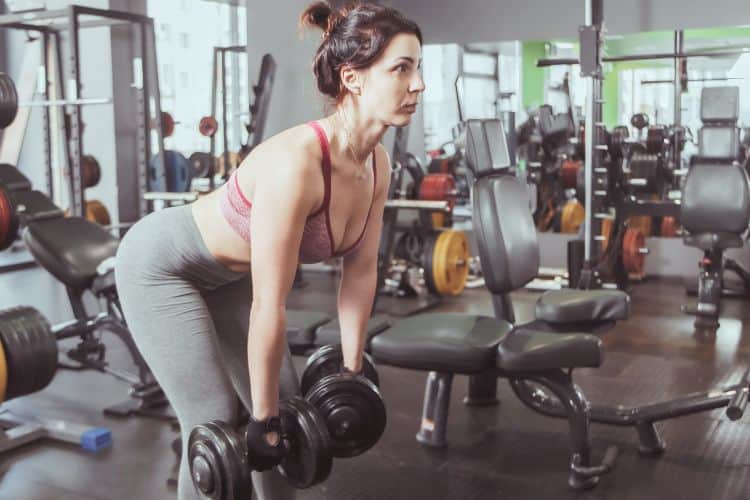
Hold a dumbbell in each hand with your palms facing one another. Soften your knees and hinge forward from the hips until your torso is inclined. Keep your back neutral and your abdominal muscles engaged.
Pull the dumbbells toward your ribs in one second. Pause and squeeze your shoulder blades together. Lower the weights for three seconds until your arms are extended without allowing your shoulders to roll forward.
Perform 8 to 12 repetitions. Avoid jerking your torso or using momentum to lift the dumbbells. If maintaining the hinged position is difficult, perform a supported one-arm row with one hand resting on a stable bench or chair.
Lie on your back with your knees bent at approximately 90 degrees and your feet lifted. Hold one dumbbell over your chest with both hands. Gently press your lower back toward the floor and tighten your core.
Lower the dumbbell behind your head for three seconds while extending one leg away from your body. Pause before the weight or your heel touches the floor. Bring the dumbbell and leg back to the starting position in one controlled second.
Alternate legs for 6 to 8 repetitions per side. Only lower as far as you can without arching your back. Beginners can keep both feet on the floor and perform only the pullover portion.
Complete two rounds before moving to the second circuit.
Stand with your feet hip-width apart and hold the dumbbells in front of your thighs. Keep your knees slightly bent, shoulders down, and spine neutral.
Push your hips backward and lower the dumbbells close to your legs for three seconds. Continue until you feel tension in your hamstrings without rounding your back. Pause for one second, press your feet into the floor, and drive your hips forward to stand.
Perform 8 to 12 repetitions. Think about closing a car door with your hips rather than squatting toward the floor. The dumbbells should remain close to your body throughout the movement.
Lie on your back with your knees bent and feet flat. Hold a dumbbell in each hand over your chest with your palms facing forward or slightly inward.
Lower the dumbbells for three seconds until your upper arms gently contact the floor. Pause for one second without releasing the muscular tension. Press the dumbbells upward in one second while keeping your wrists stacked above your elbows.
Perform 8 to 12 repetitions. The floor limits shoulder extension, making this a practical alternative to a bench press. Do not allow the dumbbells to crash together at the top.
Kneel with your right knee on a mat and your left foot planted in front. Hold a dumbbell at your right shoulder. Tighten your glutes and core so your lower back does not arch.
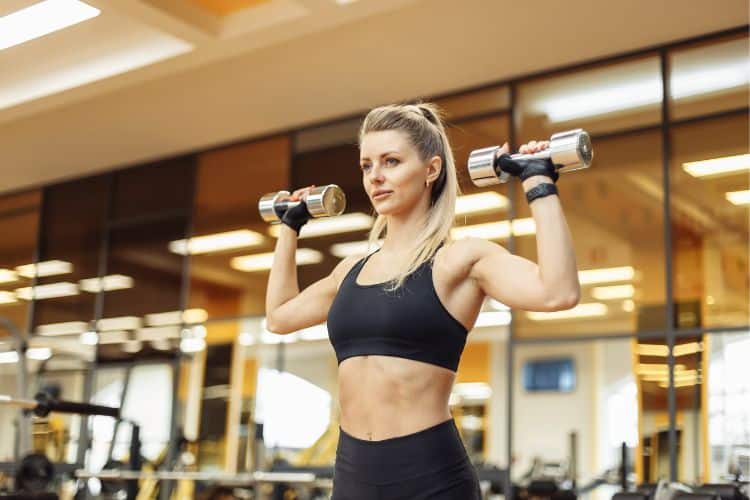
Press the dumbbell overhead in one second. Pause briefly at the top, then lower it toward your shoulder for three seconds. Complete 6 to 10 repetitions before switching sides.
The half-kneeling position reduces the ability to generate momentum and requires your core to stabilize your torso. You may also perform the exercise seated or standing if kneeling is uncomfortable.
Complete two rounds before moving to the final circuit.
Stand tall with one dumbbell in each hand. Step your right foot backward and lower your body for three seconds. Bend both knees while keeping your front foot planted and your torso upright.
Pause for one second near the bottom. Push through your front foot and return to standing in one second. Alternate sides for 6 to 8 repetitions per leg.
Shorten the range of motion if you experience discomfort. You can also perform a stationary split squat while lightly holding a wall or chair for balance.
Place two dumbbells on the floor approximately shoulder-width apart. Begin in a modified plank with your hands on the dumbbells and your knees on the mat. Keep your body in a straight line from your head to your knees.
Pull one dumbbell toward your ribs in one second. Pause at the top and lower it for three seconds. Alternate arms while limiting hip and shoulder rotation.
Complete 6 to 8 repetitions per side. For a greater challenge, perform the exercise from your toes. For an easier variation, place one hand on a bench and complete a supported row.
Lie on your back with your knees bent and feet planted. Hold one dumbbell horizontally over your chest or rest a dumbbell carefully across your hips.
Lift your hips in one second by squeezing your glutes. Hold the top position for two seconds while maintaining control. Lower your hips toward the floor for three seconds.
Perform 10 to 12 repetitions. Avoid pushing excessively through your lower back. Your ribs should remain controlled, and the movement should come primarily from your hips and glutes.
Complete two rounds of the circuit. If time remains, repeat your favorite exercise for one controlled final set.
Spend the final four minutes gradually lowering your heart rate and relaxing the muscles you trained. Begin with slow breathing while standing or lying on your back. Inhale through your nose and exhale slowly.
Move into a gentle hamstring stretch, followed by a hip-flexor stretch on each side. Stretch your chest by clasping your hands behind your back or placing one forearm against a wall and rotating away carefully.
Finish with a child’s pose, an upper-back stretch, or another comfortable position. Avoid forcing any stretch or bouncing at the end of your range of motion.
Beginners should focus on learning the movement patterns before increasing resistance. Start with light dumbbells and complete one round of each circuit if two rounds feel excessive. You can also perform six to eight repetitions instead of twelve.
Use a chair for support during squats and lunges. Elevate your upper body during rowing exercises if holding a bent-over position becomes uncomfortable. If necessary, practice individual movements without dumbbells until you feel confident.
You do not need to maintain a perfect three-second count during your first session. The important goal is to move more slowly than usual while maintaining control. As your technique improves, gradually make the tempo more precise.
If you can complete every repetition easily with excellent form, increase the dumbbell weight slightly or add two repetitions to each set. You can also use a four-second lowering phase instead of three seconds.
Another option is to increase the pause in the most difficult position. Hold the bottom of a squat, lunge, floor press, or Romanian deadlift for two seconds. These pauses eliminate momentum and make the muscles generate force from a stationary position.
Advanced exercisers may complete three rounds of each circuit, but this will extend the workout beyond 30 minutes. Alternatively, reduce transition time while still taking enough rest to protect your form.
One common mistake is counting quickly. A true three-second lowering phase should be deliberate: count “one thousand one, one thousand two, one thousand three.” Rushing the count reduces the intended training effect.
Another mistake is choosing weights that are too heavy. If you cannot control the dumbbells or maintain a neutral position, the weight is not appropriate for tempo training. Lowering the weight is a strategic adjustment, not a step backward.
Avoid holding your breath. Exhale during the most difficult lifting phase and inhale during the controlled lowering phase. Continue bracing your core without creating unnecessary tension in your neck or face.
Finally, do not relax completely during pauses. A tempo pause should maintain muscular tension. For example, remain active at the bottom of a squat instead of resting on your joints.
Most people can perform this 30-minute full-body dumbbell tempo workout two or three times per week on nonconsecutive days. Allow approximately 48 hours between demanding full-body strength sessions, particularly when you are new to tempo training.
On the days between workouts, consider walking, gentle cycling, mobility exercises, yoga, or complete rest. Recovery supports performance and gives your muscles time to adapt.
Your ideal schedule depends on your experience, sleep, nutrition, stress, and other physical activities. Persistent joint pain, declining performance, or unusual fatigue may indicate that you need more recovery.
A balanced weekly schedule might include this workout on Monday and Thursday. Use Tuesday for walking or mobility, Wednesday for light cardio, Friday for another easy activity, and the weekend for rest or recreational movement.
If you prefer three strength sessions, complete the workout on Monday, Wednesday, and Friday. Beginners can start with two weekly sessions for several weeks before deciding whether to add a third.
Consistency matters more than squeezing in as many workouts as possible. Two focused sessions performed regularly can be more productive than an overly demanding schedule that is difficult to maintain.
This 30-minute full-body dumbbell tempo workout proves that effective strength training does not require a long list of exercises or extremely heavy weights. Slowing down each repetition increases muscular tension, encourages better technique, and makes every set more purposeful.
The workout trains all major muscle groups using practical exercises that can be performed at home or in the gym. Start with manageable weights, maintain the assigned tempo, and adjust each movement to suit your current ability.
As you become stronger, progress gradually by increasing the weight, repetitions, pause length, or lowering time. Record the dumbbells and repetitions you use so you can track improvements from week to week. With consistent training and adequate recovery, this full-body tempo routine can help you build strength, improve movement control, and get more value from every 30-minute session.
Build more variety into your strength routine with this 30 Minute Full Body Dumbbell Workout Plan, which combines strength, power, and conditioning exercises. For a slightly longer session, try the 35 Minute Full Body Dumbbell Workout or increase your training volume with the One Hour Full Body Dumbbell Strength Workout. When you need a quicker option, this 15 Minute Full Body Dumbbell Workout targets every major muscle group efficiently. You can also use the Full Body Dumbbell Workout for Strength and Fat Loss to add new compound exercises to your weekly workout schedule.
Stay up to date on the latest women’s health, fitness and lifestyle trends and tips.
