


Sign up for workout ideas, training advice, reviews of the latest gear and more.

A kettlebell can turn half an hour into a practical full-body training session. You can squat, hinge, press, row, carry, and raise your heart rate with one compact weight. The key is choosing movements you can control when you become tired. This 30-minute full-body kettlebell HIIT workout pairs deliberate strength work with short intervals that keep the session moving. It is designed for women who want a clear routine at home or in the gym, although anyone comfortable with the movements can use it.
HIIT stands for high-intensity interval training: you alternate harder efforts with recovery. Hard does not mean frantic or maximal on every exercise. For a kettlebell workout, it means working briskly while keeping your breathing and technique under control, then using the recovery interval to prepare for another quality set. You will finish having trained your legs, glutes, back, shoulders, arms, and core without needing to cram in random exercises.
Set an interval timer before you begin. Allow four minutes for a warm-up, twenty minutes for the main workout, three minutes for a finisher, and three minutes for a cooldown. The main workout has two ten-minute circuits. Each circuit contains five one-minute stations performed twice. At each station, work for 40 seconds and then rest or transition for 20 seconds. The three-minute finisher contains three 45-second efforts followed by 15 seconds of recovery. These segments add up to exactly 30 minutes.
The first circuit emphasizes foundational strength: squatting, hinging, rowing, pressing, and a controlled march. The second changes the angle and stance while giving your heart rate another push. The finisher is simple enough to remember when you are breathing hard. If you are new to intervals, do 30 seconds of work and 30 seconds of rest at each one-minute station. You still complete the same 30-minute session.
Choose a kettlebell that lets you finish each interval with stable positions and roughly two or three good repetitions left in reserve. Because presses often need a lighter weight than squats or hinges, two kettlebells can help if available. With only one bell, choose a manageable press weight and make the lower-body work harder with a slower lowering phase, an extra pause, or more deliberate repetitions. Leave space around you, wear shoes that provide a stable base, and keep water nearby.
During the 40-second intervals, aim for a challenging but repeatable effort, around seven or eight out of ten on your personal effort scale. You should be breathing faster yet remain able to reset your position between repetitions. In the 20-second breaks, let your breath settle and prepare the next exercise. If your form starts to unravel, slow down, use a lighter bell, or extend recovery. The timer guides the session; it does not require you to squeeze in an unsafe last repetition.
Spend the first minute marching in place while swinging your arms naturally. Build from an easy rhythm to a brisk one, feeling your feet connect with the floor. For the second minute, practice bodyweight hip hinges: soften your knees, move your hips backward, keep your back in a comfortable neutral position, and stand by pressing through your feet. Add a few slow squats as the minute ends.
For minute three, alternate reverse lunges without weight, stepping back only as far as you can balance comfortably. If lunges bother your knees, use shallow sit-to-stands from a sturdy chair instead. For the last minute, circle your shoulders, make several controlled reaches overhead, then perform a few light deadlifts with the kettlebell. The goal is to rehearse positions and raise your temperature, not tire yourself out before the first circuit.
Run the following five stations for one minute each, then repeat the sequence once. Work for the first 40 seconds of each minute and use the final 20 seconds to rest and move to the next station. Two rounds take ten minutes. Expect your pace to vary from exercise to exercise; controlled reps matter more than hitting an arbitrary count.
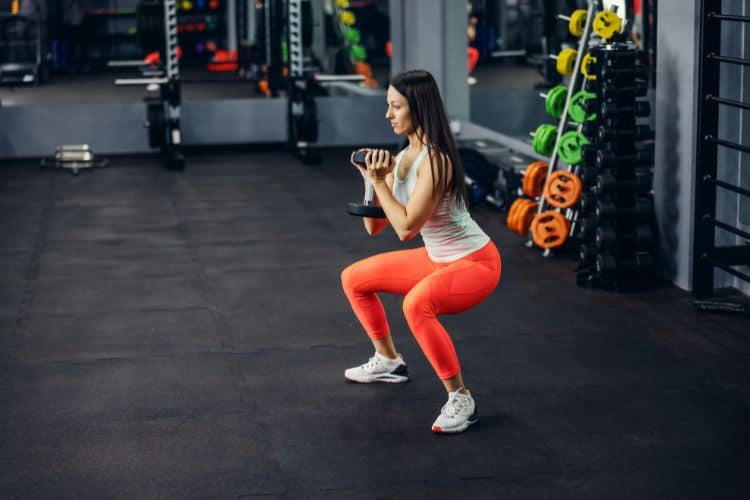
Hold the kettlebell by its horns close to your chest. Set your feet at a comfortable squat width, sit down between your hips, and stand tall. Keep your whole foot grounded and your elbows near your torso. Exhale as you rise without throwing your ribs forward. Choose the depth you can control. If the bell is light, take three seconds to lower and stand at a natural pace. This squat trains the thighs, glutes, and trunk while giving your breathing a purposeful start.
Place the bell between your feet or slightly in front of them. Move your hips backward, bend your knees enough to reach the handle, and grip firmly. Stand by driving your feet into the floor and extending your hips. Lower the bell along the same path, maintaining a long spine and letting your hips travel backward. Think of this as a hinge rather than a deep squat. Your hamstrings and glutes should do much of the work; you should not need to yank the weight off the floor.
Take a split stance, rest your free hand on a sturdy bench or chair, and let the kettlebell hang below your shoulder. Pull your elbow toward your hip, pause briefly, then lower with control. Switch arms at the 20-second mark within the work interval. Keep both shoulders level and avoid twisting your torso to lift the bell. Rows bring upper-back and arm work into a session that might otherwise be dominated by legs. If changing sides takes time, accept fewer repetitions on each side and start the next round with the opposite arm.
Lie on your back with your knees bent, hold the kettlebell beside your chest, and keep your wrist straight. Press toward the ceiling, then lower until your upper arm lightly touches the floor. Switch hands after about 20 seconds, setting the bell down safely before changing sides. Keep your elbow angled comfortably away from your torso rather than flared straight out. The floor limits the bottom range and gives you a stable base for pressing. If moving to the floor is impractical, substitute an elevated push-up against a sturdy counter for the full work interval.
Hold the bell in one hand at your side and march in place without leaning toward or away from it. Take small, steady steps, lifting one foot at a time while keeping your ribs over your pelvis. Switch hands halfway through the 40 seconds. Your grip and trunk work to resist side bending as your hips stabilize each step. If marching challenges your balance, keep both feet down and perform a suitcase hold instead. End the minute with 20 seconds to reset before repeating the circuit.
Now repeat another five-station sequence twice with the same 40-second work and 20-second rest pattern. Circuit two uses faster lower-body transitions, a unilateral leg exercise, an overhead option, and a plank variation. Keep the movements smooth. The first lap is a chance to learn the rhythm; the second is a chance to match your earlier quality.
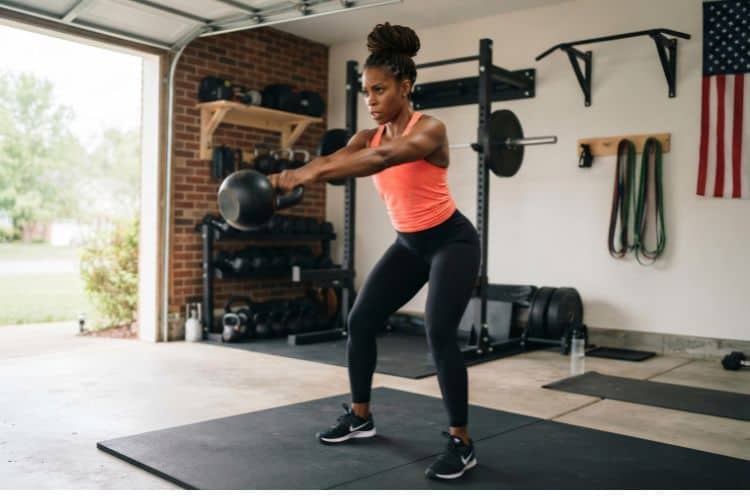
If you already know how to swing safely, start with the kettlebell a short distance in front of you, hinge, hike it back between your legs, and drive through your hips. Let the bell float to about chest height through hip power rather than lifting with your arms. Maintain your back position and let the bell return naturally into the next hinge. Stop when your hinge becomes a squat or you begin pulling with your shoulders. If swings are new to you, perform brisk kettlebell deadlifts instead; they train the same basic hinge pattern without the ballistic timing.
Bring the bell to your chest, step one foot back, bend both knees within a comfortable range, and press through the front foot to return. Alternate legs for the work interval. Stay tall without forcing a perfectly vertical torso, and make your step long enough that you can keep your balance. A shallow lunge is useful when done well. For an easier version, hold the bell at your side or complete bodyweight reverse lunges. If lunges are uncomfortable, replace them with goblet squats or sit-to-stands.
Kneel on one knee with the opposite foot planted in front, or stand if kneeling is uncomfortable. Hold the bell at shoulder height with a straight wrist and your forearm roughly vertical. Brace your middle, press upward without arching your lower back, then lower slowly. Switch sides halfway through the interval, taking the time needed to transfer the bell securely. The half-kneeling stance helps you notice when your torso wants to lean. A lighter kettlebell is often appropriate here; if overhead pressing is uncomfortable, repeat the floor press from circuit one.
Place the bell on the floor and march briskly in place, driving your arms and stepping with intent. For a harder low-impact option, hold the kettlebell at your chest and march while staying upright. Use a weight you can support without rounding forward. This station raises your breathing without asking you to perform a complicated lift at speed. You can step side to side instead if that feels better. Avoid turning it into a race: a steady, repeatable rhythm makes the following core exercise more manageable.
Set the bell just outside one hand and take a wide-foot plank position with both hands on the floor. Reach across with the opposite hand, drag the bell to the other side, and place your hand back down. Alternate directions, keeping your hips as still as practical. Use a light bell that slides predictably on your surface, or place it on a small towel if the floor allows. If the drag feels awkward or your floor could be damaged, hold a forearm plank or do a dead bug without weight. The aim is to resist rotation, not to move a heavy kettlebell quickly.
Set the timer to 45 seconds of work followed by 15 seconds of rest for three rounds. During the first work period, do controlled goblet squats. During the second, perform kettlebell deadlifts or practiced swings. During the third, march briskly with the bell in a goblet hold, or set it down and march without weight. Each 15-second break lets you lower the bell safely and set up the next movement. There is no bonus exercise to squeeze into the final few seconds. Finish the three minutes feeling challenged and still able to stand and breathe comfortably.
Spend the first minute walking slowly around the room or marching gently as your breathing eases. For the second minute, stand near a wall, step one leg behind you, and take a mild calf and hip stretch before switching sides. For the final minute, move into a comfortable standing or seated position, take several unhurried breaths, and loosen your shoulders. Stretching should feel easy, not forced. The cooldown completes the thirty minutes and gives you a chance to notice whether the chosen bell and interval pace were appropriate.
A suitable kettlebell is one you can hold securely, lift with the intended range of motion, and control through the last repetition of an interval. There is no universal starting weight for all women. Training experience, exercise selection, current strength, and previous injuries matter more than a number printed on a bell. Your lower body may handle a substantially heavier bell than your shoulders. If you have access to two weights, use the heavier one for goblet squats and hinges when your technique supports it, and the lighter one for presses, rows, and drags.
For a first attempt, err toward a bell that feels manageable. Use the initial round to check whether you can keep breathing, brace gently, and stop each set intentionally. If 40 seconds leaves you scrambling, reduce the load, take 30 seconds of work, or slow your repetitions. If the whole session feels easy and technique stays consistent, you can add repetitions within the work window or move up in weight on one or two exercises next time. Increase one demand at a time so you can tell what changed.
One bell is enough for the complete workout. Make a light bell more demanding by lowering slowly on squats and presses, pausing briefly at the bottom of a deadlift, or focusing on balance during the suitcase march. With a heavy bell, keep the hinge and squat stations but switch challenging upper-body moves to bodyweight options. Elevated push-ups can replace the floor press, and an unloaded plank can replace the drag. The pattern of movements matters more than using the kettlebell for every second of the session.
A beginner can follow the same clock without turning every interval into a sprint. Work for 30 seconds, rest for 30 seconds, and choose the deadlift in place of swings. Use bodyweight reverse lunges or chair sit-to-stands and keep your march unweighted. Practice each movement for a few controlled repetitions before starting the timer. If transitions between floor work and standing take longer, make the rest period part of the transition and shorten the next work interval as needed. The full session still has a clear beginning and end.
If this is your first kettlebell workout, you may find it more useful to learn the goblet squat, deadlift, supported row, and floor press individually before attempting a complete interval session. During the workout, stop an exercise if you feel sharp pain, dizziness, or an unusual symptom. People managing a health condition, pregnancy or postpartum changes, or an injury can get individualized guidance on which movements and intensity fit their situation. A practical workout should adapt to the person doing it.
Repeat this 30-minute session once or twice per week, leaving time to recover between demanding sessions. During week one, learn the sequence with a moderate load and 30 seconds of work at each main station. In week two, try the written 40-second work and 20-second recovery interval while keeping the same weight. In week three, improve the quality of a specific movement: add a controlled squat repetition, steady your torso during rows, or make your suitcase march less wobbly.
In week four, consider a slightly heavier bell for the squat or deadlift if all your repetitions remain solid. You do not have to increase weight in every exercise. You could instead complete the same workout with smoother transitions or a more consistent pace. Write down the bell used, whether you chose swings or deadlifts, and how the second circuit felt. Those notes give you a clearer measure of progress than sweat alone. On other days, add easier walks or separate strength sessions based on your schedule and recovery.
It can be a useful full-body session because the program includes a squat, hinge, row, press, lunge, carry-style march, and core work. Whether it is enough for your overall training goals depends on how often you exercise, the load you use, and what else your week includes. If building maximal strength or substantial muscle is a primary goal, longer strength sessions with planned sets and progressive loads may complement the intervals. This workout gives you a time-efficient way to practice major movement patterns and build conditioning.
Yes. Every station in the written routine can be performed without jumping. The marches raise your heart rate with low-impact footwork, while the squats, hinges, lunges, presses, and rows provide resistance. Choose a shallow lunge or sit-to-stand if you prefer an even gentler lower-body option. You can still make the workout challenging by using a suitable kettlebell and controlled intervals.
No. Swings are an option for people who already know the hinge pattern and can perform them well. Fast but controlled deadlifts work in both the main circuit and finisher. Learning a swing is easier outside a demanding interval, when you can focus on setup, timing, and a consistent hip hinge. You do not miss the structure of this 30-minute workout by choosing the deadlift.
This full-body kettlebell HIIT workout gives each minute a purpose. Four minutes prepare your joints and movement patterns, twenty minutes build strength and conditioning across two circuits, three minutes provide a focused finish, and three minutes let you recover. Keep the weight appropriate, use the recovery periods, and record how the workout felt. The most effective version is the one you can perform with good technique today and repeat with measurable improvement over the coming weeks.
If you are building up to this session, start with the Kettlebell Strength Training Guide For Women to get familiar with the main movement patterns, then try the 15 Minute Kettlebell HIIT Workout when you want shorter intervals. For another compact full-body option, follow the 20 Minute Full Body Kettlebell HIIT Workout. When you have more time, the 45 Minute Kettlebell HIIT Workout offers a longer session, while the 6 Week Kettlebell Workout Program helps you plan training beyond a single workout.
Stay up to date on the latest women’s health, fitness and lifestyle trends and tips.
