


Sign up for workout ideas, training advice, reviews of the latest gear and more.

A 35-minute full body dumbbell HIIT workout can fit strength training and a brisk cardiovascular challenge into one manageable session. You do not need a complicated set of exercises or a room full of equipment. With a pair of dumbbells, a timer, and enough space to step in every direction, you can work your legs, glutes, back, chest, shoulders, arms, and core. The key is to alternate purposeful effort with short recovery periods while keeping each repetition controlled.
This workout combines resistance exercises with low-impact bursts of movement. HIIT stands for high-intensity interval training, but “high intensity” is relative to your fitness level. Your harder intervals should feel challenging while still allowing you to move well. The aim is to finish feeling that you worked hard, not that you rushed through sloppy repetitions. You can perform the whole workout at home, and you can adjust the load, range of motion, and pace as you go.
The session has a five-minute warm-up, a 24-minute main workout, a three-minute finisher, and a three-minute cooldown. The main workout contains three eight-minute blocks. Each block uses four exercises, performed for 40 seconds of work followed by 20 seconds of transition or rest. Complete all four exercises twice to finish one block. Continue directly to the next block, using its first 20-second transition if you need to change weights. The finisher uses three one-minute intervals, so the total is exactly 35 minutes.
Choose dumbbells you can lift with control for the full work interval. It is fine to use a lighter pair for overhead presses and a heavier pair for hinges or squats. If you have only one pair, shorten a set when form starts to slip and spend the remaining seconds recovering. If changing weights takes longer than the timer allows, pause the timer; the 35-minute plan assumes your equipment is ready beside you.
The workout is demanding enough to raise your breathing rate, but you do not need to jump. If you are new to interval training, consider trying the moves without weights first. If you have an injury, are returning after a long break, or have been advised to limit intense exercise, get individualized guidance before attempting the session.
Have two dumbbells, a timer, water, and a clear floor space. A mat is optional for the floor press and cooldown. Keep a stable chair or bench nearby if you want a squat target or support for balance. You can use a single dumbbell for some moves if that feels more comfortable. Wear shoes that let you stand securely, and place weights where you will not trip over them during the transitions.
Spend the first minute marching in place and swinging your arms naturally. Increase your pace gradually, allowing your shoulders to relax as you breathe. During the second minute, alternate a step out to each side with an easy reach across your body. Keep your feet light and let your upper back rotate gently rather than forcing a large twist through your lower back.
For the third minute, perform slow bodyweight squats. Sit back and down only as far as you can while keeping your feet grounded. Stand tall and squeeze your glutes without leaning backward. During minute four, practice an unweighted hip hinge: soften your knees, send your hips backward, and return to standing. You should feel a gentle stretch along the backs of your legs, not strain in your lower back.
Use the fifth minute for alternating reverse steps and shoulder preparation. Step one foot back, bend both knees slightly, return to standing, and switch sides. Between steps, circle your arms or perform slow overhead reaches. By the end of the warm-up, you should feel ready to move faster while still being able to speak in full sentences.
Set your timer for eight rounds of 40 seconds of work and 20 seconds of rest. Complete the following four exercises in order, then repeat the sequence once. Begin with a measured pace; you have two more blocks ahead. Breathe out during the demanding part of a lift and use each 20-second transition to reset your posture.
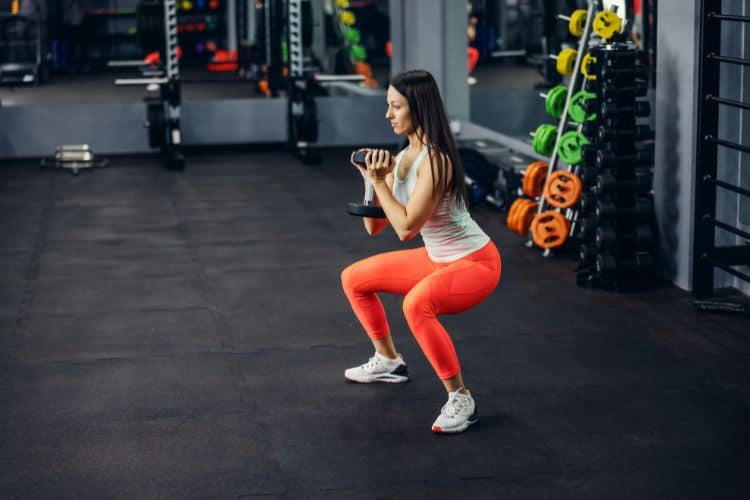
Hold one dumbbell vertically against your chest. Stand with feet around shoulder width, toes angled slightly outward if that suits your hips. Bend your knees and hips together, lower between your legs, then push through the floor to stand. Keep your chest comfortable and your ribs stacked over your pelvis. Aim for steady repetitions rather than squatting as fast as possible. If your heels rise or your back rounds significantly, shorten the depth or sit toward a stable chair and stand again.
Stand tall with one dumbbell at each shoulder and palms facing inward. Press one weight overhead while the other stays near your shoulder, lower it with control, then switch sides. Keep your knees soft and avoid leaning back to push the weight up. If your rib cage flares or you cannot reach overhead comfortably, use lighter weights or press only through a comfortable range of motion.
Hold a dumbbell in each hand with palms facing each other. Soften your knees, hinge at your hips, and keep your torso at an angle you can maintain comfortably. Pull your elbows toward your hips, pause briefly, and lower the weights without swinging. Think about bringing your upper arms backward rather than shrugging your shoulders. Your back should remain in a stable, natural position as the weights move.
Stand with the weights at your sides, shoulders relaxed and arms straight. March briskly in place, lifting one knee at a time to a comfortable height. Keep your torso upright and take small, controlled steps. The weights should stay close to your body rather than swinging across your legs. This interval raises your heart rate while challenging your grip and core.
Keep the same 40-seconds-on, 20-seconds-off timer for eight rounds. The second block combines a hip hinge with a floor press, then adds a lower-body interval and a standing core move. Move deliberately when getting down to and up from the floor. If floor work is inconvenient, use the standing alternative below and keep the timer running.
Stand with feet about hip width and the dumbbells in front of your thighs. Soften your knees and push your hips backward while letting the weights travel close to your legs. Lower only until you feel your hamstrings stretch and can keep your back position steady. Then drive through your feet, bring your hips forward, and stand tall without snapping your spine backward.
Sit on the floor, place the dumbbells on your thighs, and carefully roll onto your back while guiding the weights into position. Bend your knees and plant your feet. With your upper arms roughly 30 to 45 degrees from your torso, press the dumbbells toward the ceiling and lower until your upper arms gently reach the floor. Avoid bouncing your elbows off the floor or forcing your wrists backward.
Hold dumbbells at your sides or start without weights. Step one foot backward, bend both knees to a comfortable depth, and press through your front foot to return to standing. Switch legs with each repetition. Keep the front foot planted and your torso tall. A shorter backward step can help if balance is the main challenge; holding a sturdy chair with one hand is also a reasonable option.
Hold one light dumbbell at chest height with both hands. Step one foot slightly back, then drive that knee toward your chest while bringing the weight gently toward the knee. Return the foot to the floor and repeat for 20 seconds, then switch legs for the remaining 20. Keep the movement compact: your core braces as your hip and knee move, and your shoulders should remain relaxed.
The final eight-minute block again uses four 40-second exercises with 20 seconds between them, repeated twice. Your breathing may be heavier now, so concentrate on posture and choose a pace you can control. It is fine to take a few seconds within a work interval to reset. A short pause can help you complete the next repetition well.
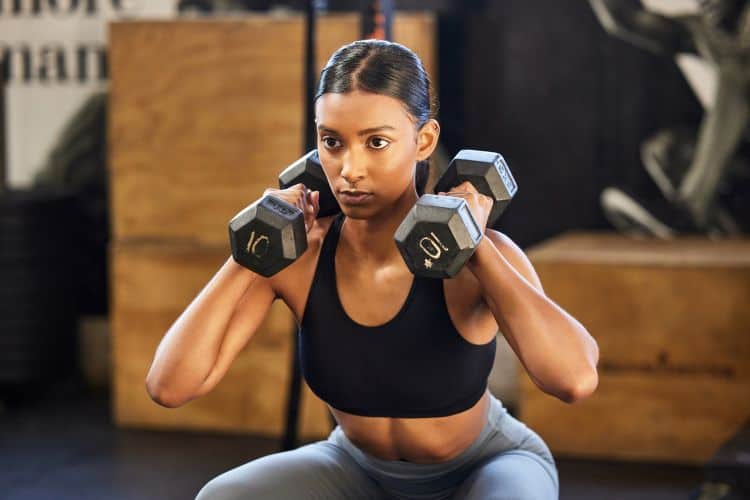
Hold light dumbbells at shoulder height. Lower into a comfortable squat, stand up fully, and press the weights overhead as you finish rising. Bring the weights back to your shoulders before the next squat. Let your legs contribute to the transition, but do not throw the weights upward or arch your back. The squat and press should feel like one coordinated repetition, with enough control to stop at any point.
Begin in a comfortable hip hinge with one dumbbell in each hand. Step your right foot a little to the side, bring your left foot toward it, and perform one controlled row. Then step to the left and row again. Keep the side steps small and the weights close to your legs while moving. Straighten up between rows if staying hinged for the whole interval is too tiring.
Hold the dumbbells at your sides. Step your right foot back into a comfortable reverse lunge and return to standing; then curl both weights toward your shoulders. Repeat with the left leg. Keep your elbows near your torso during the curl, and lower the weights slowly before the next step. The lunge and curl happen one after the other so that you can maintain balance.
Set the dumbbells down before the timer starts if necessary. Step to the right, bring your left foot behind you in a light tap, then step to the left and tap your right foot behind. Swing your arms naturally, or keep your hands near your chest if you prefer. Move at a pace that raises your breathing rate without turning the step into a jump.
For the finisher, alternate 30 seconds of brisk work with 30 seconds of easier movement, repeating that one-minute pattern three times. During each brisk half-minute, march quickly, do low-impact step jacks, or perform fast side steps. During each easier half-minute, walk slowly in place and focus on steady breathing. Use the same movement for all three minutes or change it when you need variety.
Walk slowly for the first minute, gradually reducing your pace. Let your arms hang comfortably and take slow breaths. For the second minute, place one foot a short distance behind you and gently stretch the calf, switching sides halfway through. You can also take a supported standing quadriceps stretch if it feels better. Stretch to mild tension, not pain.
During the final minute, soften your knees and hinge gently to stretch the backs of your legs, then stand and bring one arm across your chest to loosen your shoulders. Switch arms halfway through. Keep breathing normally as your heart rate comes down. If you feel lightheaded, sit safely and allow more time to recover before moving on with your day.
Use the first round of each block as a check. If you can barely control the first few repetitions, reduce the load. If you finish every interval without feeling challenged and your movement stays sound, consider a small increase next time. The 40-second timer is a cap, not a command to keep lifting through poor form. You can work for 25 or 30 seconds, then use the rest of the interval to recover.
Beginners can follow the same schedule using bodyweight movements for the first round and light dumbbells only when ready. Another option is to work for 30 seconds and use the remaining 30 seconds of each minute to rest; the 24-minute block structure stays the same. For lunges, use shallow step-backs, and for the squat-to-press, perform a plain squat. Treat the workout as practice rather than a race.
The most common mistake is moving too fast with weights that are too heavy. In HIIT, the timer can make every rep feel urgent. Slow down enough to complete each squat, hinge, row, and press in the intended position. If you cannot keep your trunk stable, shorten the set. Rest is part of the workout, and those 20 seconds help you prepare for the next exercise.
Yes. A five-minute warm-up, three eight-minute exercise blocks, a three-minute finisher, and a three-minute cooldown make a complete 35-minute session. The workout includes squat, hinge, lunge, push, pull, core, and cardio movements. Prepare your weights and timer in advance so the transitions are smooth.
No. One manageable pair can work for the whole session, and several moves can be done with a single dumbbell or no weight. If you own a lighter and a heavier pair, use the one that allows controlled technique for each exercise. In particular, do not let the weight suitable for your deadlift determine the weight you press overhead.
Beginners can modify it, but the full 40-second weighted intervals may feel demanding. Start with lighter weights or bodyweight, take 30 seconds of rest per minute if needed, and learn each movement before trying to increase speed. If you are beginning exercise after a health issue or injury, ask a qualified professional for guidance tailored to you.
Yes. Every cardio interval has a walking or stepping option. Marching, side steps, and step jacks can elevate effort without leaving the ground. You can also keep your pace moderate. Select the version that lets you finish the session with stable movement and comfortable joints.
This 35-minute full body dumbbell HIIT workout works best when you treat the weights, timer, and recovery as parts of one plan. Warm up, complete the three blocks at a controlled pace, choose a finisher you can sustain, and cool down. Your version may involve light weights and longer pauses today and a slightly heavier pair weeks from now. Both count as progress when you move with intention and return consistently.
If you want a shorter session on busy days, try this 20 Minute Full Body Dumbbell HIIT Workout for women or the 15 Minute Full Body Dumbbell HIIT Workout. For another timed challenge, follow the 30 minute Dumbbell HIIT Workout For Full-Body Fitness. If you are learning the lifts, start with the Beginner Home Dumbbell Workout For Women; when you are ready to organize your training across the week, use the Dumbbell Workout Plan For Women.
Stay up to date on the latest women’s health, fitness and lifestyle trends and tips.
