


Sign up for workout ideas, training advice, reviews of the latest gear and more.

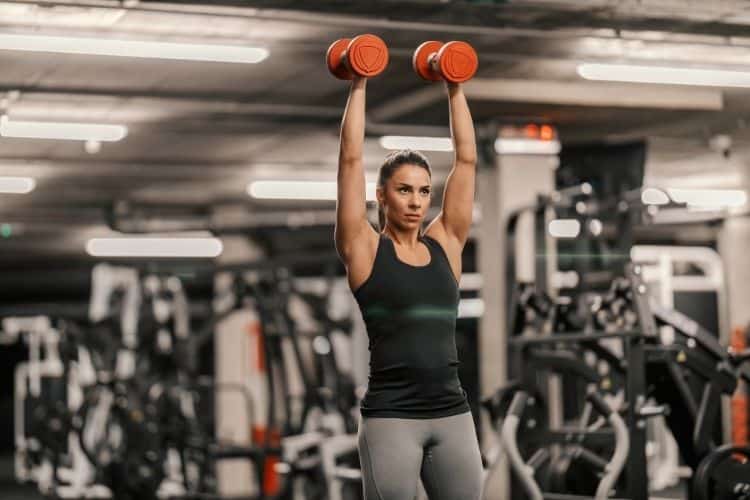
A 4 day dumbbell split workout routine is one of the most practical ways to build muscle, increase strength, improve body composition, and create a consistent training schedule without needing complicated gym equipment. With nothing more than a good pair of dumbbells, an adjustable bench if available, and enough space to move comfortably, you can train every major muscle group throughout the week.
The advantage of a four-day split is that it provides more training volume than a basic two- or three-day routine while still leaving several days each week for recovery. Instead of trying to train your entire body during every workout, you divide your training into specific muscle groups or movement patterns. This allows you to perform more focused exercises while giving previously trained muscles time to recover.
This 4 day dumbbell workout split uses two upper-body and two lower-body sessions. The structure makes it possible to train most major muscle groups twice each week while maintaining enough recovery between workouts. Whether you exercise at home or have access to a gym, this dumbbell routine can be adjusted to your strength level and available equipment.
A four-day dumbbell split is a strength-training program in which you perform four separate workouts during the week. Instead of completing a full-body workout every session, exercises are divided according to muscle groups or movement patterns.
For this routine, the weekly schedule consists of an upper-body push workout, a lower-body quadriceps-focused workout, an upper-body pull workout, and a lower-body glute and hamstring workout.
This approach creates a balanced training week without requiring you to exercise every day. The muscles trained during your first session have several days to recover before being challenged again.
One possible weekly schedule is Monday, Tuesday, Thursday, and Friday. Wednesday and the weekend can then become recovery days or opportunities for light activities such as walking, mobility exercises, stretching, or easy cardio.
Your exact schedule does not matter as much as consistency and recovery. Try to avoid placing all four workouts on consecutive days because accumulated fatigue can reduce exercise quality.
Dumbbells are sometimes viewed as simple training equipment, but they can provide an extremely effective resistance workout. They allow you to perform compound exercises, isolation movements, unilateral exercises, and loaded carries while adjusting resistance according to your ability.
A four-day schedule also provides enough weekly training opportunities to accumulate meaningful volume without requiring daily workouts.
Another major advantage is flexibility. A 4 day dumbbell workout routine can be performed in a home gym, commercial gym, apartment workout area, or almost anywhere you have sufficient space.
Dumbbells also require each side of your body to contribute independently during many exercises. This can help expose strength differences between your left and right sides and allows you to incorporate unilateral movements such as split squats, single-arm rows, and single-leg Romanian deadlifts.
The following schedule creates a straightforward upper/lower split:
Monday: Upper Body Push
Tuesday: Lower Body Quads and Calves
Wednesday: Rest or active recovery
Thursday: Upper Body Pull
Friday: Lower Body Glutes and Hamstrings
Saturday: Rest or optional light cardio
Sunday: Rest
This arrangement gives your upper and lower body alternating periods of work and recovery. If these particular days do not fit your lifestyle, move the workouts while maintaining adequate recovery.
For example, you could train Sunday, Monday, Wednesday, and Friday instead.
Before beginning each workout, spend approximately five to ten minutes preparing your body for resistance training.
Start with light movement such as brisk walking, marching in place, cycling, or another activity that gradually raises your body temperature. Follow this with dynamic movements appropriate for the exercises you will perform.
For upper-body workouts, shoulder circles, arm swings, light rows, and controlled presses can help prepare the shoulders and upper back. For lower-body workouts, bodyweight squats, reverse lunges, hip hinges, glute bridges, and leg swings can prepare your hips and legs.
You can also perform one or two lighter warm-up sets before your first major dumbbell exercise. These sets allow you to practice the movement before progressing to your working weight.
The first workout focuses primarily on your chest, shoulders, and triceps. These muscles work together during pressing exercises, making them a natural combination for one training session.
Begin with the dumbbell bench press for 3 to 4 sets of 8 to 12 repetitions.
Lie on a bench while holding the dumbbells near chest level. Press the weights upward until your arms are extended without aggressively locking the elbows. Lower the dumbbells under control before beginning the next repetition.
If you do not have a bench, perform a dumbbell floor press instead.
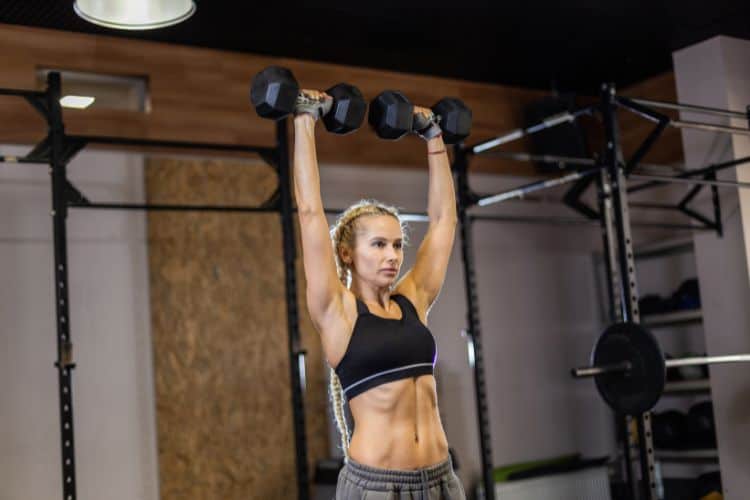
Perform 3 sets of 8 to 12 repetitions.
Hold the dumbbells near shoulder height and press them overhead while keeping your torso controlled. Lower the weights slowly to the starting position.
The exercise can be performed standing or seated depending on your preference and available equipment.
Perform 3 sets of 10 to 12 repetitions.
Using an incline bench changes the pressing angle and places additional emphasis on the upper portion of the chest while continuing to train the shoulders and triceps.
If you do not own an adjustable bench, another set of floor or standard dumbbell presses can be substituted.
Complete 3 sets of 12 to 15 repetitions.
Use relatively light dumbbells and raise your arms outward until approximately shoulder height. Keep the movement controlled instead of swinging the weights.
Finish with 3 sets of 10 to 15 repetitions.
Hold one dumbbell securely overhead and bend your elbows to lower the weight behind your head before extending your arms again. Keep your upper arms relatively stable throughout the movement.
Day two emphasizes your quadriceps while still training the glutes, hamstrings, and calves.
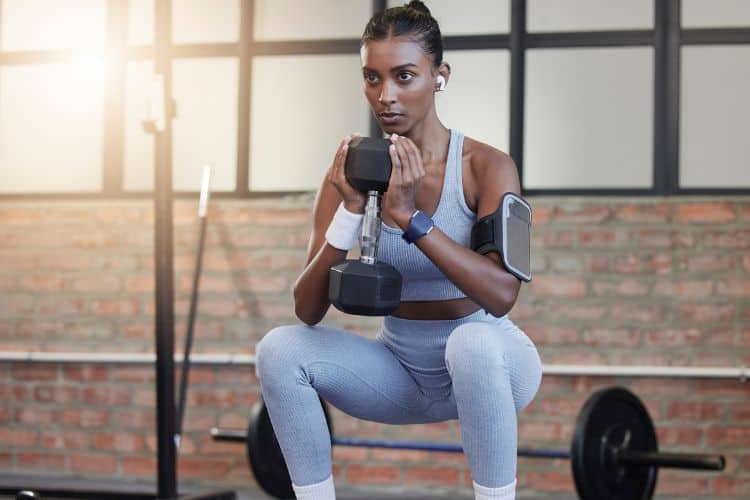
Perform 4 sets of 8 to 12 repetitions.
Hold one dumbbell vertically near your chest. Sit your hips down while bending your knees and maintaining a stable torso. Push through your feet to return to standing.
As your strength improves, gradually increase the dumbbell weight.
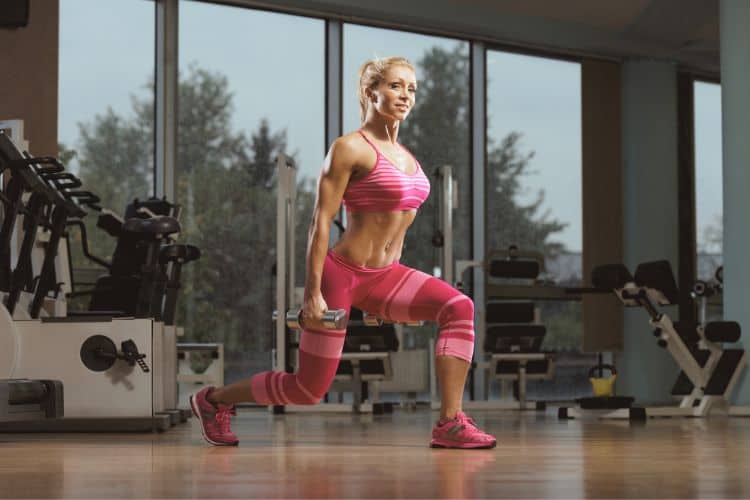
Complete 3 sets of 8 to 12 repetitions per leg.
Hold dumbbells beside your body and step backward into a lunge. Lower your back knee toward the floor while keeping the front foot planted. Drive through the front leg to return to standing.
Reverse lunges also provide valuable unilateral training because each leg works independently.
Perform 3 sets of 8 to 10 repetitions per leg.
Place your rear foot on a stable bench or elevated surface and position the front foot far enough forward to maintain balance. Lower yourself under control before pushing through the front foot.
Beginners can perform standard split squats with both feet on the floor.
Complete 3 sets of 10 repetitions per leg.
Use a stable bench, box, or step. Place one foot completely on the elevated surface and drive through that leg to stand up. Lower yourself carefully before repeating.
Finish with 3 to 4 sets of 12 to 20 repetitions.
Hold dumbbells at your sides and rise onto the balls of your feet. Pause briefly at the top before lowering your heels slowly.
After a recovery day, return to training with an upper-body pull session emphasizing your back and biceps.
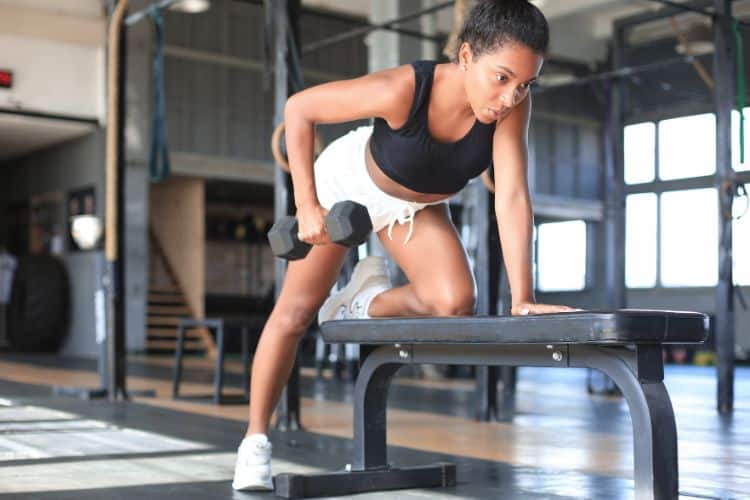
Perform 4 sets of 8 to 12 repetitions per arm.
Support one hand on a bench or another stable surface. Hold a dumbbell in the opposite hand and pull it toward your torso while keeping your spine controlled.
Lower the weight slowly until your arm is extended before performing the next repetition.
Complete 3 sets of 8 to 12 repetitions.
Hold a dumbbell in each hand and hinge forward from your hips. Pull both dumbbells toward your torso while squeezing your shoulder blades together.
Avoid turning the movement into a shrug or using excessive momentum.
Perform 3 sets of 10 to 12 repetitions.
Lie on a bench while holding a dumbbell securely with both hands. Extend the weight behind your head using a comfortable range of motion and then bring it back above your chest.
Complete 3 sets of 12 to 15 repetitions.
Use lighter dumbbells and hinge forward slightly. Raise your arms outward while maintaining a small bend in your elbows. Focus on controlled movement through the rear shoulders and upper back.
Perform 3 sets of 10 to 15 repetitions.
Keep your elbows near your sides as you curl the dumbbells toward your shoulders. Lower the weights slowly rather than allowing gravity to drop them.
Finish with 2 to 3 sets of 10 to 15 repetitions.
Keep your palms facing each other throughout the movement. Hammer curls provide another useful curling variation while training the biceps and muscles of the forearms.
The final workout of the week focuses primarily on the posterior chain, especially your glutes and hamstrings.
Begin with 4 sets of 8 to 12 repetitions.
Hold the dumbbells in front of your thighs. Push your hips backward while keeping your spine neutral and your knees slightly bent. Lower the dumbbells until you feel a comfortable stretch through the hamstrings.
Drive your hips forward to return to standing.
Perform 4 sets of 10 to 15 repetitions.
Position your upper back against a stable bench and place a dumbbell securely across your hips. Lower your hips before driving them upward by contracting your glutes.
If you do not have a bench, perform weighted glute bridges from the floor.
Complete 3 sets of 10 to 15 repetitions.
Take a wider stance than you would for a standard squat and hold one dumbbell between your legs. Lower into the squat while keeping your knees aligned with your toes.
Push through your feet to return to standing.
Perform 3 sets of 8 to 10 repetitions per side.
Shift your weight onto one leg and hinge forward while allowing the opposite leg to extend behind you. Keep the movement slow and controlled.
If balance is difficult, lightly hold a stable surface with one hand.
Finish with 3 sets of 12 to 20 repetitions.
Lie on your back with your knees bent and place a dumbbell securely across your hips. Drive your hips upward while squeezing your glutes before slowly returning toward the floor.
There is no single correct dumbbell weight for everyone. The appropriate resistance depends on the exercise, your strength, training experience, and repetition target.
Choose a weight that allows you to perform your target repetitions with good technique while making the final few repetitions challenging.
If you are supposed to perform 8 to 12 repetitions and can easily complete 20, the dumbbells are probably too light for that particular exercise. Conversely, if your target is 10 repetitions but your technique deteriorates after five, reduce the resistance.
You will also need different weights for different movements. Most people can use significantly heavier dumbbells for Romanian deadlifts and squats than for lateral raises or rear delt flies.
Progressive overload is an important component of long-term strength and muscle development. Your body adapts to repeated training, which means the same workout performed with the same resistance indefinitely eventually becomes less challenging.
One simple strategy is double progression.
Suppose your dumbbell bench press calls for 8 to 12 repetitions. Start with a weight you can control for approximately eight repetitions. Over several workouts, attempt to gradually increase repetitions.
Once you can complete all prescribed sets near the top of the range with good technique, increase the dumbbell weight slightly and begin building your repetitions again.
Progress can also come from performing an additional set, improving range of motion, using better technique, slowing the lowering phase, or improving control.
Rest periods should match the difficulty and purpose of the exercise.
For demanding compound movements such as dumbbell squats, presses, rows, and Romanian deadlifts, approximately 90 seconds to three minutes of recovery may help you maintain performance.
For smaller isolation movements such as curls, lateral raises, rear delt flies, and triceps extensions, approximately 45 to 90 seconds may be sufficient.
You do not need to rush between sets. The goal is to recover enough to perform your next set effectively.
Most people can complete this 4 day dumbbell split workout routine in approximately 45 to 60 minutes.
Workout length depends on your number of sets, rest periods, warm-up time, and how quickly you transition between exercises.
Avoid reducing rest periods simply to finish faster if doing so significantly decreases the quality of your repetitions. Strength training should prioritize controlled, productive sets rather than racing through the workout.
Beginners can use a four-day split, but training volume should be introduced gradually.
During your first few weeks, consider performing two working sets instead of three or four for several exercises. This allows your muscles and connective tissues to adapt to regular resistance training.
Focus primarily on learning movements such as squats, hinges, rows, presses, and lunges.
As your technique and recovery improve, gradually increase the number of working sets.
Beginners should also avoid immediately training every set to complete muscular failure. Leaving a few repetitions in reserve can help maintain technique while you develop experience.
Training provides the stimulus for adaptation, but recovery allows your body to respond to that stimulus.
Aim for consistent sleep, sufficient nutrition, adequate hydration, and regular rest days. Protein-containing foods can also help support muscle repair as part of an overall balanced diet.
Your recovery needs may change depending on your age, training experience, stress levels, calorie intake, and activity outside the gym.
Muscle soreness can occur when starting a new program, but extreme soreness is not required for a workout to be effective.
If performance consistently decreases, motivation drops, or soreness remains unusually high, consider reducing your training volume or taking additional recovery time.
One challenge of home training is eventually becoming stronger than your available dumbbells.
If purchasing heavier weights is not immediately possible, several techniques can make lighter dumbbells more challenging.
Increase repetitions within a reasonable range, slow the eccentric or lowering portion of each exercise, add pauses, use unilateral exercises, or increase your range of motion where appropriate.
For example, a standard dumbbell squat may become relatively easy with limited weights, while Bulgarian split squats using the same dumbbells can be considerably more demanding because one leg performs most of the work.
You can also use supersets for smaller accessory exercises to increase training density, although heavier compound exercises generally benefit from adequate rest.
One common mistake is attempting to increase weight too quickly. Progressive overload is valuable, but adding resistance at the expense of technique can reduce exercise quality.
Another mistake is performing excessive training volume. More exercises do not automatically produce better results. A focused workout containing several productive movements is often more sustainable than a session filled with unnecessary exercises.
Skipping lower-body workouts is another problem. Dumbbells are excellent tools for squats, lunges, Romanian deadlifts, split squats, step-ups, and hip thrusts. Training your legs consistently helps create a balanced program.
Finally, avoid changing your routine every week. Give your workout plan enough time to evaluate whether you are progressing.
Consider following the routine consistently for approximately 6 to 12 weeks while tracking your workouts.
Record the dumbbell weight, sets, and repetitions completed for major exercises. Your training log provides an objective way to determine whether you are becoming stronger.
After several weeks, you can modify individual exercises while maintaining the same basic structure. For example, you might replace goblet squats with front-loaded dumbbell squats or switch standard curls for incline curls.
You do not need to replace the entire program simply because several weeks have passed. If you continue progressing and enjoy the routine, you can continue using it while making small adjustments.
A 4 day dumbbell split workout routine offers a practical balance between training frequency, exercise variety, muscle-building volume, and recovery. By dividing your week between upper-body push, lower-body quad, upper-body pull, and lower-body posterior-chain workouts, you can systematically train your entire body using dumbbells.
The key is consistency rather than complexity. Focus on fundamental exercises such as dumbbell presses, rows, squats, lunges, Romanian deadlifts, shoulder presses, and hip thrusts. Use controlled repetitions, select appropriate resistance, and gradually increase the challenge as your strength improves.
Your four weekly workouts should be challenging enough to stimulate progress without leaving you unable to recover for the next session. Pay attention to exercise technique, sleep, nutrition, and rest while recording your performance.
Whether your goal is to build muscle, become stronger, improve fitness, or simply establish a dependable resistance-training routine, this 4 day dumbbell workout split routine can provide a structured foundation. Follow the program consistently, make gradual improvements, and allow enough time for those small increases in strength and performance to accumulate into meaningful long-term results.
To get even more from this 4 day dumbbell split workout routine, explore more strength-training guides from Women’s Fit Club. Start with this complete Dumbbell Workout Plan for Women for additional ways to organize your weekly training, or add more upper-body variety with the 30 Minute Upper Body Dumbbell Strength Workout and 40 Minute Dumbbell Upper Body Workout. If you’re newer to strength training, the Beginner Upper Body Dumbbell Workout provides an approachable place to build your foundation. You can also use the Full Body Dumbbell Workout for Women when you want to replace one of your split sessions with a complete head-to-toe dumbbell workout.
Stay up to date on the latest women’s health, fitness and lifestyle trends and tips.
