


Sign up for workout ideas, training advice, reviews of the latest gear and more.


Finding an effective workout after 40 does not mean spending hours in the gym or pushing your body through punishing exercise sessions. A well-designed 45 minute HIIT for women over 40 workout can combine cardiovascular exercise, strength training, core work, and functional movements into one efficient routine. The key is choosing exercises and work intervals that challenge your body while allowing you to maintain good form and recover properly.
High-intensity interval training, commonly known as HIIT, alternates periods of harder exercise with periods of lower-intensity movement or rest. For women over 40, HIIT can be adapted to different fitness levels by adjusting exercise selection, speed, resistance, work intervals, and recovery periods. You do not need to perform nonstop jumping or extremely advanced exercises to have a challenging HIIT session.
This 45-minute workout focuses on full-body movements that train the legs, glutes, arms, shoulders, back, and core while raising your heart rate. It can be completed at home with minimal equipment, although dumbbells can be added for additional resistance. Beginners can use bodyweight exercises and longer recovery periods, while experienced exercisers can increase resistance or intensity.
Your workout priorities may change as you get older. Instead of focusing only on how many calories you can burn during a workout, it becomes increasingly useful to incorporate strength, mobility, cardiovascular fitness, balance, and recovery into your exercise routine.
A 45 minute HIIT workout for women over 40 provides enough time to include a gradual warm-up, several structured training circuits, core exercises, and a cooldown without rushing through the session.
HIIT is also flexible. The word “high intensity” refers to intensity relative to your current fitness level. One woman may perform squat jumps during an interval, while another may perform controlled bodyweight squats. Both can create an appropriately challenging workout by working at an intensity suited to their abilities.
Traditional cardio and resistance training are often treated as completely separate workouts. HIIT makes it possible to combine elements of both.
Exercises such as squats, reverse lunges, dumbbell rows, presses, step jacks, mountain climbers, and glute bridges can be arranged into circuits that challenge multiple muscle groups while keeping the workout moving.
Adding resistance exercises is particularly valuable because strength training helps maintain and build muscle. Instead of making every interval a fast cardiovascular exercise, this workout alternates faster movements with controlled strength exercises.
Busy schedules can make long gym sessions difficult. A structured 45-minute workout gives you a clear starting and finishing point while still providing enough time for a comprehensive full-body session.
Rather than deciding what exercise to perform next, you can follow predetermined intervals and circuits. This makes the workout especially convenient for exercising at home before work, during a lunch break, or whenever you have an uninterrupted training window.
You can perform this routine using only your body weight. A pair of light or moderate dumbbells is optional if you want additional resistance for squats, rows, deadlifts, and presses.
You may also want an exercise mat, supportive athletic shoes, water, and an interval timer.
Choose dumbbells that allow you to maintain controlled technique throughout each interval. Because the workout contains multiple rounds, weights that feel comfortable during the first few repetitions can become considerably harder as fatigue accumulates.
The goal is not to use the heaviest possible weight. Choose resistance that lets you complete the movements with good form.
The workout is divided into a warm-up, several HIIT circuits, a core and conditioning section, and a cooldown. A practical interval structure is approximately 40 seconds of work followed by 20 seconds of recovery.
If you are new to HIIT, consider starting with 30 seconds of work and 30 seconds of recovery. Experienced exercisers can use the 40/20 format or adjust the intervals according to their fitness level.
Use the recovery periods intentionally. Take a few deep breaths, reset your posture, and prepare for the next movement rather than trying to exercise continuously for the entire 45 minutes.
Never underestimate the value of your warm-up. Moving gradually before the harder intervals gives you an opportunity to increase your heart rate and prepare your joints and muscles for the exercises ahead.
Begin with approximately one minute of easy marching in place. Allow your arms to swing naturally and gradually increase the height of your knees.
Continue with alternating step touches while moving your arms from side to side. Follow with controlled bodyweight squats, keeping your chest lifted as you sit your hips backward and stand tall.
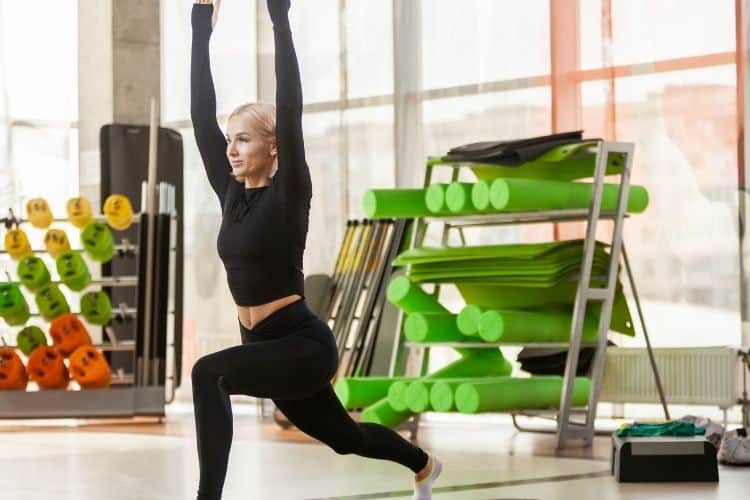
Add alternating reverse lunges or shallow step-backs depending on your mobility. Finish the warm-up with arm circles, gentle torso rotations, and slightly faster marching.
By the end of five minutes, you should feel warmer and ready to exercise, but you should not already feel exhausted.
The first circuit focuses on the major muscles of the lower body. Strong legs and glutes contribute to everyday activities such as walking, climbing stairs, lifting objects, and getting up from a chair.
Stand with your feet approximately shoulder-width apart. Brace your core and send your hips backward as you bend your knees. Lower yourself only as far as you can comfortably maintain good posture before pressing through your feet to stand.
To increase the challenge, hold one dumbbell at your chest in a goblet position or hold two dumbbells by your sides.
Avoid rushing your repetitions simply because this is HIIT. Controlled squats can still become highly challenging during a 40-second interval.
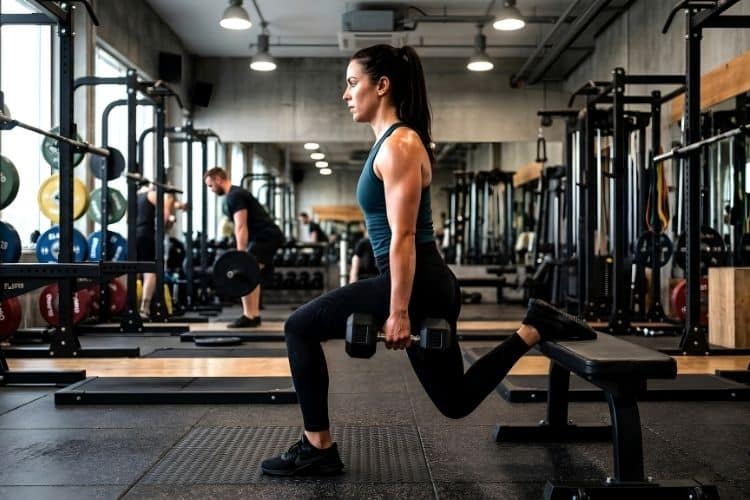
Stand upright and step one foot backward. Bend both knees while maintaining control, then push through your front foot to return to standing. Alternate sides.
Reverse lunges can be easier to control than forward lunges for many exercisers. If balance is challenging, keep the range of motion smaller or lightly hold a stable surface.
Perform a regular squat and, as you return to standing, rise onto the balls of your feet for a calf raise. Lower your heels under control before beginning the next repetition.
This combination trains the thighs, glutes, and calves while adding a balance component.
Step your right foot laterally and bring your left foot behind you. Reverse the movement to the opposite side.
Increase the pace to raise your heart rate or keep the movement controlled for a lower-impact alternative. More experienced exercisers can perform lateral skater hops if jumping feels appropriate.
Complete the circuit for approximately eight minutes, repeating the exercises while following your chosen work-to-rest intervals.
After training the lower body, shift attention toward the back, shoulders, chest, and arms.
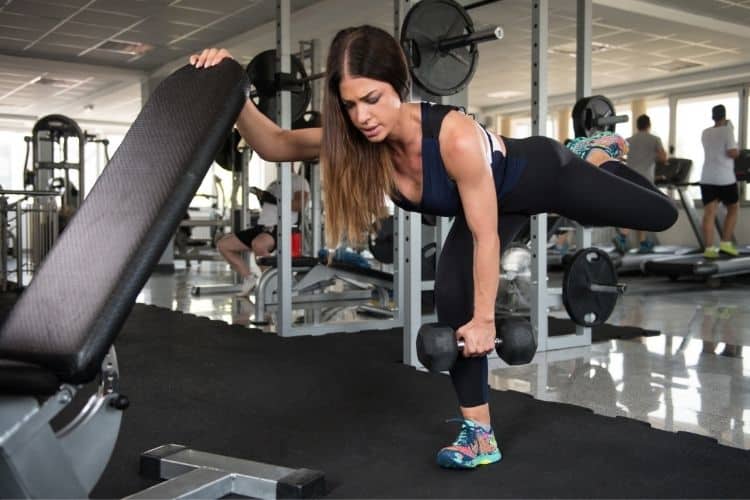
Hold a dumbbell in each hand and hinge forward from your hips while maintaining a neutral spine. Pull the weights toward your ribs, squeeze your shoulder blades together, and lower them slowly.
If you do not have dumbbells, replace rows with another bodyweight upper-body movement or use resistance bands if available.
Hold your dumbbells around shoulder height. Brace your core and press the weights overhead without excessively arching your lower back.
Lower the dumbbells slowly before repeating.
Place your hands on a sturdy elevated surface such as a secure bench or countertop. Walk your feet backward until your body forms a straight line.
Bend your elbows and lower your chest toward the surface before pressing yourself away.
Incline push-ups are an excellent way to adjust push-up difficulty. As your strength improves, you can gradually use a lower surface.
Traditional jumping jacks can be replaced with step jacks to reduce impact. Step one foot sideways while raising your arms overhead, return to the middle, and repeat on the opposite side.
Move faster if you want a greater cardiovascular challenge.
Repeat these movements for approximately eight minutes.
The third circuit brings the upper and lower body together.
Hold your dumbbells near your shoulders and perform a squat. As you stand, press the weights overhead.
This compound movement trains several large muscle groups simultaneously and can quickly elevate your heart rate.
If combining the movements feels uncomfortable, perform a squat, stand completely, pause, and then complete the shoulder press.
Stand with the dumbbells in front of your thighs. Keep a slight bend in your knees and push your hips backward while lowering the weights along your legs.
Stop when you feel tension through your hamstrings without losing your neutral spine. Drive your hips forward and return to standing.
Think about moving through your hips instead of turning the exercise into a squat.
Stand tall and drive one knee toward your chest while bringing your opposite arm forward. Alternate sides at a controlled but energetic pace.
For greater intensity, increase your speed while maintaining balance.
Place your hands on a sturdy elevated surface and step one foot backward at a time until you reach a plank position.
Drive one knee toward your chest and then alternate legs. Increase your pace according to your ability.
Using an elevated surface can make mountain climbers more accessible while still providing a significant cardiovascular challenge.
Continue this circuit for approximately eight minutes.
Your final training section combines core stability with cardiovascular conditioning.
Stand tall with your hands lightly positioned behind your head. Bring your right knee toward your left elbow while rotating through your torso. Return to standing and alternate sides.
Focus on controlled rotation rather than pulling on your neck.
Lie on your back with your knees bent and feet planted on the floor. Brace your core and squeeze your glutes as you lift your hips.
Pause briefly at the top before lowering your hips under control.
For additional resistance, an appropriate dumbbell can be carefully positioned across the hips.
Lie on your back with your arms extended upward and your knees bent. Brace your abdominal muscles and slowly extend the opposite arm and leg away from your body.
Return to the starting position and alternate sides.
Move slowly. The dead bug is about maintaining core control rather than completing as many repetitions as possible.
Finish with an energetic march. Drive your knees upward and pump your arms while maintaining an upright posture.
Increase the speed during the final seconds of the interval if you feel comfortable.
Complete approximately six to eight minutes of this final circuit.
Gradually reduce your exercise intensity instead of stopping abruptly.
Begin by walking slowly around the room or marching gently in place. Focus on steady breathing as your heart rate begins to settle.
Continue with gentle stretches for the quadriceps, hamstrings, calves, chest, shoulders, and upper back. Hold each position comfortably without bouncing or forcing yourself into an extreme range of motion.
Your cooldown can also be an opportunity to evaluate how the workout felt. Consider whether your chosen resistance, exercise modifications, and interval lengths were appropriate. This information can help you adjust your next session.
More HIIT is not automatically better. High-intensity training places greater demands on your body than easy walking or gentle mobility work, making recovery an important part of a balanced fitness program.
Many women may prefer to begin with one or two HIIT sessions per week and see how their bodies respond. Other training days can include traditional resistance training, walking, cycling, swimming, mobility work, yoga, Pilates, or other moderate activities.
Your ideal frequency depends on your training experience, workout intensity, recovery, sleep, schedule, and overall exercise program.
Avoid turning every workout into a maximum-intensity session.
One of the biggest misconceptions about HIIT is that every exercise must involve jumping. It does not.
You can replace squat jumps with regular squats, jumping jacks with step jacks, burpees with elevated step-back burpees, running high knees with fast marching, and skater jumps with lateral steps.
These modifications allow you to keep moving and raise your heart rate while decreasing impact.
You can also shorten your range of motion. A shallow squat performed with control may be more suitable than forcing yourself into a deeper position you cannot comfortably maintain.
Intensity can come from many sources, including faster movement, additional resistance, shorter recovery periods, compound exercises, and increased range of motion. Jumping is only one option.
Progress does not have to mean making every workout dramatically harder.
Start by learning the exercises and completing the full workout with consistent technique. Once the routine becomes easier, increase one variable at a time.
For example, you might move from 30-second work intervals to 35 or 40 seconds. You could use slightly heavier dumbbells for your strength movements or complete more controlled repetitions during each interval.
Another strategy is improving movement quality. Performing deeper squats with proper technique, more controlled lunges, or stronger push-ups can represent meaningful progress even if the timer stays exactly the same.
Avoid changing everything simultaneously. Gradual progression makes it easier to determine what your body can tolerate and recover from.
HIIT can include resistance exercises, but it does not necessarily replace dedicated strength training.
Women over 40 can benefit from maintaining a balanced fitness routine that includes exercises for all major muscle groups. Dedicated resistance sessions make it easier to focus on progressive overload because you can track your exercises, weights, repetitions, and sets more precisely.
Consider using HIIT primarily for conditioning and combining it with two or more appropriately programmed strength sessions depending on your goals, experience, and recovery.
A common mistake is beginning every interval at maximum effort. If you exhaust yourself during the opening minutes, your technique and workout quality may decline later.
Another mistake is choosing exercises based on difficulty rather than suitability. Complicated movements are not automatically better. Basic exercises performed consistently and correctly can produce an excellent training session.
Skipping recovery is another problem. Rest periods are included for a reason. Use them to prepare yourself for the next interval.
Finally, avoid comparing your intensity to somebody else’s. Your HIIT workout should reflect your fitness level, not the speed or resistance another person uses.
Consistency is more important than making one workout exceptionally difficult. Create a weekly exercise schedule you can realistically maintain and allow enough time between demanding sessions.
Support your training with balanced nutrition that provides adequate protein, carbohydrates, healthy fats, fruits, vegetables, and fluids according to your individual needs.
Sleep and recovery also matter. If you are unusually fatigued, modifying your workout or choosing a lower-intensity session may be more productive than forcing yourself through a demanding HIIT routine.
Track progress beyond the scale. Improvements in strength, stamina, exercise technique, walking pace, workout recovery, and daily energy can all be useful indicators that your fitness is improving.
A complete workout can be organized into approximately five minutes of warming up, eight minutes of lower-body intervals, eight minutes of upper-body intervals, eight minutes of full-body training, six to eight minutes of core and conditioning work, short transition periods, and approximately five minutes of cooling down.
You do not need to follow the clock perfectly. Allow additional recovery when necessary and prioritize good exercise technique.
As your conditioning improves, you can gradually increase your work intervals, resistance, or exercise difficulty without making the workout longer.
Yes, but the routine should match the beginner’s current fitness level.
If you are completely new to exercise, you may want to begin with shorter workouts before progressing toward a full 45-minute session. For example, perform the warm-up and two circuits initially and gradually add additional sections.
A beginner interval of 20 to 30 seconds of activity followed by 30 to 40 seconds of recovery may be more appropriate than starting immediately with longer high-intensity intervals.
There is no advantage to rushing your progression. Building exercise consistency and movement confidence gives you a stronger foundation for more challenging workouts later.
If you have medical concerns, significant pain, recent injuries, or have been inactive for an extended period, consider discussing a new high-intensity exercise program with an appropriately qualified healthcare professional.
A 45 minute HIIT for women over 40 workout can provide a challenging combination of cardiovascular conditioning, strength work, core training, balance, and functional movement without requiring complicated gym equipment.
The most effective approach is not necessarily the hardest version of HIIT. Choose exercises that fit your ability, use modifications when needed, and gradually progress as your strength and conditioning improve.
Start with a thorough warm-up, alternate challenging intervals with intentional recovery, and focus on controlled movement throughout every circuit. Combine HIIT with regular strength training, moderate cardiovascular activity, mobility work, nutritious eating, and sufficient recovery to create a more complete fitness routine.
Whether you perform this 45-minute HIIT workout at home or at the gym, consistency should remain the priority. Keep track of your intervals, weights, and exercise modifications so you can recognize progress over time. With a sustainable approach, your HIIT sessions can become an efficient and adaptable part of your fitness routine after 40.
Ready to keep building strength, endurance, and confidence after 40? Explore our HIIT Workouts for Women Over 40 for more interval-training ideas, or start with our HIIT for Beginners Over 40 if you want a more beginner-friendly approach. You can also add resistance training with our Full Body Strength Training Plan for Women Over 40, follow a balanced Workout Plan for Women Over 40, or discover more ways to stay active with our Best Workouts for Women Over 40. These routines make it easier to combine HIIT, strength training, cardio, mobility, and recovery into a well-rounded weekly fitness plan.
Stay up to date on the latest women’s health, fitness and lifestyle trends and tips.
