


Sign up for workout ideas, training advice, reviews of the latest gear and more.

Starting a barbell workout routine can feel intimidating, especially when you are new to strength training. However, barbells are not reserved for competitive lifters or experienced gym members. With appropriate exercises, manageable weights, and proper technique, a beginner barbell workout plan can help women build strength, increase lean muscle, improve bone health, and feel more confident in the gym.
This full body beginner barbell workout plan for women trains the major muscle groups through fundamental movement patterns. Rather than performing complicated exercises or spending hours at the gym, you will focus on a small selection of effective lifts that are easier to learn and progress over time.
The plan includes three weekly workouts, with rest days between sessions. Each workout targets the legs, glutes, back, chest, shoulders, arms, and core. Beginners can follow the program for eight to twelve weeks while gradually improving technique and increasing resistance.
Always consult a qualified healthcare professional before beginning a new exercise program, particularly if you have an injury, medical condition, are pregnant, or recently gave birth.
Barbell training provides a straightforward way to make exercises progressively more challenging. Unlike a fixed-weight dumbbell, a barbell can be loaded with small plates, allowing you to increase resistance gradually as you become stronger.
Consistent resistance training can help women develop lean muscle, maintain bone density, support joint health, and improve everyday physical function. Exercises such as squats, deadlifts, rows, and presses train multiple muscles together, making barbell workouts efficient for women with limited training time.
Strength training may also support body-composition goals. Muscle tissue requires energy to maintain, and challenging workouts can contribute to overall daily energy expenditure. However, sustainable fat loss still depends on nutrition, recovery, activity levels, and long-term consistency. A barbell workout should be viewed as part of a balanced lifestyle rather than a quick weight-loss solution.
Perhaps one of the most valuable benefits is increased confidence. Watching your technique improve and gradually lifting more weight provides visible evidence of progress that is not determined by the number on a scale.
You need a barbell, weight plates, collars, and a stable training area. A squat rack or power rack is strongly recommended because it allows you to position the bar safely for squats and overhead presses. A flat bench is needed for the barbell bench press.
Many gyms have a standard Olympic barbell that weighs 45 pounds. This may be too heavy for some beginners, particularly for upper-body exercises. If possible, use a 15-pound training bar, a 33-pound women’s Olympic bar, or a fixed-weight barbell until you can comfortably control a standard bar.
Weight plates should be added in small increments. Fractional plates and lightweight bumper plates are especially useful for beginners because they make gradual progression possible. Do not feel pressured to begin with large plates simply because other people in the gym are using them.
Flat, stable shoes are generally preferable for barbell exercises. Heavily cushioned running shoes can make it harder to maintain balance during squats and deadlifts. Wear comfortable clothing that allows your hips, knees, and shoulders to move freely.
Most beginners can perform this full body barbell workout three days per week. A Monday, Wednesday, and Friday schedule works well because it provides at least one recovery day between sessions. Tuesday, Thursday, and Saturday is another suitable option.
Two weekly workouts may be more realistic if you are returning to exercise, balancing a demanding schedule, or recovering slowly. You can still make meaningful progress with two consistent sessions per week.
Avoid performing all three workouts on consecutive days. Strength training creates fatigue in the muscles and nervous system, and adequate recovery helps your body adapt. Rest days do not mean that you must remain completely inactive. Walking, gentle stretching, mobility work, and relaxing recreational activities are reasonable options.
Choose a starting weight that allows you to complete every repetition with controlled technique. The final two repetitions of a set should feel challenging, but they should not cause your form to deteriorate.
A useful guideline is to finish most sets with approximately two or three good repetitions left in reserve. For example, if you complete eight repetitions but believe you could have performed another two repetitions with proper form, the weight is probably appropriate.
Start with an empty bar or lightweight training bar while learning each exercise. There is no disadvantage to starting conservatively. Using manageable resistance gives you time to develop coordination, understand the movement, and become comfortable in the gym.
Record the exercise, weight, repetitions, and any useful technique notes after each workout. A training log removes guesswork and makes it easier to determine when you are ready to add weight.
Begin with five to ten minutes of easy movement to raise your body temperature. You could walk on a treadmill, pedal a stationary bike, or use an elliptical at a comfortable pace. The objective is to feel warm rather than tired.
Continue with dynamic movements that prepare the joints and muscles you will train. Bodyweight squats, hip hinges, glute bridges, alternating reverse lunges, arm circles, and wall slides are suitable choices. Perform each movement slowly and focus on your available range of motion.
Before the first major lift, complete two or three warm-up sets. Start with an empty bar and gradually increase the weight without approaching muscular failure. Warm-up sets prepare your technique and should not exhaust you before the working sets begin.
This plan uses two workouts, labeled Workout A and Workout B. Alternate them across three weekly sessions. During the first week, complete Workout A, Workout B, and Workout A. During the second week, complete Workout B, Workout A, and Workout B. Continue alternating throughout the program.
Rest for approximately 90 to 120 seconds between most working sets. You may need up to three minutes after demanding sets of squats or deadlifts. Longer rest is acceptable if it helps you maintain safe technique.
Begin with the barbell back squat for three sets of six to eight repetitions. Follow it with the barbell bench press for three sets of six to eight repetitions. Perform the bent-over barbell row for three sets of eight to ten repetitions, followed by the barbell Romanian deadlift for three sets of eight to ten repetitions. Finish with a plank for three rounds of 20 to 40 seconds.
This workout prioritizes squatting strength while also training the chest, back, glutes, hamstrings, arms, shoulders, and core. Keep the starting weights manageable because the combination of squats and Romanian deadlifts can be demanding for beginners.
Start with the conventional or sumo barbell deadlift for three sets of five repetitions. Continue with the standing barbell overhead press for three sets of six to eight repetitions. Perform a barbell reverse lunge for three sets of six to eight repetitions per leg. Complete the strength portion with a barbell glute bridge for three sets of ten to twelve repetitions. Finish with the dead bug for three sets of six to ten controlled repetitions per side.
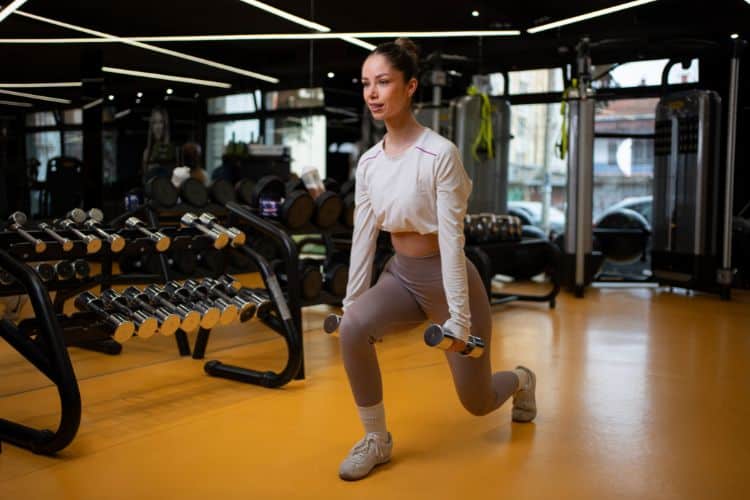
Workout B emphasizes the hip-hinge movement while strengthening the shoulders, triceps, legs, glutes, back, grip, and core. If barbell reverse lunges feel unstable, practice bodyweight or dumbbell lunges before placing a bar across your upper back.
Set the bar in a rack at approximately upper-chest height. Step underneath it and position the bar across the muscular part of your upper back, not directly on your neck. Grip the bar firmly, brace your abdomen, stand tall, and take one or two controlled steps away from the rack.
Place your feet around shoulder-width apart with your toes turned slightly outward. Sit your hips down while bending your knees, keeping your whole foot in contact with the floor. Descend only as far as you can while maintaining control, then press through your feet to stand.
Your knees can move forward as long as they track in the same general direction as your toes. Avoid allowing them to collapse sharply inward. If you are not comfortable with a back squat, begin with a goblet squat or an empty-bar box squat.
Place the bar over the middle of your feet. Bend at the hips and knees and take a grip slightly outside your legs. Keep the bar close to your shins, brace your core, and create tension through your back before lifting.
Push the floor away and stand up by extending your knees and hips together. At the top, stand tall without leaning backward. Lower the bar by pushing your hips behind you and bending your knees once the bar moves past them.
The back should remain controlled rather than excessively rounded. If you cannot reach the bar while maintaining a comfortable position, elevate it on blocks or use full-size bumper plates.
Lie on a flat bench with your eyes positioned slightly behind the bar. Plant your feet firmly and keep your upper back in contact with the bench. Grip the bar slightly wider than shoulder width.
Unrack the bar with control and position it above your shoulders. Lower it toward the middle or lower portion of your chest while keeping your wrists stacked over your forearms. Press the bar upward until your arms are straight without forcefully locking the elbows.
Use safety pins or ask a qualified person to spot you. If you are training alone without appropriate safeties, substitute a dumbbell bench press or barbell floor press.
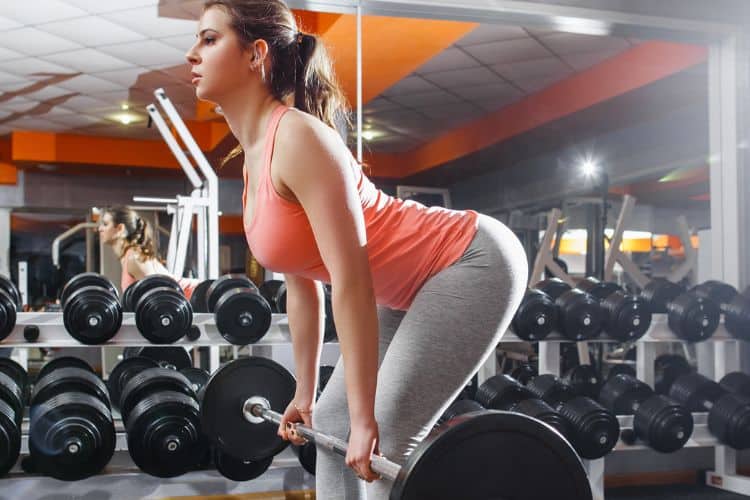
Hold the bar with your hands just outside your legs. Push your hips backward and lean forward while maintaining a braced torso. Allow the bar to hang underneath your shoulders.
Pull the bar toward your lower ribs or upper abdomen. Pause briefly, lower it under control, and avoid using excessive body momentum. If maintaining the bent-over position is difficult, reduce the weight or use a chest-supported dumbbell row while developing back strength.
Hold the bar in front of your thighs with your knees slightly bent. Push your hips backward while keeping the bar close to your legs. Lower the bar until you feel tension through your hamstrings without forcing it toward the floor.
Drive your hips forward and return to a tall position. The Romanian deadlift is a hip-hinge exercise, so most of the movement should come from the hips rather than a deep bend of the knees.
Hold the bar near your upper chest with your hands slightly wider than shoulder width. Brace your glutes and abdominal muscles, then press the bar overhead. Move your head slightly back as the bar passes your face, then bring your head through once the bar is overhead.
Avoid leaning excessively backward. If you must arch your lower back to finish each repetition, the weight is likely too heavy. A lighter training bar is particularly helpful for learning this exercise.
Sit on the floor with your upper back near a bench and place a padded barbell across your hips. For a floor-based glute bridge, lie completely on the floor. Bend your knees and position your feet so your shins are close to vertical at the top.
Brace your abdomen and drive through your feet to raise your hips. Squeeze your glutes at the top without overextending your lower back, then lower the weight slowly.
During weeks one and two, concentrate on technique and consistency. Use a light weight and stay within the lower end of the recommended sets if necessary. You may perform only two working sets per exercise during your first few sessions.
In weeks three and four, aim to complete all prescribed sets. Add repetitions before adding weight. If the target range is six to eight repetitions, try to progress from six repetitions to seven and then eight while using the same resistance.
During weeks five and six, add a small amount of weight once you can complete the top of the repetition range for every set with good form. An increase of two-and-a-half to five pounds may be enough for upper-body lifts, while a five- to ten-pound increase may be appropriate for lower-body exercises.
Continue this gradual approach during weeks seven and eight. Do not add weight automatically if the previous session felt uncontrolled. Repeat the same load, reduce it slightly, or perform fewer repetitions until your technique is reliable.
Progressive overload means gradually increasing the training challenge as your body adapts. Adding weight is one method, but it is not the only option. You can also complete another repetition, improve your range of motion, use better technique, or perform the same work with greater control.
A simple double-progression method works well for beginners. Suppose your exercise calls for three sets of six to eight repetitions. Start with a weight you can lift for three sets of six. Over subsequent workouts, build toward three sets of eight. Once you reach eight repetitions on every set with solid form, add a small amount of weight and return to six repetitions.
Progress should be gradual rather than forced. Sleep, stress, nutrition, and menstrual-cycle symptoms may affect performance from one workout to another. A single difficult session does not mean the program has stopped working.
One common mistake is adding weight before mastering the movement. A heavier bar may feel exciting, but poor technique can prevent the intended muscles from working effectively and may increase injury risk.
Another mistake is changing exercises too frequently. Beginners benefit from repeating fundamental movements because repetition develops skill. Follow the same basic plan long enough to evaluate your progress before replacing exercises.
Skipping warm-up sets can also make the first working set feel unnecessarily difficult. Conversely, performing too many warm-up sets may create fatigue. Use enough preparation to feel ready without turning the warm-up into a second workout.
Training every set to failure is rarely necessary for a beginner. Stop while you can still maintain good form. Consistent, high-quality repetitions are more valuable than struggling through forced repetitions.
Finally, avoid comparing your starting weight to someone else’s working weight. Strength varies based on experience, anatomy, exercise technique, recovery, and many other factors. Your goal is to improve your own performance.
Aim for seven to nine hours of sleep whenever possible. Sleep supports muscle repair, physical performance, appetite regulation, and overall well-being. If your schedule makes this difficult, focus on a consistent bedtime and a relaxing evening routine.
Eat balanced meals containing protein, carbohydrates, dietary fats, fruits, and vegetables. Protein supports muscle repair, while carbohydrates help fuel demanding workouts. Useful protein sources include eggs, Greek yogurt, chicken, fish, lean meat, tofu, tempeh, lentils, beans, and cottage cheese.
Drink water throughout the day and bring a water bottle to your workout. More fluid may be necessary in hot conditions or during longer sessions. A balanced meal containing protein and carbohydrates within a few hours before or after training can support energy and recovery.
Normal muscle soreness may occur when beginning a program, but severe pain is not a requirement for progress. Sharp, sudden, or persistent pain should not be ignored. Stop the aggravating exercise and seek guidance from an appropriate healthcare or fitness professional.
Lifting weights does not suddenly create excessive muscle size. Noticeable muscle growth requires consistent training, sufficient nutrition, and significant time. Most beginners experience gradual changes in strength, muscle definition, and body composition.
Yes. The empty bar may provide enough resistance while you learn the exercises. If a 45-pound bar is too heavy, use a lighter training bar, fixed barbell, PVC pipe, or another beginner-friendly variation.
Most sessions should take approximately 45 to 60 minutes, including the warm-up. The exact duration depends on your rest periods, equipment availability, and number of warm-up sets.
Continue with the next scheduled workout instead of trying to perform multiple sessions close together. One missed workout will not erase your progress. Long-term consistency matters more than maintaining a perfect schedule.
Consider advancing after eight to twelve weeks if you have learned the exercises, made consistent progress, and can recover comfortably between workouts. You can also continue this plan longer if it remains effective.
A successful full body beginner barbell workout plan does not need dozens of exercises or an exhausting daily schedule. Three balanced weekly sessions can provide an effective foundation for building strength, developing lean muscle, and becoming comfortable with resistance training.
Begin with weights you can control, practice the primary movement patterns, and progress in small increments. Give your body adequate rest, eat nourishing meals, and record your workouts so you can recognize improvements that might otherwise be easy to overlook.
The most important goal during the first several weeks is not lifting the heaviest possible bar. It is developing the technique, confidence, and consistency that will allow you to keep getting stronger for years to come.
Build your confidence and technique before beginning this routine with these Beginner Strength Training Exercises for women. You can also review The Best Barbell Exercises For Women to learn the foundational lifts used in the plan. For more total-body training ideas, explore this Full Body Strength Workout For Women or challenge yourself with a 35 Minute Full Body Barbell Circuit once your form and conditioning improve. When you are ready for a higher-frequency routine, progress to this 5 Day Full Body Barbell Workout for additional strength and muscle-building work.
Stay up to date on the latest women’s health, fitness and lifestyle trends and tips.
