


Sign up for workout ideas, training advice, reviews of the latest gear and more.

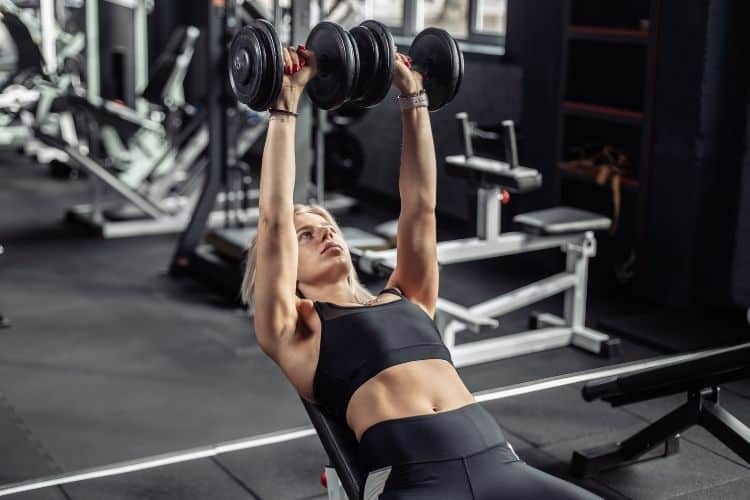
A progressive overload dumbbell workout plan is one of the most effective ways to build strength, increase lean muscle, improve muscular endurance, and continue making progress without needing complicated gym equipment. Whether you train at home or in a gym, dumbbells provide enough versatility to train nearly every major muscle group while allowing you to gradually increase the difficulty of your workouts.
Progressive overload simply means challenging your muscles slightly more over time. Instead of performing the same exercises with the same dumbbells, repetitions, and sets every week, you gradually increase the training demand. That might mean lifting heavier dumbbells, performing additional repetitions, adding another set, improving your range of motion, slowing down each repetition, or reducing rest periods.
The key is progression without rushing. You do not need to increase your dumbbell weight every workout. Small improvements accumulated over several weeks can produce meaningful results. This progressive overload dumbbell workout plan provides a structured approach that can work for beginners and intermediate lifters who want a straightforward strength-training routine.
Progressive overload is the process of gradually increasing the demands placed on your muscles during resistance training. When your body adapts to a certain workload, continuing to perform exactly the same workout may eventually produce fewer improvements.
For example, imagine you perform dumbbell goblet squats with a 20-pound dumbbell for three sets of 10 repetitions. Initially, those sets may feel challenging. After several weeks of consistent training, however, you may be able to complete every repetition comfortably.
Instead of continuing indefinitely with the same workload, you could perform 11 or 12 repetitions, increase the dumbbell weight, add a fourth set, or use a slower lowering phase. Each strategy increases the challenge and gives your body a reason to continue adapting.
Progressive overload does not mean every workout needs to be harder than the previous one. Training progress rarely happens in a perfectly straight line. Some workouts will feel easier than others because of sleep, stress, nutrition, recovery, and everyday activity. The goal is to look for gradual improvements across several weeks and months.
Dumbbells are especially useful for progressive overload because they allow you to increase resistance in manageable increments while performing dozens of different exercises. You can use dumbbells for squats, lunges, Romanian deadlifts, chest presses, rows, shoulder presses, curls, triceps exercises, and many other movements.
Another advantage is unilateral training. Exercises such as single-arm dumbbell rows, split squats, and single-arm shoulder presses allow each side of your body to work independently. This can help you identify differences in strength and control between sides.
Dumbbells also offer greater freedom of movement than many fixed-path machines. You can adjust your grip, arm angle, stance, and range of motion according to the exercise and your comfort level.
Most importantly, dumbbell workouts are easy to track. Recording the weight, sets, and repetitions performed gives you measurable numbers you can use when deciding how to progress your next workout.
Following a structured progressive overload program gives your workouts direction. Instead of choosing random exercises every training session, you repeat important movement patterns and attempt to gradually improve your performance.
Resistance training provides the muscular tension necessary to support muscle growth. When combined with appropriate recovery and nutrition, progressively challenging dumbbell workouts can help increase lean muscle over time.
Muscle growth does not require constantly changing exercises. In fact, repeating key exercises for several weeks can make progression easier because you can compare your current performance with previous workouts.
Strength improves as your muscles and nervous system become better at producing force. Gradually increasing your dumbbell loads or performing more repetitions with an existing weight can help develop strength throughout your entire body.
You do not need a large collection of machines to use progressive overload. An adjustable dumbbell set or several pairs of dumbbells can provide enough resistance for an effective full-body program.
Progressive overload turns vague goals into measurable improvements. Instead of wondering whether your workouts are working, you can review your training log and see whether you are lifting more weight, completing more repetitions, or performing more total training volume.
Choosing the appropriate dumbbell weight is essential. The resistance should be challenging enough that the final repetitions of each working set require effort while still allowing you to maintain controlled technique.
If your program calls for 8 to 12 repetitions and you can easily perform 15 or more, the dumbbells may be too light for that particular exercise. If you cannot reach the bottom of the target range without losing your form, the weight may be too heavy.
Remember that different exercises require different weights. You will probably be able to use considerably heavier dumbbells for Romanian deadlifts or squats than for lateral raises or biceps curls.
Keep several dumbbell options available when possible and select the resistance based on the exercise rather than attempting to use the same pair for your entire workout.
This plan uses four training days per week. The schedule provides enough training frequency to practice the major exercises regularly while still including recovery days.
A practical weekly schedule could be Monday for upper body, Tuesday for lower body, Wednesday for recovery, Thursday for upper body, Friday for lower body, and the weekend for rest or light activity.
If four workouts per week do not fit your schedule, you can complete three sessions and continue with the next workout the following week rather than trying to squeeze everything into fewer days.
Begin with the dumbbell chest press for three sets of 8 to 12 repetitions. Lie on a bench or stable floor surface, position the dumbbells near your chest, and press them upward while maintaining control. Lower the weights gradually instead of allowing gravity to take over.
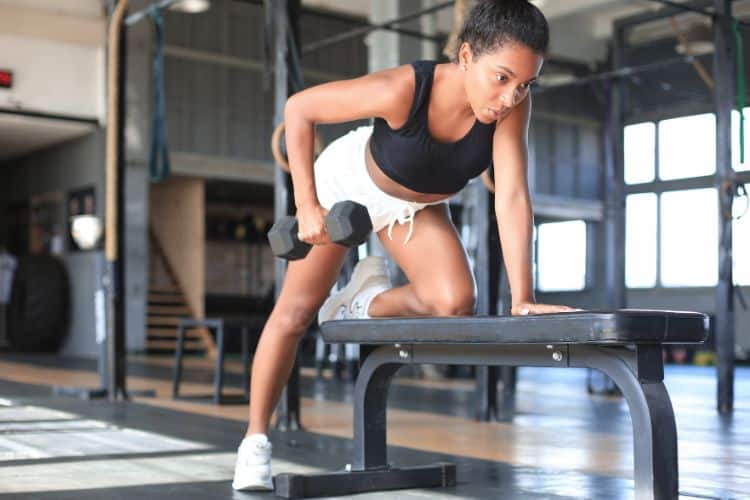
Next, perform one-arm dumbbell rows for three sets of 8 to 12 repetitions per side. Keep your torso stable and pull the dumbbell toward your hip while focusing on using your back rather than simply curling the weight.
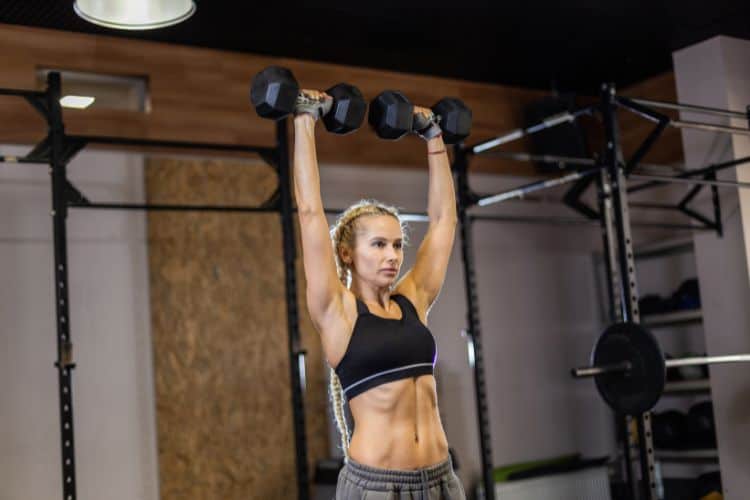
Move into dumbbell shoulder presses for three sets of 8 to 12 repetitions. Keep your core engaged and avoid excessively arching your lower back.
Finish with dumbbell lateral raises, biceps curls, and overhead triceps extensions for two or three sets of 10 to 15 repetitions each.
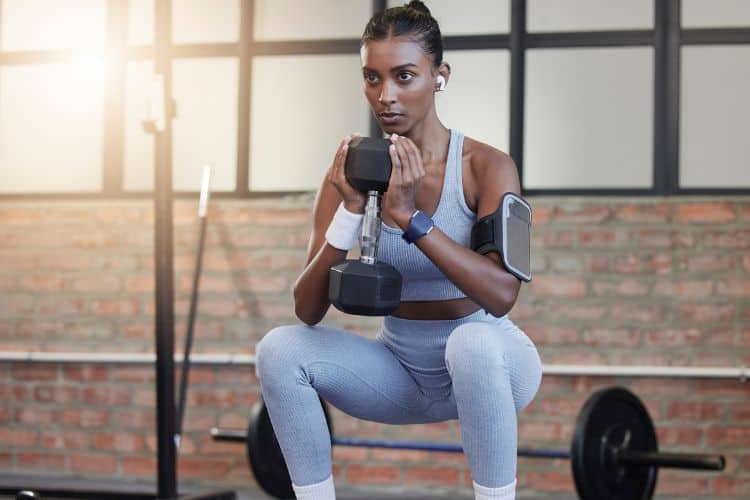
Start your lower-body session with goblet squats for three sets of 8 to 12 repetitions. Hold a dumbbell close to your chest and squat down while keeping your feet firmly planted.
Follow with dumbbell Romanian deadlifts for three sets of 8 to 12 repetitions. Push your hips backward while keeping the dumbbells close to your legs. Maintain a neutral spine and focus on controlled hip movement.
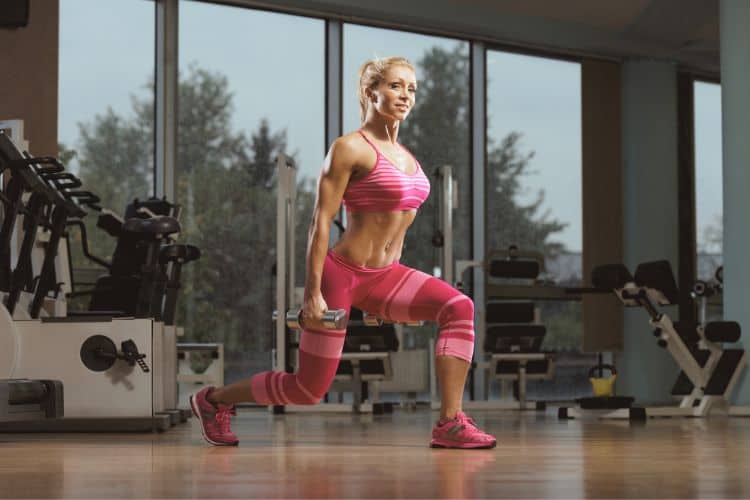
Perform dumbbell reverse lunges for three sets of 8 to 12 repetitions per leg. Step backward into the lunge and push through your front foot to return to standing.
Complete the session with dumbbell glute bridges or hip thrusts for three sets of 10 to 15 repetitions and standing dumbbell calf raises for three sets of 12 to 20 repetitions.
Your second upper-body workout changes some exercise angles while still training the same major muscle groups.
Start with an incline dumbbell chest press for three sets of 8 to 12 repetitions. Follow with bent-over dumbbell rows for three sets of 8 to 12 repetitions.
Next, perform Arnold presses for three sets of 8 to 12 repetitions. Use a weight you can control throughout the rotation instead of selecting dumbbells that force you to rush the movement.
Continue with dumbbell reverse flyes for two or three sets of 10 to 15 repetitions. Finish with hammer curls and dumbbell triceps kickbacks for two or three sets of 10 to 15 repetitions.
Begin the second lower-body workout with dumbbell sumo squats for three sets of 8 to 12 repetitions. Use a wider stance than your regular squat and maintain controlled movement throughout the exercise.
Next, perform Bulgarian split squats for three sets of 8 to 12 repetitions per leg. Because this exercise can be challenging even with relatively light dumbbells, prioritize balance, range of motion, and technique before increasing resistance.
Follow with dumbbell deadlifts for three sets of 8 to 12 repetitions and dumbbell step-ups for three sets of 8 to 12 repetitions per leg.
Finish with weighted glute bridges for three sets of 12 to 15 repetitions and calf raises for three sets of 15 to 20 repetitions.
The workout exercises are only part of the plan. The progression strategy is what turns a standard dumbbell routine into a progressive overload program.
One of the easiest strategies is double progression. Suppose your target range is 8 to 12 repetitions. Start with a dumbbell weight that allows you to perform approximately eight quality repetitions.
Over subsequent workouts, try to increase the repetitions gradually.
You might perform 8 repetitions during week one, 9 during week two, 10 during week three, 11 during week four, and eventually 12.
You do not need to follow this exact timeline. Some exercises may progress faster or slower.
Once you can perform the upper end of the repetition range across your working sets with good technique, consider increasing the dumbbell weight.
After reaching the top of your repetition range, move to the next practical dumbbell weight.
Your repetitions may temporarily decrease after increasing resistance. That is normal.
For example, you might progress from three sets of 12 repetitions with 15-pound dumbbells to three sets of 8 repetitions with 20-pound dumbbells. You can then gradually build toward 12 repetitions with the heavier weight.
Adding a set increases total training volume. An exercise performed for three sets can eventually be increased to four sets when additional volume is appropriate.
However, more sets are not automatically better. Adding excessive volume can increase fatigue without improving results. Prioritize the quality of your working sets before continually adding more.
Progressive overload is not limited to numbers. Performing an exercise with better control, stability, and range of motion can represent meaningful progress.
If your dumbbell squat becomes deeper and more controlled while using the same weight and repetitions, the exercise may be more demanding even though the numbers in your workout log have not changed.
Tempo can increase exercise difficulty without requiring heavier dumbbells. Try lowering the weight for approximately two to three seconds during exercises such as squats, Romanian deadlifts, chest presses, and rows.
Avoid intentionally making every repetition extremely slow. The goal is controlled movement, not turning each set into an endurance contest.
During weeks one and two, focus primarily on learning the exercises and establishing appropriate starting weights. Stay near the lower or middle portion of your repetition ranges and record your results.
During weeks three and four, begin adding repetitions whenever you can complete your current workload with good technique. You might add one repetition to each set or increase only the final set.
Weeks five and six can be used to increase dumbbell resistance on exercises where you have consistently reached the top of your target repetition range. After increasing the weight, return toward the lower end of the repetition range.
During weeks seven and eight, continue building repetitions with the heavier dumbbells while evaluating your overall recovery. You may also add a set to selected major exercises if you are recovering well and need additional training volume.
After eight weeks, review your training log. Compare your starting weights and repetitions with your current numbers. You can repeat the program with heavier resistance, adjust selected exercises, or begin another progressive training cycle.
Rest periods influence workout performance. For larger compound exercises such as dumbbell squats, Romanian deadlifts, chest presses, and rows, approximately 90 seconds to two or more minutes of rest may help you maintain performance.
Smaller isolation exercises such as lateral raises, curls, and triceps extensions may require less recovery.
Do not reduce your rest periods simply to make the workout feel harder. If your primary goal is progressive strength training, adequate recovery between demanding sets can help you perform more high-quality repetitions.
A good warm-up prepares your body for training without exhausting you before your working sets begin.
Start with several minutes of easy movement to gradually increase your body temperature. Follow with dynamic movements related to the muscles you will train.
Before your first heavy exercise, consider performing one or two lighter practice sets. For example, before starting your working sets of dumbbell chest presses, perform a lighter set to practice the movement and prepare your shoulders, elbows, and chest.
Your warm-up should leave you feeling prepared rather than fatigued.
Keeping a training log is one of the simplest ways to make progressive overload more consistent.
Record the exercise, dumbbell weight, number of sets, and repetitions completed. You can also record short notes about technique or difficulty.
For example, your log might show that you performed goblet squats with 30 pounds for 10, 10, and 9 repetitions. During your next lower-body session, your goal could be 10, 10, and 10 repetitions.
That small improvement is progressive overload.
Over several months, these seemingly minor increases can add up to substantial improvements in training performance.
One of the biggest mistakes is increasing dumbbell weight too quickly. Heavier weights are useful only when you can control them properly. Sacrificing technique just to move larger dumbbells can reduce the quality of the exercise.
Another mistake is trying to progress every variable simultaneously. You generally do not need to add weight, repetitions, sets, and intensity techniques all at once. Choose one manageable form of progression.
Constantly changing exercises can also make progress difficult to measure. Exercise variety can be useful, but replacing your entire routine every week prevents you from developing consistency with your primary movements.
Finally, avoid assuming that soreness determines workout quality. A productive workout does not need to leave you extremely sore. Progress should be evaluated through improvements in strength, repetitions, movement quality, and long-term consistency.
Training creates the stimulus for adaptation, but recovery gives your body an opportunity to respond to that stimulus.
Eat a balanced diet that provides sufficient protein, carbohydrates, fats, vitamins, minerals, and overall energy for your needs. Protein is particularly important for supporting muscle maintenance and growth, while carbohydrates can help fuel demanding resistance-training sessions.
Sleep also plays an important role in recovery. Consistently getting adequate sleep can support training performance and help you feel prepared for your next workout.
Recovery days do not necessarily require complete inactivity. Walking, gentle mobility work, and other comfortable activities can be included according to your preferences and recovery needs.
Increase your dumbbell weight when you can consistently complete the upper end of your target repetition range with good technique and the exercise no longer provides an appropriate challenge.
For example, if your goal is three sets of 8 to 12 dumbbell shoulder presses and you can perform 12 controlled repetitions on all three sets, you may be ready for heavier dumbbells.
Move up by the smallest practical increment available. After increasing the weight, your repetitions will probably decrease. Build them back up gradually before increasing resistance again.
There is no requirement to increase weight every week. Some exercises may progress quickly, while smaller isolation movements can take considerably longer.
Beginners should emphasize consistency and exercise technique before aggressively increasing resistance. During your first several weeks, becoming more comfortable with the exercises is progress in itself.
Start with manageable weights and leave a few good repetitions in reserve rather than pushing every set to complete muscular failure.
You can also begin with fewer training days. Two or three full-body dumbbell workouts per week may be enough to establish a strong foundation before moving into a four-day program.
As your technique, strength, and confidence improve, gradually increase resistance and training volume.
Dumbbells can provide substantial resistance for building muscle, particularly when your program includes exercises covering the major movement patterns and you continue increasing the training challenge over time.
A dumbbell-only program can include squatting, hinging, lunging, horizontal pressing, overhead pressing, rowing, arm training, and loaded core exercises.
Eventually, extremely strong lifters may encounter limitations if their available dumbbells are not heavy enough. In that situation, unilateral exercises, additional repetitions, longer ranges of motion, and more challenging exercise variations can extend the usefulness of lighter dumbbells.
Adjustable dumbbells can be particularly helpful because they provide a wider range of resistance without requiring dozens of individual weights.
Consider following the core program for approximately six to eight weeks before making major changes. This gives you enough time to practice the movements and measure meaningful progression.
You do not need to change your workout simply because several weeks have passed. If you are still improving your repetitions, weights, technique, and overall performance, the routine can remain productive.
Change exercises when you have a practical reason, such as discomfort, equipment limitations, boredom that is affecting consistency, or a new training goal.
A successful progressive overload dumbbell workout plan does not need to be complicated. The foundation is simple: choose effective exercises, train consistently, record your performance, recover properly, and gradually increase the challenge.
Start with weights you can control and establish a baseline for each exercise. Work within a defined repetition range and gradually add repetitions. Once you reach the top of that range with good form, increase your dumbbell weight and begin building your repetitions again.
Remember that progressive overload is about long-term improvement rather than making every workout dramatically harder. Adding one repetition, improving your range of motion, using slightly heavier dumbbells, or completing your sets with better control can all represent progress.
Stay patient and focus on small, repeatable improvements. When those improvements accumulate across weeks and months, a simple set of dumbbells can become an extremely effective tool for building a stronger, more muscular, and more capable body.
To keep building strength and getting more from your progressive overload dumbbell workout plan, explore these related workouts from Women’s Fit Club. Start with this Progressive Overload Workout Plan for Women to learn additional ways to gradually increase weight, reps, and sets. Next, try the Dumbbell Workout Plan for Women for a balanced strength routine, or challenge yourself with this 35 Minute Dumbbell Workout Plan for Strength and Muscle Growth. For a longer full-body training session, follow the 45 Minute Full Body Dumbbell Strength Training Workout. You can also build a consistent weekly routine with the Ultimate 5-Day Dumbbell-Only Workout Plan for Women, which makes it easy to apply progressive overload across multiple muscle groups throughout the week.
Stay up to date on the latest women’s health, fitness and lifestyle trends and tips.
