


Sign up for workout ideas, training advice, reviews of the latest gear and more.

Finding time for exercise can be challenging when work, family responsibilities, errands, and everyday life fill your schedule. The good news is that an effective workout does not have to take an hour. Quick 15 minute full body dumbbell workouts can train your major muscle groups, improve cardiovascular fitness, build strength, and help increase your daily calorie expenditure without requiring a long gym session.
Dumbbells are especially useful for short workouts because they allow you to move quickly between exercises while training several muscle groups at once. Squats, presses, rows, lunges, deadlifts, and other compound movements can create a challenging full-body routine with very little equipment. Whether you exercise at home or at the gym, a pair of dumbbells and 15 focused minutes can be enough to complete a productive training session.
The key is making those minutes count. Instead of spending a lot of time on isolation exercises or taking long breaks, a short dumbbell workout should emphasize efficient movements, controlled repetitions, and brief rest periods. This 15 minute full body dumbbell workout provides a simple structure you can adjust according to your fitness level, available weights, and training goals.
A common misconception is that workouts must be long to produce meaningful results. Training duration is only one part of an effective exercise program. Exercise selection, effort, consistency, resistance, technique, and progression all influence your results.
A well-designed 15 minute workout can include several compound dumbbell exercises that challenge multiple muscles simultaneously. For example, a dumbbell squat primarily targets the quadriceps and glutes while also requiring the core and upper body to stabilize the weights. A dumbbell row trains the back and arms, while an overhead press targets the shoulders, triceps, and core.
Combining these movements allows you to train much of your body within a relatively short period.
Short workouts may also make consistency easier. Completing a 15-minute session several times per week may be more realistic for a busy schedule than repeatedly planning hour-long workouts that you struggle to complete.
One of the biggest advantages of full-body dumbbell training is efficiency. Compound exercises allow several muscle groups to contribute to the same movement.
Instead of performing numerous exercises for individual muscles, you can build your routine around movements such as squats, Romanian deadlifts, lunges, rows, chest presses, and shoulder presses.
This approach makes it possible to create a balanced workout even when you only have 15 minutes.
Dumbbells require each side of your body to control its own weight. This can help develop coordination, stability, and balanced strength.
Exercises such as reverse lunges, one-arm rows, and alternating overhead presses also challenge your core because your body must resist unwanted rotation and maintain proper alignment.
These qualities can transfer to everyday activities such as carrying groceries, climbing stairs, lifting objects, and performing household tasks.
When full-body dumbbell exercises are performed in a circuit with short rest periods, the workout can provide both resistance training and a cardiovascular challenge.
Moving from squats into rows, presses, and lunges keeps several large muscle groups working. As the demand increases, your heart rate will usually rise as well.
You do not need to rush your repetitions. Maintaining good technique while keeping transitions short is usually a better strategy than sacrificing form simply to move faster.
A 15 minute dumbbell workout at home requires very little space or equipment. In many cases, one pair of dumbbells is enough.
You can perform the workout in a bedroom, living room, garage, or another small training area. Adjustable dumbbells can make home workouts even more versatile because you can increase or decrease resistance for different exercises.
Choosing an appropriate weight is important because resistance that is too light may not challenge your muscles enough, while weights that are excessively heavy can make it difficult to maintain good form.
A useful starting point is choosing dumbbells that allow you to complete the recommended repetitions while maintaining controlled technique. The final few repetitions of a working set should feel challenging, but you should still be able to complete them without dramatically changing your movement pattern.
You may also need different weights for different exercises. Your legs and back can generally handle more resistance than smaller muscle groups such as your shoulders.
If you only have one pair of dumbbells, you can modify difficulty by adjusting repetitions, tempo, range of motion, or rest periods.
Even when time is limited, preparing your body before lifting is worthwhile. A warm-up does not need to be complicated.
Spend approximately two minutes performing movements such as bodyweight squats, alternating reverse lunges, arm circles, hip hinges, and gentle torso rotations. Gradually increase your range of motion as your muscles warm up.
Perform several repetitions of the exercises you plan to use with no weight or lighter resistance when necessary.
Your goal is to prepare your joints and muscles rather than exhaust yourself before the workout begins.
This workout uses six exercises to target your lower body, upper body, and core. Complete the exercises as a circuit.
Perform each exercise for approximately 40 seconds, followed by 20 seconds to transition or rest. Six exercises will take about six minutes. Complete two rounds, resting approximately one minute between rounds. Use the remaining time for a brief warm-up and cooldown.
Beginners can reduce the work interval to 30 seconds and increase recovery time. More experienced lifters can use heavier dumbbells or reduce rest while maintaining proper technique.
Begin with the goblet squat to train your quadriceps, glutes, hamstrings, and core.
Hold one dumbbell vertically near your chest with both hands. Position your feet approximately shoulder-width apart with your toes slightly turned outward if comfortable. Brace your core and sit your hips downward while bending your knees.
Lower yourself as far as you can comfortably while maintaining control. Keep your chest lifted and your knees tracking in the same general direction as your toes.
Push through your feet to return to standing and squeeze your glutes at the top.
Avoid rushing through the movement. Controlled squats increase muscular tension and help you maintain proper positioning.
The dumbbell Romanian deadlift emphasizes the hamstrings and glutes while also training your back and core to stabilize the weight.
Stand upright holding a dumbbell in each hand in front of your thighs. Keep your knees slightly bent. Push your hips backward while allowing the dumbbells to travel downward close to your legs.
Maintain a neutral spine and continue lowering until you feel tension through your hamstrings without losing your back position.
Drive your hips forward and return to standing.
Think about moving primarily from your hips instead of turning the exercise into a squat. The dumbbells should remain relatively close to your body throughout the movement.
Rows are important for balancing pressing movements and strengthening the muscles of your upper and middle back.
Hold a dumbbell in each hand and hinge forward from your hips. Keep your spine neutral and your core engaged. Allow your arms to hang beneath your shoulders.
Pull the dumbbells toward your sides by driving your elbows backward. Pause briefly near the top before lowering the weights under control.
Avoid using excessive momentum or repeatedly raising and lowering your torso to move the weights.
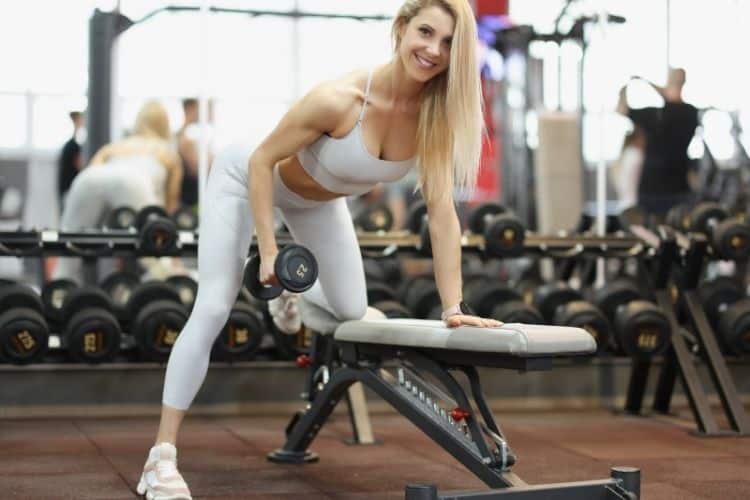
If maintaining the bent-over position is difficult, perform supported one-arm rows with one hand placed on a sturdy bench or stable surface.
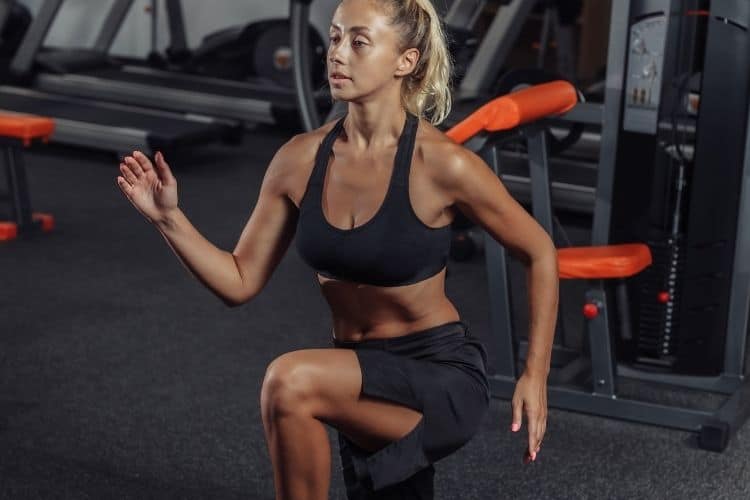
Reverse lunges train your quadriceps, hamstrings, glutes, calves, and core while adding a unilateral component to your quick dumbbell workout.
Stand tall holding dumbbells at your sides. Step one foot backward and lower yourself toward the floor by bending both knees.
Push through your front foot to return to standing and repeat with the opposite leg.
Keep your torso controlled and avoid letting your front knee collapse inward.
Beginners can perform the movement without dumbbells until they become comfortable with the balance and technique required.
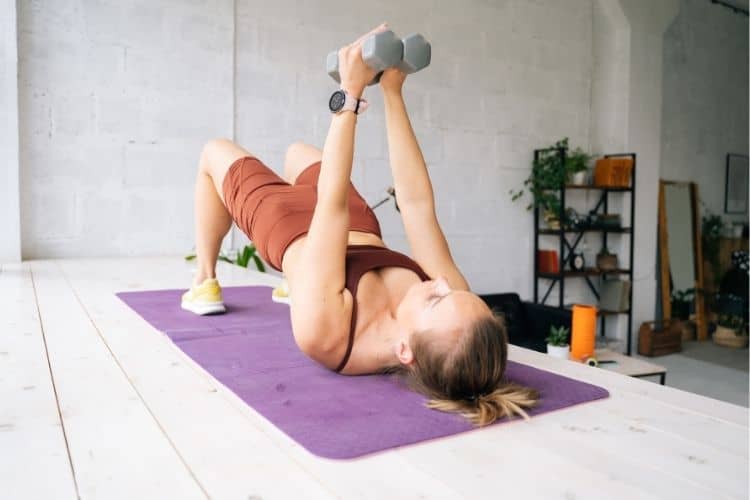
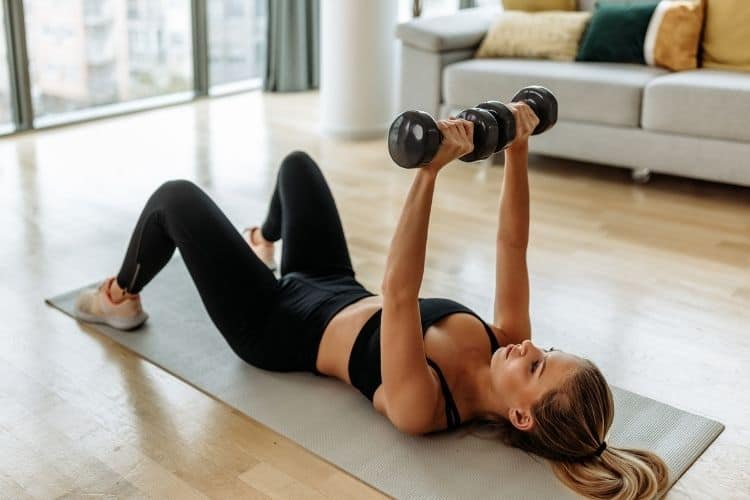
The dumbbell floor press trains your chest, shoulders, and triceps without requiring a workout bench.
Lie on your back with your knees bent and feet planted on the floor. Hold one dumbbell in each hand with your upper arms resting lightly against the floor.
Press the dumbbells upward until your arms are extended without aggressively locking your elbows. Lower the weights slowly until your upper arms gently contact the floor.
Keep your wrists relatively straight and maintain control throughout every repetition.
The floor naturally limits your range of motion, making this an excellent pressing option for home dumbbell workouts.
Finish the circuit with a dynamic exercise that challenges your shoulders, triceps, legs, and core.
Hold the dumbbells near shoulder height. Slightly bend your knees and hips, then drive through your legs while pressing the dumbbells overhead.
Lower the dumbbells back toward your shoulders under control and repeat.
The leg drive allows several muscle groups to work together and can elevate your heart rate near the end of the circuit.
If you prefer a slower strength-focused movement, replace the push press with a strict standing dumbbell shoulder press.
As your fitness improves, the same workout will eventually feel easier. Progressive overload is important if your goal is to continue building strength and muscle.
One option is increasing your dumbbell weight. Even a small increase can significantly change the difficulty of compound exercises.
You can also perform more repetitions during each interval, but only when you can maintain good form.
Another effective method is slowing the lowering portion of an exercise. For example, lower into a squat for three seconds before standing normally. This increases time under tension without requiring heavier dumbbells.
Reducing rest periods can increase cardiovascular difficulty, although rest should never become so short that your technique deteriorates.
Beginners do not need to perform the workout at maximum intensity.
Start with five basic exercises: goblet squats, Romanian deadlifts, supported dumbbell rows, floor presses, and standing shoulder presses.
Perform each movement for approximately 30 seconds and rest for 30 seconds. Complete two rounds at a comfortable pace.
Focus primarily on learning proper exercise technique.
During your first few weeks, gradually increase your repetitions or resistance rather than attempting to dramatically increase workout intensity immediately.
Consistency provides a stronger foundation for long-term progress.
Experienced exercisers can make a short workout surprisingly demanding by combining movements.
Try dumbbell squat-to-presses, alternating reverse lunges, renegade rows, Romanian deadlift-to-rows, push presses, and dumbbell thrusters.
Perform each movement for approximately 45 seconds followed by 15 seconds of recovery.
The goal is not simply completing as many repetitions as possible. Choose challenging weights and maintain controlled technique throughout the workout.
Advanced lifters can also alternate between heavier strength-focused sessions and lighter, faster circuits during the week.
A 15 minute full body dumbbell workout for fat loss can contribute to a weight-management program because physical activity increases energy expenditure and resistance training helps maintain or build muscle.
However, no workout can selectively burn fat from specific areas such as your stomach, thighs, or arms.
Overall fat loss depends largely on maintaining an appropriate calorie balance over time. Nutrition, physical activity, sleep, stress management, and consistency all contribute to the process.
Instead of viewing a short workout as a quick fix, consider it one component of an active lifestyle.
Walking, recreational activities, strength training, and other forms of movement can complement your dumbbell workouts.
For many people, performing a full-body dumbbell workout two to four times per week can provide a practical training schedule.
Your ideal frequency depends on your fitness level, workout intensity, recovery, and other activities.
Beginners may start with two or three nonconsecutive training days each week. This provides recovery time while allowing frequent practice of the major exercises.
As your conditioning improves, you can increase training frequency or combine short dumbbell workouts with walking, cycling, mobility work, or other activities.
Avoid assuming that more training is automatically better. Recovery is part of the process.
One common mistake is moving too quickly. A 15-minute workout is short, but that does not mean every exercise should become a race.
Another problem is selecting weights that are too heavy. If you cannot control the dumbbells or maintain your normal range of motion, reduce the resistance.
Using weights that are consistently too light can also limit progress. Once you can easily complete every interval, gradually increase the challenge.
Avoid performing the exact same workout indefinitely. Your body adapts to repeated training. Change resistance, repetitions, tempo, exercise variations, or workout structure periodically to continue progressing.
Finally, do not ignore discomfort. Normal muscular effort is different from sharp or unusual pain. Stop an exercise that causes pain and choose an appropriate alternative. Anyone with an injury, medical condition, or uncertainty about exercise should consider getting individualized guidance from a qualified health or fitness professional.
Tracking your workouts can make progression easier.
Write down which dumbbells you used and approximately how many quality repetitions you completed for each exercise. The next time you perform the workout, try to improve one variable.
For example, you might complete one additional squat, use slightly heavier dumbbells for rows, or perform your Romanian deadlifts with a slower lowering phase.
Small improvements accumulate over time.
You can also rotate different 15 minute dumbbell workouts throughout the week. One session might emphasize heavier strength movements, while another uses lighter weights and shorter rest periods for conditioning.
This variety can help keep your workouts interesting while challenging your body in different ways.
A simple weekly routine might include full-body dumbbell training on Monday, Wednesday, and Friday.
Monday could focus on traditional strength exercises such as squats, Romanian deadlifts, rows, floor presses, and shoulder presses.
Wednesday could include more unilateral exercises such as split squats, one-arm rows, single-leg Romanian deadlifts, alternating presses, and weighted core movements.
Friday could use a faster circuit containing goblet squats, reverse lunges, push presses, rows, and dumbbell deadlifts.
On the days between your dumbbell workouts, consider walking or performing light mobility work depending on your recovery and goals.
The variety helps distribute training stress while still allowing you to exercise consistently.
Treat your short workouts with the same attention you would give a longer training session.
Choose exercises before you begin so you do not waste time deciding what to do next. Place your dumbbells and any other equipment nearby.
Minimize distractions during the workout. Fifteen minutes can pass quickly, and checking your phone between exercises can significantly reduce actual training time.
Prioritize controlled repetitions over speed. The purpose of resistance training is to challenge your muscles, not simply finish the circuit as quickly as possible.
Nutrition and recovery also matter. Eat a balanced diet that supports your activity level, include adequate protein, stay hydrated, and prioritize consistent sleep.
Most importantly, remain consistent. A workout does not need to be complicated to be productive.
Fifteen minutes can be enough for a useful workout, particularly when you select compound exercises and train consistently. Your overall results will depend on your goals, training intensity, weekly exercise volume, nutrition, and recovery.
People pursuing significant muscle or strength gains may eventually benefit from longer or additional training sessions, but short workouts can still play an important role.
Yes. Beginners can perform full-body dumbbell workouts by choosing manageable weights, using simpler exercise variations, taking longer rests, and focusing on technique.
Start gradually and increase difficulty as your strength and confidence improve.
Daily training may be appropriate in some circumstances, but you do not necessarily need to train the same muscles intensely every day.
Alternating hard sessions with lighter activity or recovery days can help manage fatigue. Pay attention to your performance and recovery rather than focusing only on workout frequency.
Exercises involving large muscle groups generally require more overall effort than small isolation movements. Dumbbell squats, lunges, deadlifts, thrusters, rows, and push presses are examples of exercises that can create substantial full-body demand.
Calorie expenditure varies significantly between individuals, so exercise selection should also consider strength, technique, and long-term progression.
Quick 15 minute full body dumbbell workouts offer an efficient way to make strength training fit into a busy schedule. With just a pair of dumbbells, you can challenge your legs, glutes, back, chest, shoulders, arms, and core without spending hours exercising.
Build your routine around compound exercises such as goblet squats, Romanian deadlifts, rows, lunges, floor presses, and overhead presses. Keep transitions efficient, select resistance that challenges you without compromising form, and gradually increase the difficulty as you become stronger.
Most importantly, do not underestimate the value of consistency. A focused 15-minute workout completed regularly can be more useful than an ambitious workout program you rarely have time to follow. Whether your goal is building strength, improving fitness, supporting fat loss, or simply becoming more active, a pair of dumbbells and 15 minutes can give you a practical place to start.
Looking for more ways to keep your dumbbell training fresh? After completing this quick 15-minute routine, try our 15-Minute Dumbbell Workout for a Full Body Burn for another fast total-body session, or build strength with the 15-Minute Low Impact Dumbbell Workout when you want a joint-friendly option. If you have a little more time, progress to our 25-Minute Full Body Dumbbell Workout or challenge yourself with the 30-Minute Full Body Muscle-Building Dumbbell Workout. For a longer-term training strategy, follow our 4-Week Dumbbell Workout Plan for Full-Body Strength and Fat Loss to progressively increase the challenge and stay consistent with your workouts.
Stay up to date on the latest women’s health, fitness and lifestyle trends and tips.
