



Sign up for workout ideas, training advice, reviews of the latest gear and more.

If you want to build muscle without living in the gym, a four-day split offers a practical middle ground. The 4 day SplitLean workout organizes the week into two upper-body and two lower-body sessions. You practice the main movement patterns often enough to improve, while leaving room for recovery, walking, other activities, and everyday life. “Lean” in the name describes a training style focused on building strength and muscle with a manageable schedule; it does not promise that one exercise can remove fat from a particular area.
This plan is designed for women who have some basic lifting experience, though beginners can use the modifications below. You will squat or lunge, hinge, push, pull, and train your core each week. The first upper and lower sessions emphasize controlled, relatively heavier sets. The second pair adds different angles and a little more repetition work. You can use dumbbells for almost everything, and a bench, cable machine, or resistance band gives you extra options.
The goal is steady improvement, not exhaustion. Choose weights that make the final repetitions challenging while keeping your form intact. Record what you lift, repeat the plan for eight to twelve weeks, and increase the demands gradually. The details that follow show exactly how to schedule the days, warm up, perform each session, and decide when to progress.
“SplitLean” is the name of this four-day strength and muscle-building routine, not a standardized training method. The split separates upper- and lower-body training so that each session has a clear focus. That allows enough work for the muscles you are training without requiring a long full-body workout every time you exercise. It also puts at least one day between repeated sessions for the same region in the suggested schedule.
The approach fits a broad principle of resistance training: repeatedly challenge your muscles, allow them to recover, and gradually increase the work they can handle. Current American College of Sports Medicine guidance advises training all major muscle groups at least twice weekly and building gradually. Four lifting days are one workable way to do that, but they are not mandatory for health or results. If four days are more than you can recover from or consistently schedule, begin with two or three strength sessions instead.
Muscle building is sometimes called hypertrophy. You do not need to chase a burning sensation or make every set a maximum-effort test. Productive sets combine a suitable resistance, enough repetitions, a full range of motion you can control, and consistent practice. The specific weights will differ from person to person, and the right load may differ between a squat, row, and lateral raise.
Train upper body on Monday, lower body on Tuesday, rest or move gently on Wednesday, train upper body on Thursday, and train lower body on Friday. Saturday and Sunday can be rest days or include enjoyable low-intensity movement. If your week looks different, keep the order and try to allow roughly 48 hours before training the same region hard again. For example, a Tuesday/Wednesday/Friday/Sunday schedule can also work.
Plan on about 45 to 65 minutes per workout, including a brief warm-up. Allow two to three minutes between challenging compound sets if needed to maintain performance, and around 60 to 90 seconds between smaller accessory exercises. Those are starting points rather than a stopwatch rule. If your breathing is still making it hard to brace or lift well, take a little longer. Moving faster is not inherently better for muscle growth.
On each exercise, a notation such as “3 sets of 8–10” means complete three working sets, performing between eight and ten controlled repetitions in each. Warm-up sets do not count toward that number. Start near the lower end of the range when you learn a movement or add weight. Choose a load that leaves approximately one to three repetitions in reserve on most working sets: you should feel that you could complete a few more good repetitions if necessary. Beginners can leave a little more room while learning technique.
Spend five to eight minutes walking briskly, cycling, or doing another easy activity that raises your body temperature. Then rehearse the movements you are about to train: several unloaded squats and hip hinges before a lower-body day, or arm circles, light rows, and easy presses before an upper-body day. Perform one or two lighter practice sets before the first demanding exercise. The purpose is to prepare for the work ahead, so choose movements that help you feel ready rather than trying to turn the warm-up into another workout.
Start with a dumbbell or barbell bench press for three sets of six to eight repetitions. Keep your feet planted and your shoulder blades comfortably supported on the bench. Lower the weights with control toward the sides of your chest and press upward without bouncing. If a bench is unavailable, perform a dumbbell floor press; the floor limits the depth but still gives your chest, shoulders, and triceps meaningful work. Choose a challenging weight that lets you finish every set without twisting or flaring your elbows excessively.
Next, perform a one-arm dumbbell row for three sets of eight to ten repetitions per side. Support your free hand on a bench or sturdy surface, brace your trunk, and pull the weight toward your hip. Let your shoulder blade move naturally without rotating your whole torso to fling the dumbbell upward. A cable row is a useful substitute when it is available. Pairing a horizontal pull with the press helps balance the session and builds the muscles of your upper back.
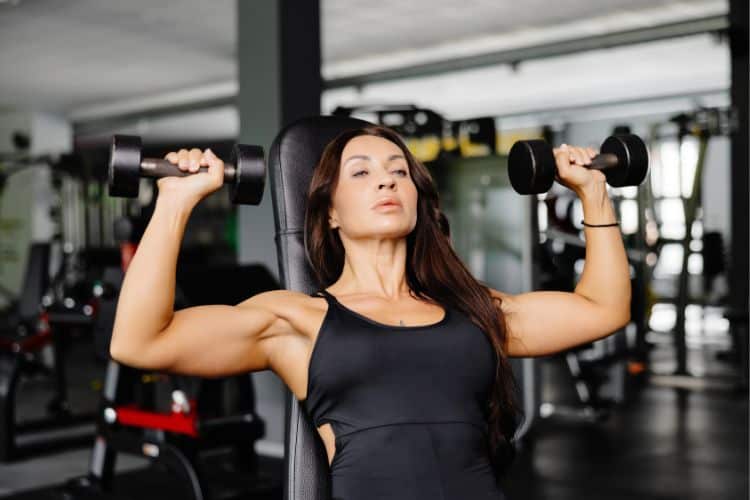
For your third exercise, do a seated or standing dumbbell overhead press for three sets of eight to ten. Begin with the weights at shoulder height, press to a comfortable overhead position, and lower under control. Keep your ribs stacked over your pelvis rather than leaning far backward. If overhead pressing feels uncomfortable, try a neutral-grip press with your palms facing each other or use a landmine press if your gym has the equipment. Persistent pain is a reason to change the exercise and seek appropriate advice.
Finish the main work with a lat pulldown or assisted pull-up for three sets of eight to twelve. Pull your elbows down toward your sides while keeping your chest lifted, and return to the start without letting the weight snap upward. At home, an anchored resistance-band pulldown can fill this slot. Then complete two sets of ten to fifteen dumbbell lateral raises and two sets of ten to twelve triceps extensions. Use lighter loads on these smaller movements; deliberate repetitions count more than momentum. If time is limited, complete the first four exercises and consider the last two optional.
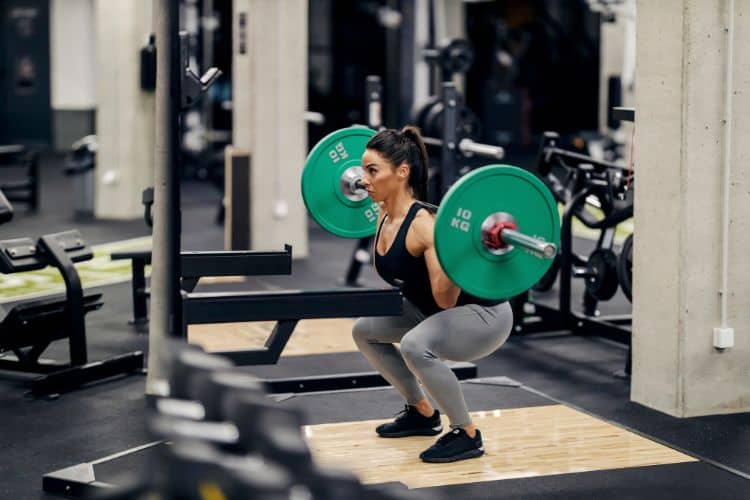
Begin with a goblet squat, front squat, or barbell back squat for three sets of six to ten repetitions. Pick the version you can perform confidently and safely with the equipment you have. Set your feet at a comfortable width, keep pressure across your whole foot, and lower as far as your mobility and control allow. Your knees may travel forward; focus on a balanced movement rather than forcing an identical squat shape on everyone. If you are new to squatting, holding one dumbbell at chest level can make it easier to learn the pattern.
Follow with a Romanian deadlift for three sets of eight to ten. Hold dumbbells beside your thighs or a barbell in front of them, soften your knees, and move your hips backward as the weight travels close to your legs. Stop when you feel a strong hamstring stretch and can still keep your back position steady, then drive through your feet to stand. This is a hip hinge, not a contest to touch the floor. Start light if the movement is unfamiliar.
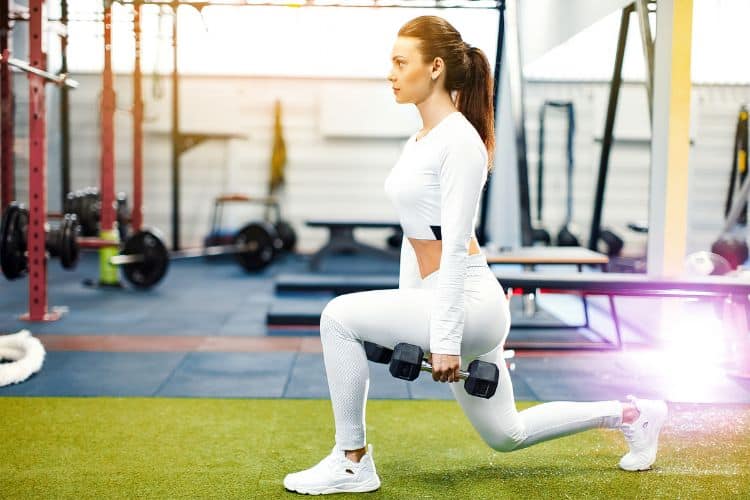
Next, perform reverse lunges for three sets of eight to ten per leg. Step back far enough that you can lower with balance, then push through your front foot to return. A split squat with feet staying in place works well if stepping disrupts your balance. You can hold a rail lightly for support; that is a useful modification, not a shortcut. Each leg should receive the same number of repetitions, even if one side feels stronger.
Complete two sets of ten to fifteen glute bridges or hip thrusts, pausing briefly at the top without arching your lower back. Add two sets of twelve to fifteen standing calf raises, lowering your heels slowly between repetitions. Finish with two sets of a plank held for 20 to 40 seconds. Brace as though preparing for a gentle push to your stomach, breathe normally, and end the hold before your lower back begins to sag. If you are short on time, prioritize the squat, Romanian deadlift, and lunge.
After your rest day, open with an incline dumbbell press for three sets of eight to twelve repetitions. Set the bench at a modest incline rather than nearly upright, and lower the weights to a comfortable depth. The angle changes the pressing emphasis slightly and gives you another chance to practice controlled chest and shoulder work. A standard push-up or hands-elevated push-up is a good alternative when you do not have a bench.
Perform a chest-supported dumbbell row or seated cable row for three sets of eight to twelve. Supporting your chest reduces the temptation to use your lower back to move the weight, which can make it easier to focus on pulling with your upper back. Let your arms reach forward at the bottom without collapsing your posture, then draw your elbows back. If you trained a one-arm row on Day 1, this variation adds a different challenge without requiring an entirely new movement pattern.
Then do a neutral-grip dumbbell shoulder press for two sets of ten to twelve, provided it feels comfortable. Follow with two or three sets of ten to fifteen face pulls or band pull-aparts. Pull toward upper-chest or face level with your elbows moving outward and avoid jerking your head forward. The lighter pulling work gives your rear shoulders and upper back attention that pressing alone would miss. If you cannot anchor a band safely, perform bent-over rear-delt raises with light dumbbells instead.
Finish with two sets of ten to twelve biceps curls and two sets of ten to twelve close-grip push-ups or cable triceps pushdowns. Use an elevated surface for the push-ups if the floor version causes your form to break down. If you want to save time, you can alternate one curl set with one triceps set, resting enough to keep both movements controlled. The purpose of this day is to add useful upper-body training volume, not to chase a different exercise for every muscle.
Begin with a dumbbell or barbell hip thrust for three sets of eight to twelve repetitions. Support your upper back on a stable bench if using the bench version, or choose a floor glute bridge when that setup is unavailable. Keep your chin comfortably tucked and finish the lift when your torso and thighs are approximately aligned. Squeeze your glutes at the top without pushing into an exaggerated back arch. If positioning a heavy weight is awkward, use a lighter dumbbell and slow the lowering phase.
Next, perform a heel-elevated goblet squat or leg press for three sets of ten to twelve. A small, stable heel elevation may help some lifters squat comfortably, but regular flat-footed squats are fine if they feel better. On a leg press, choose a depth that lets your pelvis stay supported. Control both directions and avoid bouncing at the bottom or locking your knees aggressively at the top. This exercise adds quad-focused work after the hip thrust.
Use a step-up or Bulgarian split squat for three sets of eight to ten per leg. Choose a box height or rear-foot position that allows a steady movement; a lower step is often a better starting point than a dramatic one. Lean forward slightly if it feels natural, keep your leading foot planted, and push through that leg instead of springing off the back foot. If balance is a limiting factor, choose a stationary split squat and hold onto a support.
Follow with a dumbbell Romanian deadlift or a hamstring curl for two sets of ten to fifteen. If you already feel that Day 2’s hinge work was plenty, the curl offers a different way to train the back of the thighs. Complete two sets of a suitcase carry, walking 20 to 40 steps on each side with one moderately heavy dumbbell while keeping your torso upright. If you lack space, replace the carry with a side plank held for 20 to 30 seconds per side. Finish with calf raises for two sets of twelve to fifteen if you have time and energy.
Progressive overload means increasing the training challenge over time as you adapt. The simplest method for this plan is double progression. Suppose the bench press calls for three sets of six to eight repetitions. Keep the same weight until you can perform eight good repetitions on all three working sets. Then increase the load by the smallest practical amount and work back toward eight. A session of eight, eight, and seven repetitions still represents progress; there is no need to force the last rep with poor form.
Apply the same method to the other exercises using their listed rep ranges. If the next available dumbbell is a large jump, keep the current weight and improve your control, add a repetition, or pause briefly in the difficult position before increasing it. You can also increase one exercise at a time. Four training days offer many opportunities to improve, so there is no reason to make every workout harder in every possible way.
Keep a simple log with the exercise, weight, repetitions, and any relevant note about technique. Review it once a week. If you repeat an exercise after an illness, travel, or poor sleep, choose a lighter weight or do fewer sets and rebuild. Progress is rarely perfectly linear. When several sessions feel unusually difficult and performance is falling, reduce your training load or total sets for a week before pushing again.
The correct weight is the one that matches the exercise and repetition target while allowing consistent form. A goblet squat may require a much heavier dumbbell than a lateral raise. During a set of eight to twelve, the first few repetitions should feel manageable, while the last few require concentration. If you can easily perform many extra reps, try a modest increase next time. If you cannot reach the minimum with sound technique, reduce the load.
Beginners should spend the first two weeks learning the movements and testing comfortable loads. Two working sets per exercise are enough to start if the full plan would be overwhelming; build toward the listed number as your recovery and schedule allow. Experienced lifters may need more total work over time, but adding sets should follow a clear reason, such as consistently recovering well without further progress. More soreness is not proof that more sets are needed.
Muscle growth depends on what happens between training sessions as well as during them. Aim for regular sleep and enough food to support your activity. Include protein-containing foods across your meals and choose an overall eating pattern you can sustain. A large calorie deficit can make it harder to gain muscle and recover from four lifting days. If your primary goal is fat loss, you can still get stronger while eating less, but judge progress by multiple measures and expect muscle gain to be slower.
You do not have to stop doing cardio. Walking, cycling, or other moderate activities can fit on rest days or after lifting, depending on your preferences and recovery. United States physical activity guidance recommends adults get at least 150 minutes of moderate-intensity aerobic activity per week as well as muscle-strengthening activity on at least two days. If demanding cardio leaves your legs exhausted before lower-body training, move it to another day, shorten it, or lower its intensity.
Normal muscle soreness can happen when you begin a new routine, especially after lunges or split squats. Sharp pain, worsening joint discomfort, dizziness, or symptoms that do not settle are different signals. Stop the painful movement and adjust your plan; a qualified clinician or physical therapist can help with individual concerns. Training hard should still leave you able to function and recover.
The SplitLean workout gives each session a purpose: establish strong upper-body patterns, train the lower body through squats and hinges, then revisit both regions with complementary exercises later in the week. Set up four realistic appointments with yourself, choose starting weights you can control, and write down the results. Increase repetitions first, then resistance when your form and recovery support it. Over time, those repeatable steps are what turn a four-day schedule into a muscle-building plan you can actually keep.
To make this SplitLean plan your own, compare its weekly structure with our Guide To Split Workouts For Women, then use the Compound Training Plan For Women to sharpen your main lifts. Our Progressive Overload Guide For Women explains how to increase the challenge over time. For extra lower-body ideas, explore these Dumbbell Squat Variations; if you train outside the gym, try our Exercises To Build Muscle at Home.
Stay up to date on the latest women’s health, fitness and lifestyle trends and tips.
