




Sign up for workout ideas, training advice, reviews of the latest gear and more.

A five-day workout schedule can feel like a puzzle. You want enough lifting to get stronger, enough movement to build stamina, and enough recovery to come back ready for the next session. The 5 day SplitLean workout solves that puzzle by giving every training day a full-body foundation while changing the emphasis from one session to the next. You will train your legs, hips, back, chest, shoulders, and core throughout the week, but you will not try to set a personal record on every exercise every day.
This plan works best for someone who already knows the basic squat, hinge, push, and row patterns. A beginner can use lighter weights and fewer sets, or begin with three sessions per week before working toward all five. Most sessions take about 40 to 55 minutes, including a warm-up. You need a pair of dumbbells, a bench or sturdy chair, and some floor space. A resistance band is helpful but optional.
Each day includes lower-body work, upper-body work, and some form of core training or loaded movement. Monday is the main strength day, Tuesday adds controlled conditioning, Wednesday trains unilateral strength and stability, Thursday uses a lighter recovery-focused circuit, and Friday brings the week together with moderate-load full-body work. The change in intensity matters: doing five equally hard full-body sessions in a row would make it difficult to maintain good technique and recover.
A practical schedule is Monday through Friday training, followed by two easier days. You can also place a rest day after Day 2 if that fits your energy and schedule better. Keep the sessions in order, but let the calendar serve you. If you miss a workout, continue with the next day in the plan rather than doubling up to catch up. Walking, gentle cycling, and easy mobility on nontraining days can support recovery without adding another demanding workout.
For most strength sets, select a load that leaves roughly two or three good repetitions in reserve. The final reps should require attention without changing your posture or range of motion. Rest about 90 to 120 seconds after heavier squats, hinges, and presses, and 45 to 75 seconds after lighter accessory exercises. If you are still breathing too hard to perform the next set well, take more time. The conditioning day is intentionally brisk, but brisk should never mean rushed or sloppy.
If the weight available at home is limited, slow the lowering phase to about three seconds, add a pause in a stable position, or increase reps within the suggested range. Keep those changes controlled; you do not have to make every exercise as exhausting as possible. Record your weight, completed reps, and how hard the final set felt. Those notes make progression far more reliable than guessing from memory.
Spend five to eight minutes preparing for the first exercise. Start with easy marching, cycling, or walking until you feel warmer. Then do a few bodyweight squats, hip hinges, arm circles, and alternating reverse lunges. Finish with one or two lighter practice sets of the first loaded movement. If a motion feels restricted, use a comfortable range and gradually build into it instead of forcing a stretch.
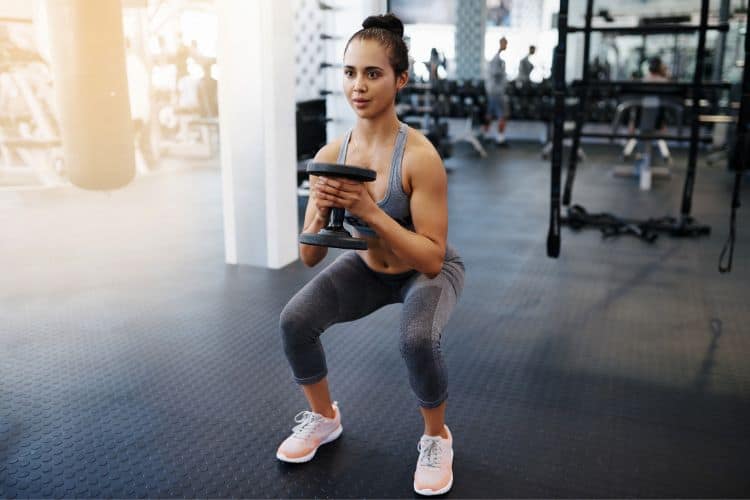
Day 1 sets the tone with deliberate, moderate-to-heavy lifting. Perform a goblet squat for three sets of six to eight reps, holding one dumbbell close to your chest. Keep your feet planted and descend as far as you can while maintaining control. Follow it with a dumbbell Romanian deadlift for three sets of eight to ten reps. Soften your knees, move your hips back, and lower the weights along your legs until you feel a comfortable hamstring stretch. Stand tall by driving through your feet rather than leaning backward.
Next, do a dumbbell floor press or bench press for three sets of eight to ten reps, then a one-arm dumbbell row for three sets of eight to ten reps per side. Press with your forearms reasonably vertical and control the descent. During the row, brace your free hand on a sturdy support and draw the working elbow toward your hip without twisting your torso to lift more weight. Finish with two sets of a front plank held for 20 to 40 seconds. Breathe normally and end each hold when you can no longer keep your ribs and pelvis steady.
Day 2 raises your heart rate without turning strength movements into a race. After warming up, complete three rounds of the following sequence: eight dumbbell reverse lunges per leg, ten incline push-ups, twelve band pull-aparts or ten supported dumbbell rows per side, and 30 to 45 seconds of fast marching or step-ups on a stable, low platform. Rest around 60 to 90 seconds between rounds. Set the pace so you can speak in short sentences and maintain consistent form from the first round to the last.
For the lunges, step backward far enough that you can lower with balance, then press through your front foot to return. Use a hand on a chair for support if needed. For incline push-ups, choose a stable counter or bench that allows a straight line from shoulders through hips; a higher surface makes the movement easier. Avoid pairing unstable furniture with fast reps. Band pull-aparts should come from controlled shoulder movement rather than flaring your ribs.
After the circuit, perform two sets of dead bugs for six to eight slow reps per side. Lie on your back with your knees and hips bent, gently brace your middle, and extend the opposite arm and leg only as far as you can without your low back lifting excessively. If you have extra time and energy, finish with five to ten minutes of comfortable walking. The goal is to leave this session feeling worked but able to train again tomorrow.
Single-side movements reveal differences in balance and control that can hide during two-legged lifts. Begin with a split squat for three sets of eight reps per leg. Keep most of your weight through the front foot, bend both knees, and lower within a stable range. Hold dumbbells by your sides if bodyweight reps feel smooth. Follow with a single-leg Romanian deadlift for two sets of eight reps per side. You can lightly hold a wall and keep the rear toes near the floor while learning the hinge; balance is a tool here, not the main test.
For the upper body, do a standing or seated dumbbell shoulder press for three sets of eight to ten reps, followed by a chest-supported or bench-supported row for three sets of ten to twelve reps. Press without throwing your torso backward; if your shoulders prefer it, keep your palms facing each other. For the supported row, pause briefly at the top and lower the dumbbells with control. Finish with a suitcase carry for three walks of about 30 to 45 seconds per side. Hold a weight in one hand, stand tall, and resist leaning toward either side. If you have little room, march in place slowly instead.
Day 4 is a purposeful lower-stress session. Use weights that feel clearly easier than those on Days 1 and 3. Complete two or three unhurried rounds of ten bodyweight or light goblet squats, ten light dumbbell Romanian deadlifts, eight elevated push-ups, ten band or supported dumbbell rows, and 20 to 30 seconds of a side plank on each side. Rest as needed. Keep the movements smooth and stop each set well before fatigue changes your technique.
After the circuit, spend five to ten minutes walking and moving your joints through comfortable ranges. Try gentle hip flexor stretches, thoracic rotations, or slow shoulder circles if they feel useful. Recovery is the point of this day, so you can replace the circuit with 25 to 35 minutes of easy walking if you are unusually sore or your sleep has been poor. A lighter day still counts: it keeps the habit in place while making the next harder session more productive.
If ordinary warm-up movements feel unusually heavy, soreness changes the way you walk, or you are dealing with illness, take a rest day. Resume when you feel ready, then continue the sequence rather than skipping ahead to Friday’s workout. Pain that is sharp, persistent, or worsening is a reason to stop the aggravating exercise and seek individualized guidance. Training hard only helps when you can repeat quality work over the following weeks.
Finish the training week with paired movements that keep you focused without compromising form. First, alternate three sets of dumbbell step-ups for eight reps per leg with three sets of dumbbell floor presses for eight to twelve reps. Use a low, sturdy step that lets you drive through the working leg and lower under control. Rest 60 to 90 seconds between exercises, taking longer if needed. If step-ups irritate your knees or you do not have a safe platform, substitute reverse lunges or goblet squats.
Next, alternate three sets of dumbbell Romanian deadlifts for ten reps with three sets of one-arm rows for ten reps per side. Choose a moderate load: you should feel your muscles working while keeping the final reps as tidy as the first. Finish with two sets of farmer carries lasting 40 to 60 seconds, holding a dumbbell in each hand. Walk with an even stride and relaxed shoulders. A stationary march is a good alternative in a small space.
Use Week 1 to learn the order of the workouts and find comfortable starting loads. For your main exercises, stay near the lower end of each rep range while keeping two or three reps in reserve. In Week 2, try to add one rep to some sets without sacrificing technique. In Week 3, add another rep where appropriate or make a small weight increase if you already reached the top of the range across all sets. When you increase weight, return to the lower end of the range and build up again.
In Week 4, choose your next step based on recovery. If you feel energetic, continue progressing one or two main exercises. If you feel worn down, reduce each exercise by one set and keep weights manageable. Either choice can help you stay consistent. You do not need to increase every lift each week; improved control, a steadier pace, and less need for rest are meaningful signs of progress too.
For example, suppose you perform goblet squats for three sets of six with a 25-pound dumbbell in Week 1. You might do seven reps per set in Week 2 and eight in Week 3. When eight clean reps across all three sets feel repeatable, try the next available weight and work back up from six reps. If the jump is too large, keep the 25-pound dumbbell and add a slow lowering phase or a brief pause at the bottom. Progression should challenge you while preserving a movement you can trust.
If five sessions feel like too much, do Days 1, 3, and 5 across a week with at least one easier day between them. After two or three weeks, add Day 2 as a shorter circuit. Introduce Day 4 only when the schedule and your recovery allow it. This approach keeps the plan’s main strength work while building your tolerance gradually. More training days are useful only when you can keep showing up and recovering.
For a 30-minute version, warm up for five minutes, complete the first four exercises of the assigned session, and finish with a brief core movement or walk. On Day 4, two easy rounds are enough. Keep the basic movement balance intact rather than squeezing all five days into a weekend. If you train at a gym, you can swap a cable row for the dumbbell row or a machine chest press for the floor press; keep the same set and rep targets.
Strength training provides a reason for your muscles to adapt, but training is only one part of changing body composition. Eat regular meals that include protein, fruits or vegetables, and enough overall energy to support your workouts. If fat loss is a goal, a sustainable eating pattern matters more than trying to “burn off” meals with extra conditioning. Rapid changes on the scale may reflect shifts in water and glycogen as well as body fat, so judge progress over weeks rather than a single day.
Track a few useful indicators: weights and reps on Day 1, how steady your breathing feels during Day 2, balance on Day 3, and how well you recover by Day 5. Measurements, photos, or body weight are optional if they help you evaluate a personal goal. Notice everyday benefits too, such as carrying groceries more comfortably or climbing stairs with less effort. Those changes often make it easier to keep going long enough for larger results to emerge.
Yes, if the workload varies as it does here and you recover well. The plan mixes harder strength days, a conditioning circuit, and a lighter day. Five maximal lifting days in a row would be a different challenge. If you are new to exercise or consistently sore, use the three-day version first or insert rest days between sessions.
You can add easy walking or another comfortable aerobic activity on rest days or after a workout. Start modestly and see how it affects your legs and energy. You do not need a hard cardio session after every lift. Day 2 already gives you a structured conditioning session, and everyday movement can contribute to fitness without making recovery difficult.
Use the same pair where suitable, but adjust the movement before forcing a poor fit. You may be able to squat holding one dumbbell, use both for a hinge, and use just one for rows and carries. If the pair is too heavy for shoulder presses, perform fewer clean reps or choose an incline push-up variation. If it is too light for lower-body work, slow the descent, pause, or use single-leg variations.
Four weeks gives you enough time to learn the movements and compare your performance. You can repeat the cycle with slightly higher weights, better technique, or a few more reps. After that, decide whether you want to keep the five-day format, train fewer days, or prioritize a particular goal. Consistency across cycles is more valuable than constantly changing exercises before you can measure progress.
The SplitLean workout gives each training day a job. Day 1 establishes your strength foundation, Day 2 builds controlled conditioning, Day 3 develops balance and unilateral strength, Day 4 gives your body room to recover, and Day 5 lets you practice full-body work under moderate fatigue. Pick weights you can control, keep notes, and adjust the schedule when life gets busy. A plan you can repeat with good form is the one most likely to help you grow stronger over time.
For another week of dumbbell training, explore this 5 Day Full Body Dumbbell Workout Plan. Learn how to increase reps or weight over time with the Progressive Overload Workout Plan For Women. On a shorter training day, try the 30 Minute Full Body Dumbbell Workout; for a change of pace, use the 30 Minute Dumbbell Circuit Workout. When you want a brief, gentler option, choose the 15 Minute Low Impact Dumbbell Workout.
Stay up to date on the latest women’s health, fitness and lifestyle trends and tips.
