


Sign up for workout ideas, training advice, reviews of the latest gear and more.


A five-day workout plan can feel exciting until every session starts to look the same: another set of squats, another round of curls, and no clear idea of whether you are getting stronger. The 5 day SplitLean workout gives each training day a job. You will work your lower body twice, your upper body twice, and finish with a full-body session that brings the week together. The goal is to practice useful movements often enough to improve them while giving hard-worked muscles time to recover.
“Lean” in the name describes a training approach, not a promise of rapid fat loss or a particular body shape. Resistance training helps build strength and muscle; body composition also depends on nutrition, activity outside the gym, sleep, and individual circumstances. This plan focuses on what you can control in a workout: sound technique, challenging sets, steady progression, and a schedule you can repeat. You can use it at home with dumbbells and a sturdy bench or in a gym with machines and cables.
SplitLean is a five-session strength split organized around movement patterns. Day one emphasizes squats and glutes, day two trains upper-body pushing and pulling, day three targets hip hinges and hamstrings, day four returns to the upper body with different angles, and day five uses a moderate full-body circuit. The two lower-body days and two upper-body days provide repeated practice without asking you to attack the same muscle groups hard on consecutive days.
For most exercises, complete two or three working sets. Choose a weight that makes the last few repetitions demanding while leaving roughly one to three good repetitions available. Rest about 60 to 90 seconds after smaller exercises and 90 to 150 seconds after heavy squats, hinges, presses, or rows. These are practical starting points, not stopwatch rules. Take longer when you need it to perform your next set well.
The five sessions usually take 35 to 55 minutes. Start with five to eight minutes of easy movement and rehearsal sets, then spend most of your time on the first two or three exercises. When time is short, finish the main lifts and reduce accessory work. An efficient session done consistently is more useful than a perfect schedule that you cannot sustain.
This plan suits women who know the basic squat, hinge, press, and row patterns and want a more organized week. It also works for newer lifters who reduce each session to two sets per exercise, choose easier variations, and place a rest day between sessions as needed. Five demanding lifting days can be too much at first. If you are new to resistance training, begin with three days per week and add days gradually as your technique and recovery improve.
You need a pair of dumbbells or adjustable weights, a bench or stable chair for supported work, and room to move. A resistance band can replace some cable exercises. In a gym, you can use barbells or machines for equivalent patterns. A chair used for step-ups must be stable, appropriately low, and safe to step onto; a low platform is usually better. Nothing in the plan requires jumping or racing through repetitions.
A useful weekly arrangement is Monday lower body A, Tuesday upper body A, Wednesday rest or easy walking, Thursday lower body B, Friday upper body B, Saturday full body, and Sunday rest. The break after the first two sessions helps keep the later workouts productive. If weekends are busy, train Monday through Friday but keep Wednesday lighter and be conservative with Thursday’s loads. You can also run the five sessions across eight or nine days. The order matters more than fitting them into a calendar week.
Do not turn the rest days into punishment cardio. Walk, stretch gently, or take a complete day off according to how you feel. If you want aerobic work, add comfortable walks or short cycling sessions on rest days or after lifting. U.S. physical activity guidance recommends muscle-strengthening activity on at least two days weekly and 150 to 300 minutes of moderate aerobic activity for adults; this five-day strength split can cover the strength component, while walking or other activities can support the aerobic component.
Before lower-body days, walk or cycle for a few minutes, then perform bodyweight squats, unloaded hip hinges, and easy lunges. Before upper-body days, try shoulder circles, light rows, and a few unweighted pressing motions. Start your first main lift with one or two lighter sets before the working weight. A warm-up should make the upcoming movement feel smoother, not tire you out.
Move through a comfortable range and keep your breathing natural. Exhale through the hardest portion of a repetition and inhale during the easier return. If a movement causes sharp or worsening pain, stop and choose a more comfortable variation. If you have a condition that affects exercise or are returning after an injury, adapt the plan with a qualified clinician or exercise professional.
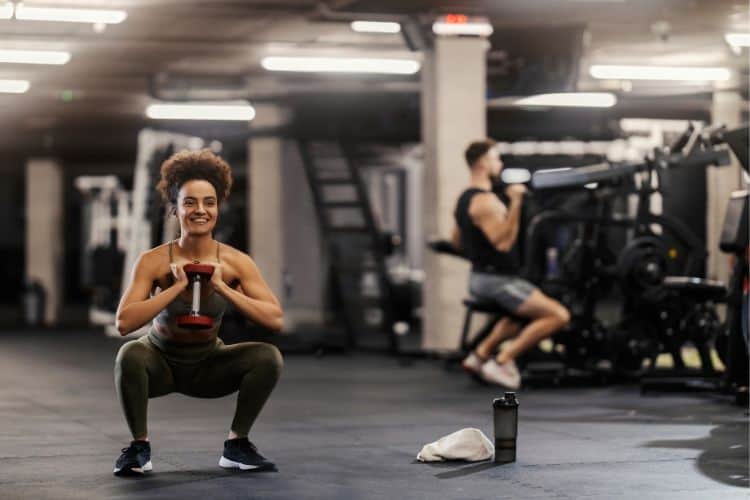
Day one leads with a goblet squat for three sets of eight to ten repetitions. Hold one dumbbell close to your chest, brace your torso, sit down between your hips, and push the floor away to stand. Keep your feet planted and descend only as far as you can control. A box squat or leg press is a reasonable alternative if it lets you move more comfortably. Use a load that allows consistent depth and a steady torso across all sets.
Next, perform dumbbell reverse lunges for three sets of eight repetitions per leg. Step back far enough that your front foot stays flat and lower under control. Push through the front leg to return. If balance limits the work, hold a rail or wall lightly and use one dumbbell. Then do dumbbell hip thrusts or floor glute bridges for three sets of ten to twelve repetitions. Pause briefly at the top without arching your lower back. The pause makes the glutes work without requiring a heavier weight.
Finish with a supported step-up for two sets of eight per leg and standing calf raises for two sets of twelve to fifteen. Choose a low step that permits a controlled ascent and descent. Drive through the working foot instead of pushing hard from the trailing leg. For calf raises, rise deliberately, pause at the top, and lower your heels slowly. These finishing exercises add useful single-leg and lower-leg work without making the session a cardio race.
Your thighs and glutes should do the work, but you should still be able to control each rep. If the lunges become unstable after squats, lower the weight or shorten the set. Beginners can skip the step-ups and complete just two sets of the first three exercises. Record the squat weight and reps so you have a clear target when the workout comes around again.
Start with a dumbbell bench press or floor press for three sets of eight to ten. Plant your feet, keep your wrists stacked above your forearms, and lower the weights with control. The floor press limits the depth of the movement and may feel more comfortable for some shoulders. Pair that with a one-arm supported dumbbell row for three sets of eight to ten per side. Place your free hand on a sturdy bench, pull your elbow toward your hip, and resist twisting your torso to heave the weight upward.
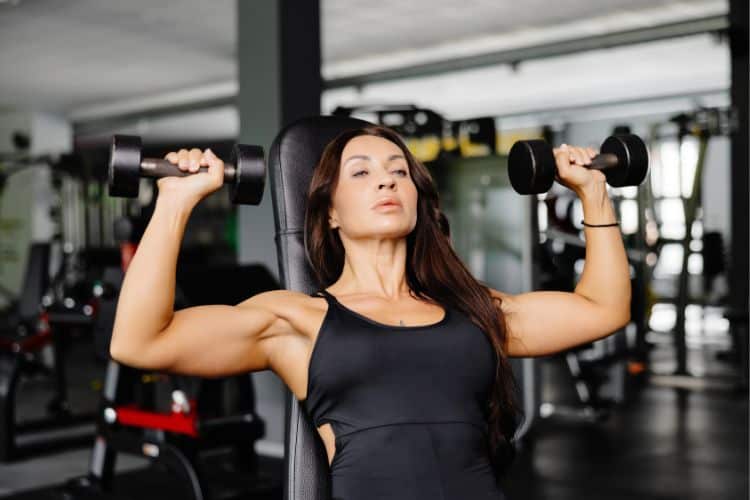
Follow with a seated dumbbell shoulder press for two or three sets of eight to ten. Press in a comfortable path and keep your ribs from flaring. If overhead pressing bothers your shoulder, use a landmine press or a lighter incline press instead. For your next pull, choose a lat pulldown, assisted pull-up, or band pulldown for three sets of eight to twelve. Think about drawing the elbows toward the sides of your body rather than yanking with your hands.
Complete the session with lateral raises for two sets of twelve to fifteen and a front plank for two holds of 20 to 40 seconds. Use light weights for raises, lift only as high as you can without shrugging, and lower with control. During planks, gently tighten your abdomen and glutes while breathing. End the hold when you can no longer maintain a steady position; longer is not automatically better.
Pushing and pulling in the same session makes the workout practical and gives your upper body balanced attention. You can alternate a press set with a row set to save time, but still rest enough between efforts to lift well. This is a convenient pairing, not a challenge to keep your heart rate as high as possible. If your shoulders feel tired after the presses, lower the weight for lateral raises rather than forcing extra repetitions.
Lead with a dumbbell Romanian deadlift for three sets of eight to ten. Hold the weights near your legs, soften your knees, and move your hips backward while keeping your back in a comfortable, stable position. Lower until you feel tension in the backs of your legs, then drive through your feet to stand tall. The weights do not have to reach the floor. Your goal is a controlled hip hinge, not a contest to touch your toes.
Next, try a front-foot elevated split squat for three sets of eight per leg. A low elevation can allow more range of motion, but a regular split squat works just as well if the setup is awkward. Keep your stance wide enough to balance and lower at a pace you can control. Then perform a hamstring curl for three sets of ten to twelve using a machine, sliders on a smooth floor, or a resistance band. If a slider curl is too difficult, use shorter ranges or substitute another set of Romanian deadlifts at a lighter load.
Finish with a single-leg glute bridge for two sets of eight to ten per side and a suitcase carry for two walks of 30 to 45 seconds per side. For the bridge, keep your hips level and choose a shorter range if you feel your lower back taking over. For the carry, hold one dumbbell at your side, stand tall, and walk slowly without leaning toward or away from the weight. If you cannot walk safely in your space, stand in place for the same time.
This session uses movements that can feel unfamiliar, especially the Romanian deadlift and slider curl. Make the first week a technique week. Stop sets before your back position changes or your balance disappears. If day one left your legs very sore, begin with two sets of each exercise or move this workout back one day. You should finish feeling challenged, not depleted for the rest of the week.
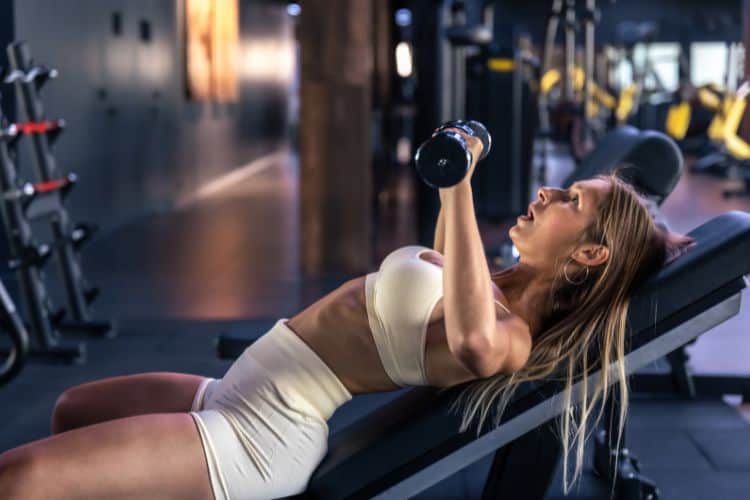
Use a different pressing angle from day two. Begin with an incline dumbbell press for three sets of eight to ten, adjusting the bench to a modest incline. Keep your shoulder blades supported and let your elbows travel in a comfortable path. Next, perform a chest-supported dumbbell row for three sets of ten to twelve. Lie facedown on an incline bench and pull the weights toward your ribs without lifting your chest. If you do not have a bench, repeat a supported one-arm row or use a seated band row.
Continue with a neutral-grip pulldown or assisted pull-up for two sets of eight to twelve and a rear-delt fly for two sets of twelve to fifteen. A light bend in your elbows and modest weights help you feel the upper back working during the fly. If you trained pulldowns hard on day two, use an easier band version today or choose a second row variation. The purpose is quality upper-back practice, not piling on volume for its own sake.
Finish with dumbbell biceps curls and overhead triceps extensions, each for two sets of ten to twelve. Keep your elbows mostly still during curls and lower the weights deliberately. For triceps, choose a single dumbbell held with both hands or a band pressdown if overhead positioning is uncomfortable. These arm exercises add focused work after your larger muscles have already handled the main pressing and pulling.
Your upper body has had at least one day away from hard lifting, but you may still feel the previous session. If performance is down, remove one accessory set and prioritize clean presses and rows. If you feel strong, keep the planned volume and resist adding several more exercises. A sustainable split leaves you ready to return next week with slightly better reps or control.
Day five combines familiar movements at a moderate effort. Complete three rounds of the following sequence: dumbbell squat to a box for ten reps, dumbbell row for ten reps per side, dumbbell floor press for ten reps, and dumbbell Romanian deadlift for ten reps. Rest 60 to 90 seconds between exercises if needed and two minutes between rounds. Use weights lighter than you would use for your heaviest sets earlier in the week. The purpose is extra practice and useful training volume, not an all-out test.
After the rounds, complete two sets of eight alternating reverse lunges per leg and two sets of ten dead bugs per side. For the dead bug, lie on your back with your knees and arms raised, extend opposite arm and leg slowly, and keep your torso steady. Shorten the reach if your back arches. If you prefer a carry, replace the dead bugs with two 30-second farmer carries while keeping your shoulders level and breathing normally.
The word “sculpt” can suggest a special type of exercise, but muscles respond to progressive, repeatable resistance work. The circuit format simply gives this day a different rhythm. You can pause between movements, use the same weights throughout, or set up two pairs of dumbbells. If the week has been especially demanding, complete two rounds and go home. That is a useful adjustment, not a failed workout.
Run the plan for six to eight weeks before making major changes. In week one, choose manageable weights and learn the exercise order. During subsequent weeks, add a repetition within the prescribed range when technique stays consistent. Once you reach the top of the range for all working sets, increase the weight by the smallest practical amount and begin again near the lower end. For example, a goblet squat can move from three sets of eight to three sets of ten over several workouts before the dumbbell gets heavier.
A training log can be simple: exercise, weight, repetitions, and one note about how the sets felt. If you used a 20-pound dumbbell for eight, eight, and seven reps last time, matching all three sets at eight is progress. More range of motion, improved balance, and smoother control are useful signs too. Progress is rarely perfectly linear. A poor night’s sleep or a stressful week may call for repeating a weight or reducing a set.
Avoid increasing weight and volume across every exercise at once. The newer ACSM resistance training guidance emphasizes consistency and training major muscle groups at least twice a week over chasing a complicated plan. Follow that principle here: keep the main patterns stable long enough to improve them. If you have trained consistently for several weeks and feel unusually run down, take an easier week by reducing sets or loads, then resume.
For four days, complete lower A, upper A, lower B, and upper B; treat the full-body day as optional. For three days, alternate lower A, upper A, and full body in one week, then lower B, upper B, and full body in the next. Another simple option is to complete the five workouts in sequence across a longer cycle without resetting every Monday. Keep the same order and give heavily worked muscles time to recover.
A five-day label should not pressure you to train through exhaustion. If you can complete three focused sessions consistently, start there. Add frequency when your schedule, sleep, and performance support it. Two well-executed strength days still meet the basic muscle-strengthening frequency in national physical activity guidance, so a shorter version can be worthwhile while you build the habit.
Eat enough to support your training, include protein-rich foods throughout the day, and build meals around a variety of satisfying foods. There is no required “sculpt” menu or special supplement. If your personal goal includes changing body composition, make nutrition changes that fit your health needs and daily life rather than trying to outwork an extreme diet. Consistent resistance training and adequate recovery give your muscles a reason and opportunity to adapt.
Sleep and rest days also affect your next workout. Mild muscle soreness is common when you introduce new exercises, but severe soreness is not a badge of success. Easy movement may feel good, and an extra rest day can help when your legs or shoulders are still very stiff. Persistent pain, dizziness, or symptoms that concern you deserve professional attention. The workout plan should serve your life rather than crowding out recovery.
Yes, but start with fewer sessions or two working sets per exercise. Keep day five optional while you learn the movements, then add a day if you recover well. Beginners do not need five hard days to benefit from lifting.
Yes. Dumbbells cover most exercises. Use floor presses instead of bench presses, bands instead of pulldowns, and floor bridges instead of hip thrusts. Choose substitutions by movement pattern and comfort.
No. If you enjoy intervals, add a brief session when it does not interfere with lifting or recovery. Walking is another option. Keep the strength workouts focused on controlled sets and gradual progress.
Try six to eight weeks. If your lifts are progressing and the schedule fits, continue. Swap exercises that do not suit you while retaining squat, hinge, push, pull, and single-leg patterns.
The SplitLean 5-Day Strength and Sculpt workout gives you a clear purpose each time you pick up a weight. Squat and train your glutes, press and row, hinge and work your hamstrings, revisit the upper body, then reinforce the week with a full-body session. Start with a schedule you can actually keep, use loads you can control, and let your log guide gradual increases. When the fifth day does not fit, shorten the week and continue. Strength grows from repeated good sessions, not from forcing every planned workout into every week.
If you want to compare schedules before starting SplitLean, read How To Choose a Workout Split For Women or use the Beginner Workout Split Guide to ease into more training days. For a shorter weekly alternative, try this 4-Day Strength Training Split. When you are ready to make each session more challenging, follow the Progressive Overload Dumbbell Workout Plan, then explore the 4 Week Dumbbell Strength Plan for another structured training block.
Stay up to date on the latest women’s health, fitness and lifestyle trends and tips.
