


Sign up for workout ideas, training advice, reviews of the latest gear and more.

Christmas travel can make a normal fitness routine feel almost impossible. Between long drives, crowded airports, family gatherings, restaurant meals, and changing sleep schedules, exercise often slips to the bottom of the list. A workout does not have to be long, complicated, or performed in a hotel gym to help you feel stronger and more energized. This 20 minute hotel room workout for Christmas travel uses only your body weight and a small amount of floor space, making it practical for busy holiday mornings or evenings away from home.
The routine combines lower-body strength, upper-body work, core stability, and low-impact cardio. There is no equipment required, and the movements can be completed quietly without disturbing guests in the room below. You can also modify every exercise to match your current fitness level. Instead of trying to compensate for Christmas meals or “earn” holiday treats, use this short session as an opportunity to care for your body, maintain a familiar habit, and create a little time for yourself during a hectic season.
A short workout is especially valuable during the holidays because it removes many of the barriers that prevent people from exercising. You do not need to locate a gym, pack weights, wait for a treadmill, or rearrange an entire day. Twenty minutes can fit before breakfast, between family activities, after a flight, or before getting ready for a Christmas dinner. The workout is brief enough to feel approachable but structured enough to train the major muscle groups.
Consistency matters more than completing one unusually difficult session. If you normally exercise several days each week, one or two hotel workouts can help maintain your rhythm until you return home. If you are new to exercise, this routine can provide a simple introduction to full-body training without an intimidating environment. It will not undo every effect of extended sitting or missed workouts, but it can improve circulation, reduce stiffness, and help you reconnect with purposeful movement.
Exercise may also offer a mental reset during a busy trip. Holiday travel can include delays, unfamiliar surroundings, social pressure, and less privacy than usual. Moving for 20 minutes can provide a clear beginning and end to a small period that belongs to you. The goal is not perfection. It is to finish feeling better prepared for the day rather than exhausted before the celebrations begin.
You need comfortable clothing, supportive shoes if you prefer them, a timer, and enough room to extend your arms and step backward safely. A space beside the bed is often sufficient. A towel can provide a cleaner or more comfortable surface for floor exercises. Water should be nearby, particularly if the hotel room is warm or you have recently completed a long flight.
Before starting, check the floor for loose items, luggage straps, chargers, or slippery rugs. Make sure you will not strike a lamp, desk, television, or low ceiling fixture when reaching overhead. Avoid relying on rolling chairs or lightweight furniture for balance because they can move unexpectedly. If you want support for squats or standing core work, use a solid wall or a stable desk that cannot slide.
This plan is designed as a quiet hotel workout. It does not include jumping jacks, burpees, running in place, or other high-impact movements that may disturb neighboring guests. You can perform it barefoot if the surface is safe and you are accustomed to barefoot training, although athletic shoes may offer better grip on carpeting or smooth flooring.
The session includes a three-minute warm-up, a 14-minute full-body circuit, and a three-minute cool-down. During the main circuit, complete seven exercises for 40 seconds each, followed by 20 seconds to rest and transition. One round takes seven minutes. Repeat the circuit twice to reach 14 minutes.
Choose a pace that allows you to use controlled form throughout each interval. The 40-second work period is not a race. Aim for smooth, repeatable repetitions, and stop early if your technique begins to break down. During the 20-second transition, breathe steadily, prepare your position for the next movement, and take a sip of water only if needed.
Beginners can use a 30-second work interval followed by 30 seconds of rest. More experienced exercisers can maintain the 40/20 schedule while slowing the lowering phase of each strength exercise or choosing a more challenging variation. The routine should feel purposeful and moderately challenging, but it should not cause sharp pain, dizziness, chest discomfort, or unusual shortness of breath.
Begin with 30 seconds of easy marching in place. Let your arms swing naturally and gradually lift your knees a little higher. Keep the steps light so the movement remains quiet. Next, perform 30 seconds of shoulder rolls and arm circles. Move slowly through a comfortable range rather than forcing your shoulders backward.
Use the third 30-second interval for alternating side steps with an overhead reach. Step to the right while reaching both arms upward, return to center, and repeat to the left. Continue with 30 seconds of bodyweight good mornings. Place your hands across your chest or behind your head, soften your knees, push your hips backward, and keep your spine long as your torso leans forward. Squeeze your glutes to stand.
Perform 30 seconds of shallow squats, sitting your hips back and keeping your knees aligned with your toes. Finish with 30 seconds of alternating reverse reaches. Step one foot slightly behind you while lifting the same-side arm overhead, return to the center, and switch sides. By the end of the warm-up, you should feel warmer and more mobile without feeling tired.
Complete each of the following seven exercises for 40 seconds, then rest or transition for 20 seconds. After the seventh exercise, begin again at the top and complete a second round. If you need additional recovery, pause for up to one minute between rounds and shorten the cool-down only if your breathing has returned to a comfortable level.
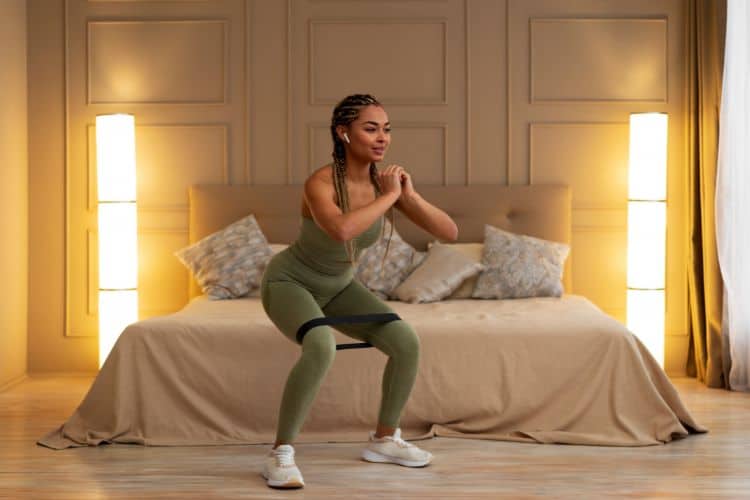
Stand with your feet about hip- to shoulder-width apart and your toes turned out slightly. Brace your midsection and sit your hips backward as though lowering toward a chair. Bend your knees, keep your chest lifted, and descend only as far as you can while maintaining balance and a neutral spine. Press through your whole foot to stand, then rise onto the balls of your feet for a controlled calf raise. Lower your heels and begin the next repetition.
This combination trains the quadriceps, glutes, hamstrings, and calves while gently increasing your heart rate. Make it easier by reducing the squat depth or touching the edge of a stable bed lightly before standing. Make it harder by pausing for two seconds near the bottom of each squat and moving slowly through the calf raise.
Place your hands on a sturdy desk, fixed counter, or another solid surface that will not move. Walk your feet backward until your body forms a straight line from your head to your heels. Brace your core, bend your elbows at roughly a 30- to 45-degree angle from your torso, and lower your chest toward the surface. Press through your palms to return to the starting position without letting your hips sag.
The incline position can make push-ups more accessible than performing them on the floor, and it avoids using a hotel bed that may be too soft for stable support. To reduce the challenge, use a higher surface or stand closer to it. To increase the challenge, use a lower stable surface or perform push-ups from the floor. Skip any surface that rolls, tips, or slides.
Stand tall with your feet under your hips. Step your right foot backward, bend both knees, and lower into a reverse lunge while keeping most of your weight through the front foot. Press through the front heel to return to standing, then repeat with the left leg. Keep your torso upright and your front knee tracking in the same direction as your toes.
If full lunges feel uncomfortable or unstable, step one foot back and tap the toes to the floor without lowering deeply. You can also keep one hand against a wall for balance. More experienced exercisers can add a knee drive as they return to standing, provided they can control the movement without hopping or stomping.
Stand with your feet comfortably apart and place your hands lightly behind your head or hold them near your chest. Lift your right knee toward your left elbow while rotating through your upper torso. Return your foot quietly to the floor and repeat on the opposite side. Think about drawing the ribs toward the hip rather than pulling your neck forward.
This low-impact movement elevates the heart rate while engaging the abdominal muscles and hip flexors. Move at a steady tempo and remain tall between repetitions. For a gentler option, lift each knee only a few inches and reduce the rotation. To make the exercise more demanding without jumping, slow the return and balance briefly at the top of each knee drive.
Lie on your back with your knees bent, feet flat, and arms resting beside you. Press through your heels and squeeze your glutes to lift your hips until your body forms a diagonal line from your shoulders to your knees. Hold this bridge position, brace your core, and lift one foot just off the floor. Replace it gently, then lift the other foot. Keep your pelvis as level as possible.
If the marching variation causes your hips to drop or your lower back to arch, perform regular glute bridges instead. Lift, pause, and lower with control on each repetition. For additional difficulty, maintain the bridge and extend one leg at a time, but only if you can keep your hips stable and your back comfortable. A folded towel can be placed beneath your shoulders if the floor is firm.
Begin on your hands and knees with your wrists beneath your shoulders and your knees beneath your hips. Brace your abdomen and extend your right arm forward while reaching your left leg backward. Keep your hips square to the floor and avoid arching your back. Return to the starting position and switch sides.
For a greater core challenge, draw the extended elbow and opposite knee toward each other underneath your torso before lengthening again. Move slowly enough to prevent rocking from side to side. If kneeling is uncomfortable, perform a standing version by placing your hands against a wall and extending the opposite arm and leg. This exercise trains core stability, coordination, and the muscles along the back of the body.
Stand with your knees slightly bent and take small, quick steps in place while keeping your feet close to the floor. As you step, alternate reaching your hands forward or diagonally across your body. Land softly and keep the movement controlled. The goal is to raise your heart rate without creating the heavy impact of running or jumping.
For a lower-intensity option, use a brisk march with alternating punches. For a higher-intensity version, widen your stance and shift quickly from side to side while remaining low, but continue to place your feet quietly. Finish the interval with good posture rather than speeding up so much that you lose control.
Spend the first minute walking slowly around the room or marching gently in place. Let your arms relax and take longer, calmer breaths. Do not stop suddenly if your heart rate is still elevated. Use the second minute for a standing quadriceps and hip-flexor stretch. Hold a wall for balance, bend one knee, and bring the heel toward the glute without forcing it. Hold for about 15 seconds on each side, then step one foot back and gently shift forward to stretch the front of the hip.
For the final minute, perform a chest-opening stretch and a relaxed forward fold. Clasp your hands behind your back or place your palms against your lower back, gently draw your shoulders down, and open across your chest for about 20 seconds. Then soften your knees, hinge at the hips, and let your torso fold forward comfortably. Keep your hands on your thighs if reaching toward the floor strains your back. Slowly roll or hinge back to standing, take two deep breaths, and notice how your body feels.
If you are restarting exercise or feel stiff from travel, use 30 seconds of work followed by 30 seconds of rest. Complete one circuit if 14 minutes of strength and cardio feels like too much, then add a longer walk later in the day if you feel comfortable. Use shallow squats, step-back taps instead of lunges, wall push-ups, regular glute bridges, standing bird dogs, and a steady march instead of fast feet.
You can also divide the workout into two 10-minute sessions. Complete the warm-up and one circuit in the morning, then repeat one circuit and cool down later. Although the timing changes, the movement still counts. Travel days can be unpredictable, so flexibility makes it easier to preserve the habit.
Anyone managing an injury, chronic condition, pregnancy, recent surgery, balance concern, or cardiovascular issue should follow guidance from a qualified healthcare professional. General workout instructions cannot account for individual medical needs. Stop if a movement produces sharp or increasing pain, numbness, dizziness, or symptoms that feel unusual.
The best time is the one that fits your plans and energy. A morning session can help you feel alert before a day of visiting, shopping, or sightseeing. Lay out your workout clothes the night before and begin before checking messages if you tend to become distracted. If mornings are rushed, schedule the workout in the late afternoon before showering and getting ready for dinner.
After a long car ride or flight, allow time to hydrate and move gently before attempting a harder circuit. A brief walk and the warm-up may be enough on an exhausting arrival day. Avoid intense exercise immediately after a large meal; give your body time to digest. You also do not need to sacrifice meaningful time with family simply to complete the session. Twenty minutes should support your holiday experience, not compete with it.
One common mistake is beginning too aggressively after hours of sitting or a poor night of sleep. Use the warm-up to assess how your body feels and choose modifications early. Another mistake is rushing through repetitions because the workout is timed. The interval tells you when to work, but it does not require a specific repetition count. Eight controlled squats can be more useful than 15 rushed squats with poor alignment.
Using unstable hotel furniture is another avoidable risk. Do not perform triceps dips on a rolling chair, place your feet on a soft bed for elevated push-ups, or pull against a table that is not anchored. Keep your routine based on the floor, wall, and clearly stable surfaces. Finally, avoid treating the workout as punishment for holiday eating. Movement is more likely to become a lasting habit when it is connected to strength, energy, mobility, and enjoyment rather than guilt.
Yes. A focused 20-minute session can train multiple muscle groups, raise your heart rate, and help maintain exercise consistency. Its effectiveness depends on your effort, exercise selection, form, and current fitness level. It is not identical to a longer strength session, but it is far more useful than assuming a workout only counts if it lasts an hour.
Many people can perform it two to four times during a week of travel, depending on fitness level, recovery, and other activity. You may alternate it with walking or mobility sessions. If your muscles are very sore, choose gentle movement or take a rest day rather than repeating the same circuit intensely.
A 20 minute hotel room workout for Christmas travel gives you a realistic way to stay active without a gym, equipment, or a large time commitment. The combination of squats, incline push-ups, reverse lunges, standing knee drives, glute bridges, bird dogs, and quiet cardio trains the full body while respecting the limits of a hotel environment.
Approach the workout with flexibility. Choose easier variations after a tiring journey, increase the challenge when you feel strong, or complete only one round when the day is packed. The most important result is not a calorie number or a perfect performance. It is maintaining a supportive habit while still enjoying the people, traditions, meals, and rest that make Christmas travel meaningful.
Keep your holiday routine flexible with these related Women’s Fit Club workouts. Try the Quick 20 Minute Bodyweight Workout for Full Body Fitness when you want another equipment-free session, or use the 30 Minute No Equipment Workout You Can Do Anywhere on a less crowded travel day. For a shorter hotel-friendly option, choose the 15 Minute HIIT Workout With No Equipment and No Repeats. You can also protect your joints and keep noise to a minimum with the 20 Minute Full Body Low Impact Workout, while the 20 Minute Beginner Bodyweight Workout offers simple modifications for anyone easing back into exercise during Christmas travel.
Stay up to date on the latest women’s health, fitness and lifestyle trends and tips.
