


Sign up for workout ideas, training advice, reviews of the latest gear and more.


A 20 minute HIIT kettlebell workout can deliver an impressive combination of strength training and cardiovascular conditioning when you want an efficient session without spending an hour in the gym. The kettlebell makes high-intensity interval training especially effective because it can be swung, carried, pressed, squatted, and pulled. Those movement options allow you to challenge nearly every major muscle group while keeping your heart rate elevated.
This full-body routine uses one kettlebell, five exercises, and a simple interval format. You will work for 40 seconds, transition or rest for 20 seconds, and complete four rounds. The result is exactly 20 minutes of focused training. You can perform the workout at home or in the gym, and the exercises can be adjusted for different fitness levels.
Although the pace is energetic, this workout is not about rushing through careless repetitions. Good kettlebell training combines purposeful power with control. Choose a weight you can handle safely, prioritize sound form, and stop a set if your technique begins to break down. If you are new to kettlebells, practice the exercises individually before attempting the complete HIIT circuit.
HIIT alternates demanding work periods with planned recovery. The kettlebell adds resistance, which means your muscles must produce force while your cardiovascular system works to support repeated movement. Instead of separating cardio and strength into two long sessions, this workout develops both qualities in a compact format.
Twenty minutes is long enough to accumulate meaningful training volume but short enough to fit into a busy day. It can work well before breakfast, during a lunch break, or whenever a longer gym session is unrealistic. The defined time limit also encourages focus: you know what exercise comes next, how long to work, and when the workout will finish.
Kettlebell exercises frequently involve several joints and muscle groups at once. A swing trains the hips, hamstrings, glutes, core, and upper back. A squat challenges the legs and trunk, while a press trains the shoulders, arms, and core. Combining these patterns creates a practical full-body session with little wasted time.
Traditional steady-state cardio usually relies on repeated low-to-moderate resistance movement. Kettlebell HIIT uses loaded exercises that demand more muscular tension. Your breathing rate rises, but your muscles also have to stabilize and move an external weight. This makes the session useful for improving work capacity—the ability to perform challenging physical work and recover between efforts.
The workout should not replace every form of training. Heavier strength sessions, walking, mobility work, and adequate recovery still matter. However, kettlebell HIIT is an efficient option for a conditioning day or a short full-body workout when time is limited.
You need one kettlebell, an interval timer, and enough clear space to extend your arms safely. Place the bell on a stable floor and keep children, pets, furniture, and fragile objects away from the training area. Have water nearby and wear supportive shoes if you prefer them.
Select a kettlebell that feels challenging near the end of each 40-second interval without forcing you to sacrifice posture or control. The correct weight varies widely based on the exercise, training history, and individual strength, so there is no single weight that is right for every woman.
If you are learning the movements, use a lighter bell and focus on consistency. You should be able to perform the squat and lunge without collapsing inward at the knees, complete the press without excessive back arching, and execute the swing with a crisp hip hinge rather than lifting the bell with your arms. If your grip fails early or you cannot slow the bell safely, reduce the weight.
Take approximately five minutes to prepare your hips, shoulders, core, and cardiovascular system. Begin with easy marching in place, then perform bodyweight good mornings to rehearse the hip hinge. Add alternating reverse lunges, slow bodyweight squats, arm circles, and several controlled deadlifts with the kettlebell.
Finish the warm-up with a few light practice repetitions of each exercise. This is the time to adjust your stance, confirm that the training area is clear, and decide whether your chosen kettlebell is appropriate. A gradual warm-up can improve movement quality and makes the jump into the first high-intensity interval less abrupt.
Set your timer for 20 rounds of 40 seconds of work followed by 20 seconds of transition or rest. Complete the five exercises below in order, then repeat the sequence four times. Each five-minute pass through the exercises is one round, giving you a total workout time of 20 minutes.
The exercises are kettlebell swings, goblet squats, alternating push presses, alternating reverse lunges, and kettlebell high pulls. During each work interval, use a steady pace you can sustain with good form. The 20-second break is enough time to breathe, reset your stance, and prepare for the next movement.
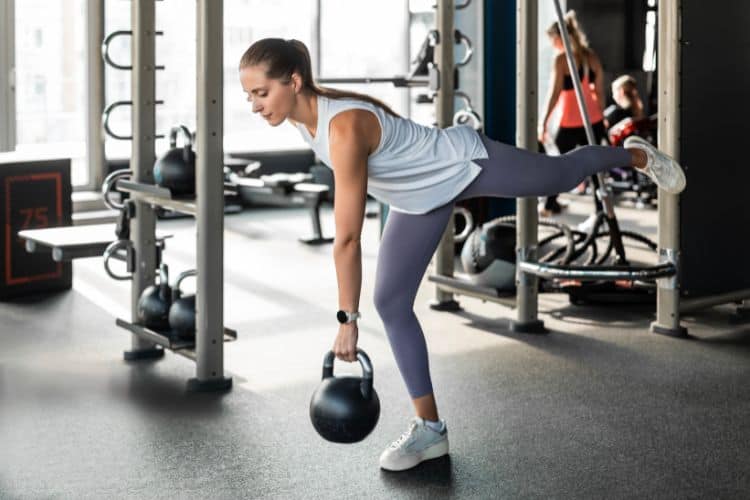
Stand with your feet approximately shoulder-width apart and place the kettlebell slightly in front of you. Hinge at your hips, keep your spine long, and grip the handle with both hands. Pull the bell back between your legs as if hiking a football, then drive your feet into the floor and extend your hips powerfully. The bell should float forward because of the force from your hips.
Keep your arms relaxed, your shoulders away from your ears, and your abdominal muscles braced. At the top, stand tall without leaning backward. Allow the bell to return, guide it high between the thighs, and immediately load the hips for the next repetition. The swing is a hinge, not a squat, so your hips travel backward and your shins remain relatively vertical.
Beginners can replace swings with kettlebell deadlifts. Place the bell between your feet, hinge down, stand by squeezing your glutes, and return the weight with control. This modification removes the ballistic portion while teaching the same fundamental hip pattern.
Hold the kettlebell close to your chest by the horns or the body of the bell. Stand with your feet in a comfortable squat position and turn your toes slightly outward if that feels natural. Brace your core, bend your knees and hips, and sit down between your legs while keeping your chest lifted.
Descend only as far as you can maintain control, then press through your whole foot to stand. Keep your knees tracking generally in the same direction as your toes. Avoid letting the kettlebell pull your shoulders forward or allowing your heels to rise from the floor.
To reduce the difficulty, squat to a sturdy chair or bench and lightly touch the surface before standing. To increase the challenge, slow the lowering phase for three seconds or add a brief pause at the bottom without relaxing your posture.
Hold the kettlebell in the rack position on one side. The handle rests diagonally across your palm, your wrist stays neutral, and your elbow remains close to your ribs. Bend your knees slightly, drive through your legs, and use that momentum to press the bell overhead. Finish with your arm extended and your ribs controlled rather than flaring upward.
Lower the kettlebell carefully to the rack position. Switch hands using a controlled hand-to-hand transfer at chest level, or place the bell down briefly before changing sides. Continue alternating for the interval. If switches disrupt your form, perform 20 seconds on one arm and 20 seconds on the other.
For a lower-impact option, perform a one-arm kettlebell floor press, changing sides halfway through the interval. Avoid overhead work if it causes shoulder pain.
Hold the kettlebell at your chest and stand tall with your feet about hip-width apart. Step one foot backward, land softly on the ball of that foot, and lower both knees under control. Press through the front foot to return to standing, then repeat on the other side.
Keep the front knee aligned with the foot and maintain a tall torso. The backward step should be long enough to create space for both knees to bend comfortably. Move deliberately rather than trying to accumulate as many repetitions as possible.
If balance is difficult, perform stationary split squats and change sides halfway through the interval, or complete bodyweight reverse lunges while holding a wall or chair for support. More advanced participants can hold the kettlebell in a suitcase position on one side, switching hands halfway through. The offset load increases the demand on the core.
Begin with the kettlebell in both hands and use a hip hinge similar to the swing. Drive your hips forward and guide the bell upward toward chest height. As it rises, bend your elbows and draw them slightly out and back, keeping the weight relatively close to your body. Extend your arms as the bell travels down, then hinge to absorb its return.
The hips should create most of the power. Do not slowly muscle the kettlebell upward with the shoulders, and do not pull it so high that control is lost. Keep your wrists aligned and your shoulders down away from your ears.
If the high pull feels unfamiliar, substitute another round of deadlifts, two-handed kettlebell rows, or controlled Russian swings. A safer familiar exercise is more valuable than a technically poor advanced movement.
Aim for a challenging but repeatable effort. During the first round, you should feel as though you could perform a little more when each interval ends. The second and third rounds can become progressively harder. In the final round, your breathing should be elevated and the last several repetitions should require focus, but you should still be able to maintain safe technique.
Use the 20-second transitions purposefully. Set the kettlebell down safely, take one or two controlled breaths, and position yourself for the next exercise. If you cannot recover enough to perform the next movement correctly, extend the rest period. The written timer is a framework, not a reason to ignore warning signs.
Beginners can change the format to 30 seconds of work and 30 seconds of rest while keeping the same five-minute rounds. Replace swings with deadlifts, use bodyweight reverse lunges, and perform a floor press instead of a push press. Complete two or three rounds at first, then build toward all four as conditioning and technique improve.
Intermediate exercisers can follow the routine as written. Advanced exercisers can increase the load where appropriate, use a strict press, pause their squats, or hold the bell in an offset position during lunges. Change only one variable at a time and preserve good technique.
Do not treat the swing like a front raise. Create momentum with your hips and let the bell float while your hands guide it. Watch for fatigue-related changes such as a rounded back during hinges, knees collapsing inward during squats, or excessive back arching during presses. Slow down, modify the exercise, or stop the interval when form deteriorates.
Finally, do not hold your breath for an entire interval. Exhale through the hardest portion of controlled exercises, such as standing from the squat or pressing overhead. During swings, use a rhythmic, forceful exhale as the hips extend. Steady breathing supports control and helps you manage the cardiovascular demand.
When the final interval ends, walk slowly until your breathing settles. Then gently stretch your hip flexors, hamstrings, glutes, chest, and shoulders. Avoid forcing a deep range while your muscles are fatigued, and rehydrate afterward.
Most people do not need high-intensity training every day. One to three kettlebell HIIT sessions per week can be enough, depending on experience, recovery, and other exercise. Leave time between demanding sessions, especially if your legs, shoulders, lower back, or grip remain significantly sore.
You can pair this workout with two or three traditional strength-training days, regular walking, and mobility work. If you already perform heavy kettlebell or barbell training, use this circuit strategically rather than adding it automatically. Total weekly workload matters more than the length of any single session.
Repeat the same version for two or three weeks while learning the exercises and tracking how the intervals feel. Progress does not have to mean completing more repetitions every time. Better balance, stronger posture, more consistent pacing, and easier recovery are meaningful improvements.
When the workout becomes noticeably easier, choose one progression. You might increase the kettlebell weight slightly, use a harder modification for one exercise, or add control with a slower lowering phase. Avoid increasing the weight, reducing rest, and choosing more difficult exercises all at once. Changing one variable makes it easier to judge whether the progression is appropriate.
Twenty focused minutes can be enough for a productive workout, particularly when the exercises train the full body and the intervals match your ability. Results depend on consistency, appropriate effort, nutrition, recovery, and what you do throughout the rest of the week. A short, well-designed session performed regularly is often more useful than an ambitious plan you rarely complete.
The routine contains no required jumping, so it can be lower impact than many HIIT workouts. However, swings and high pulls are fast, ballistic movements and may not suit everyone. Use deadlifts and rows for a more controlled version. Low impact does not automatically mean low intensity; squats, lunges, presses, and loaded hinges can still create a demanding session.
Exercise should feel demanding, but sharp pain, dizziness, chest pain, or unusual shortness of breath are reasons to stop. Speak with a qualified healthcare professional before beginning a new high-intensity program if you are pregnant, returning after an injury, managing a medical condition, or have concerns about whether vigorous exercise is appropriate for you.
Keep the kettlebell under control from the first repetition to the last. Never drop it casually or place it where you might trip. If grip fatigue becomes severe, end the interval before the bell slips. Training safely is what makes it possible to return and progress.
This 20 minute HIIT kettlebell workout proves that an effective session does not need to be complicated. With one kettlebell and a small amount of space, you can train the hips, legs, upper body, and core while challenging your cardiovascular fitness. The five-exercise circuit is easy to remember, and the 40-second work periods provide enough time to establish a rhythm without dragging the workout out.
Approach the routine with a weight and pace that support good technique. Modify any movement that does not suit your current ability, and allow recovery between HIIT days. As your fitness improves, progress one variable at a time. Twenty deliberate minutes can become a powerful and sustainable part of a balanced weekly fitness plan.
Continue building your strength and conditioning with these related workouts from WomensFitClub. If you are still learning the foundational movements, begin with this Beginner Kettlebell Workout For Weight Loss And Strength. Women seeking a longer, more controlled routine can try the Full-Body Kettlebell Strength And Mobility Workout For Adults Over 40. For a joint-friendly alternative, follow this 20 Minute Low Impact HIIT Workout With Dumbbells, or build cardiovascular endurance with these 30 Minute HIIT Workouts For Beginners at Home. You can also strengthen your back, shoulders, and grip with this Kettlebell Back Workout Featuring 10 Strength Building Exercises.
Stay up to date on the latest women’s health, fitness and lifestyle trends and tips.
