


Sign up for workout ideas, training advice, reviews of the latest gear and more.



If you are looking for a highly effective lower-body workout that emphasizes your quadriceps while minimizing unnecessary joint stress, a 30 minute cable squats for quads workout deserves a place in your training routine. While barbells and dumbbells often receive most of the attention for leg training, cable machines provide constant tension throughout every repetition, making them an excellent tool for maximizing muscle activation and improving exercise control.
Unlike traditional free-weight squats where resistance changes throughout the movement, cable machines maintain continuous resistance from start to finish. This means your quadriceps stay under tension for longer, potentially increasing muscle growth while improving stability and movement quality. Whether your goal is stronger legs, improved athletic performance, better knee stability, or more defined thighs, cable squats offer an effective solution for beginners and experienced lifters alike.
This complete guide covers everything you need to know about performing cable squats for your quads, including benefits, proper technique, common mistakes, warm-up recommendations, and a complete 30-minute cable machine workout designed to maximize quadriceps development.
The quadriceps are among the largest and strongest muscles in the human body. Located on the front of your thighs, they consist of four muscles working together:
These muscles are responsible for:
Strong quadriceps also reduce injury risk while improving athletic performance and lower-body strength.
Cable squats provide several unique advantages over standard barbell squats.
Cable resistance remains consistent throughout the entire movement. Your quadriceps continue working even at the top of each repetition where free weights often become easier.
The cable guides the movement, allowing many people to maintain better posture and squat depth.
Because the resistance angle differs from barbell squats, many lifters experience less spinal loading while still effectively training the legs.
People learning squat mechanics often find cable squats easier because they provide additional balance and control.
Constant resistance helps you focus on squeezing the quadriceps throughout every repetition.
A focused half-hour session can deliver excellent results.
Benefits include:
You’ll only need access to a cable machine with:
Never skip your warm-up.
Spend five minutes preparing your lower body.
2 sets × 15 reps
Focus on full depth and controlled movement.
2 sets × 10 each leg
Activate the glutes, quads, and hips.
15 front-to-back
15 side-to-side
Increase hip mobility.
30 seconds each direction
Improve hip movement before squatting.
2 sets × 12 reps
Use very light weight.
Correct technique is essential.
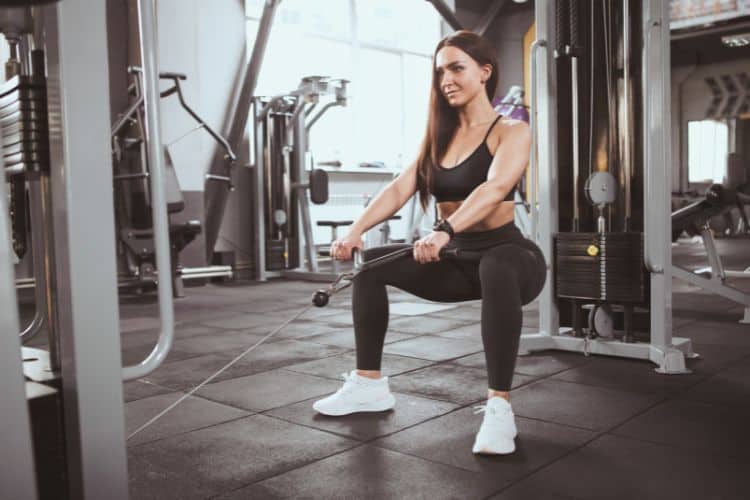
Attach a straight bar to the lowest pulley.
Stand facing the machine.
Hold the attachment with both hands.
Walk backward until tension develops.
Feet should be shoulder-width apart.
Brace your core.
Keep your chest tall.
Maintain a neutral spine.
Push your hips back slightly.
Bend the knees.
Lower until thighs become parallel or slightly below.
Drive through your heels.
Straighten the legs.
Squeeze your quadriceps at the top.
Repeat slowly.
Time: 5 minutes
Sets: 4
Reps: 10-12
Rest: 60 seconds
This movement places significant emphasis on the quadriceps while encouraging upright posture.
Focus on:
Sets: 3
Reps: 12-15
Rest: 45 seconds
Hold the rope attachment close to your chest.
Maintain an upright torso.
Drive through your heels.
Sets: 3
Reps: 12
Rest: 45 seconds
A narrower stance shifts more emphasis toward the quadriceps.
Avoid letting your knees collapse inward.
Sets: 3
Reps: 15
Rest: 30 seconds
Lower into the squat.
Perform small pulses near parallel.
Feel continuous tension in the quads.
Sets: 3
Hold: 30-45 seconds
Rest: 30 seconds
Stay in the bottom position.
Keep tension on the cable.
This exercise develops muscular endurance and mental toughness.
Finish with:
1 set
20 repetitions
Use lighter weight.
Move continuously with perfect technique.
Building stronger quadriceps requires progressive overload.
Increase training difficulty by:
Increase resistance by 5-10 pounds when all prescribed reps become comfortable.
Increase reps before increasing weight.
Lower over three to four seconds.
Pause at the bottom.
Explode upward under control.
Shorter recovery increases workout intensity.
8-12 repetitions
5-8 repetitions
15-20 repetitions
For most people, 10-15 repetitions work exceptionally well.
Heavy weight often sacrifices technique.
Prioritize movement quality.
Push through your heels.
Maintain balanced foot pressure.
Brace the core.
Keep the spine neutral.
Aim for thighs parallel to the floor whenever mobility allows.
Finish each repetition smoothly.
Maintain muscle tension.
Small adjustments produce better results.
Stable footwear improves force production.
Good posture improves squat mechanics.
Healthy knees can safely move over the toes during squats.
Avoid rushing.
Think about pushing the floor away.
Training alone won’t maximize muscle growth.
Eat enough quality calories.
Prioritize protein.
Excellent choices include:
Aim for approximately 20–40 grams of protein after training to support muscle recovery.
Complex carbohydrates also help fuel intense workouts.
Choose:
Healthy fats from avocados, nuts, seeds, olive oil, and fatty fish support overall health and recovery.
Hydration is equally important. Drink water before, during, and after your workout to maintain performance.
Muscles grow during recovery.
Support recovery by:
Cable squats work well for:
30 Minute Cable Squats for Quads
Hamstrings and glutes workout
Full lower-body cable machine workout
This schedule provides adequate recovery while allowing consistent progress.
Yes. Constant cable resistance keeps the quadriceps under tension throughout each repetition, making them highly effective for muscle growth when combined with progressive overload and proper nutrition.
Absolutely. Cable squats are beginner-friendly because the machine provides additional stability and helps reinforce proper squat mechanics.
Two to three sessions per week usually provide excellent results while allowing enough recovery between workouts.
Cable squats can be a valuable primary exercise for many people, especially those seeking consistent muscle tension or reduced spinal loading. However, combining both cable and free-weight squats can create a well-rounded lower-body program.
Choose a weight that allows you to complete every repetition with perfect form while feeling challenged during the final two or three reps. Technique should always come before adding more resistance.
With consistent training, proper recovery, and a nutritious diet, many people notice improvements in strength within a few weeks and visible muscle development after several months of regular training.
A 30 minute cable squats for quads workout is an efficient and highly effective way to develop stronger, more muscular legs while improving squat technique and lower-body stability. The constant resistance provided by the cable machine keeps your quadriceps working throughout every phase of each repetition, helping maximize muscle activation without placing excessive stress on the lower back.
Whether you are new to strength training or an experienced lifter looking to add variety to your leg routine, cable squats offer a versatile training option that can be adapted to nearly any fitness level. Stay consistent, focus on excellent form, progressively increase the challenge over time, and support your workouts with proper nutrition and recovery. By following this structured 30-minute workout regularly, you’ll be well on your way to building stronger quads, improving functional strength, and enhancing your overall lower-body performance.
Boost your lower-body training by combining this 30 Minute Cable Squats for Quads workout with other proven leg-strengthening routines on WomensFitClub. If you’re looking to build balanced leg strength, improve muscle definition, and increase overall lower-body power, check out our 30 Minute Full Body Workout on Machines Only, Best Leg Machine Workout, 40 Minute Full Body Machine Circuit Workout, 45 Minute Machine Workout Plan, and 4 Day Machine Only Workout. These workouts complement cable squats by targeting your glutes, hamstrings, calves, and core, helping you create a complete machine-based strength program for faster results and better overall fitness.
Stay up to date on the latest women’s health, fitness and lifestyle trends and tips.
