



Sign up for workout ideas, training advice, reviews of the latest gear and more.

A barbell makes it possible to train your legs, hips, back, chest, shoulders, and core in one focused session. You do not need a long list of exercises or an hour at the gym to make the workout worthwhile. With four movements, a sensible weight, and a clock, this 30-minute full-body barbell workout for women gives you a repeatable strength session that fits into a busy week.
The plan combines a squat, a hip hinge, a horizontal press, and a row. These movements cover the major muscle groups without requiring you to rush through complicated transitions. You will warm up for five minutes, complete two 10-minute strength blocks, and finish with five minutes of easier movement. The blocks use alternating sets, so each exercise gets recovery time while you train another movement. The goal is controlled repetitions and consistent effort, rather than trying to turn every set into a race.
You can use this workout whether you are learning the barbell or already have experience with basic lifts. New lifters can start with an empty training bar, a lighter fixed barbell, or an alternative that allows good control. More experienced lifters can use loads that make the last few repetitions challenging while keeping technique steady. Either way, the best starting point is the one that lets you finish the full session well.
You will need a barbell, weight plates if appropriate, collars, and a clear area where you can lift safely. A squat rack with correctly positioned safety bars is useful for the squat. A flat bench is needed for the bench press; if you have no bench, the barbell floor press is a practical substitute. Set out your equipment before starting the timer so that changing stations does not consume your working time.
If the standard bar feels too heavy, choose a lighter technique bar or fixed-weight barbell. Standard Olympic bars often weigh 20 kilograms, but gyms may stock bars of different weights. Check the marking or ask a staff member if you are unsure. Record the actual load you use, including the bar and plates, so you can track future sessions accurately.
Wear shoes that feel stable under your feet, and give yourself enough space to lower the bar without striking nearby equipment. If you are new to the bench press, use a spotter or rack safeties set for the lift. A floor press can also simplify setup because the floor limits how far your elbows travel below your torso. Give yourself time to learn how your particular rack and bench adjust before starting the clock.
The workout follows one simple sequence: a five-minute warm-up, 10 minutes alternating squats and rows, 10 minutes alternating Romanian deadlifts and presses, and a five-minute cooldown. In each strength block, perform five rounds of two exercises. Start a new exercise at the beginning of each minute, leaving whatever time remains in that minute for rest and setup. This gives you 10 work minutes per block and 20 total work sets across the session.
During minutes 5 through 15, perform six to eight barbell back squats at the start of each even-numbered minute of the block and eight to 10 bent-over rows at the start of each odd-numbered minute. During minutes 15 through 25, perform eight to 10 Romanian deadlifts on alternating minutes and six to eight bench presses or floor presses on the minutes between. The final five minutes are for easy walking, relaxed breathing, and gentle mobility. The labels “even” and “odd” refer to the minute within each 10-minute block, beginning with minute zero.
This schedule works only if you can complete the repetitions comfortably within the minute. Aim to finish each set with enough time to breathe and prepare for the next movement. If setting up the bench and rack makes the second block awkward, place both stations nearby before beginning or use a lighter fixed bar in an uncrowded training space. Do not rush a lift to catch the clock. Pause it, reduce the repetitions, or use ordinary alternating sets with about 45 to 75 seconds of rest instead.
Walk briskly, march in place, or use a bike for two minutes. Move enough to feel warmer, but keep your breathing comfortable. The warm-up is there to help you transition into lifting, not to tire you out before the first squat. If you arrived at the gym after a long walk, you may already feel warm; still spend this time checking how your hips, shoulders, and back move today.
Perform a few unweighted squats, then practice hinging by pushing your hips back while keeping your spine comfortably neutral. Add several arm circles and slow shoulder-blade squeezes. You might do six bodyweight squats, six hip hinges, and six controlled arm movements in each direction. Move smoothly rather than trying to force a deeper range of motion. Your squat depth and hinge position should match what you can control with a load.
Use the empty bar or a very light practice bar for a few easy squats and rows. Before the pressing block, perform a short light press rehearsal if you need it, even if that means pausing the timer briefly. When your working weight is much heavier than the empty bar, add a gradual warm-up set or two before the 30-minute clock begins. A fixed schedule is useful, but preparing for the load matters more than hitting an exact stopwatch target.
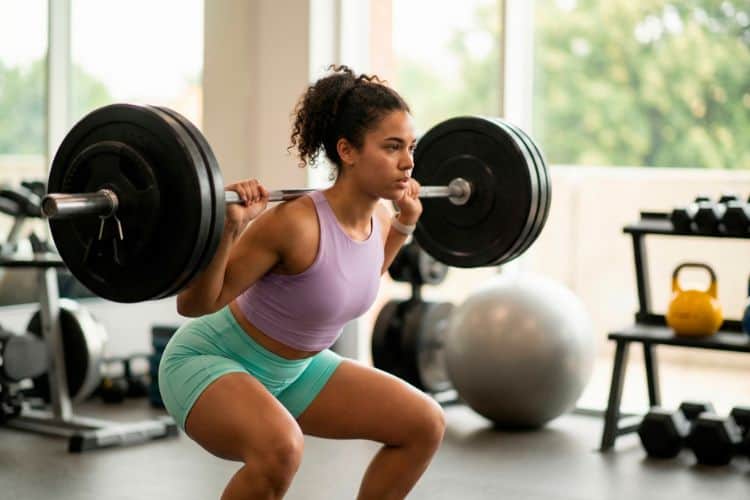
Position the bar on the upper-back muscles where it feels secure, not directly on the neck. Grip it firmly, step back just far enough to clear the rack, and place your feet in a stance that allows your knees and hips to bend comfortably. Take a breath, brace your trunk, and lower between your hips while keeping pressure through your whole foot. Stand by pushing the floor away and allowing your hips and knees to straighten together.
Choose a depth you can reach without losing balance or forcing your back into a position you cannot control. Your knees can travel forward as needed; focus on keeping the movement smooth and your feet planted. Finish each repetition standing tall without leaning back. Rack the bar deliberately after the set, making sure both sides are secure before stepping away.
Use six to eight repetitions at the start of minutes 0, 2, 4, 6, and 8 of this block. Pick a load that leaves roughly two or three repetitions in reserve at the end of each set. If your first set is already a grind, reduce the weight before the next round. For someone learning to squat, a front squat with a light bar, a landmine squat, or even a goblet squat can be an effective stepping stone while you develop confidence with the rack.
At the start of minutes 1, 3, 5, 7, and 9, set the bar at thigh height and push your hips back until your torso angles forward. Keep a small bend in your knees, let your arms extend, and pull the bar toward your lower ribs or upper abdomen. Think about moving your elbows behind you rather than throwing your chest upward to meet the bar. Lower the weight with control before starting the next repetition.
Your torso does not need to be perfectly parallel to the floor. Choose an angle you can hold without your lower back becoming the limiting factor. If maintaining that position is difficult after squats, lighten the bar or use fewer repetitions. The row should feel primarily like work for your upper back and arms, with your trunk supporting the position. Avoid yanking the weight with momentum just to complete the set within the minute.
Stand with the bar held in front of your thighs and your feet about hip-width apart. Keep your knees slightly bent, take a steady breath, and move your hips backward as the bar travels close to your legs. Lower until you feel a stretch in the back of your thighs while you can still keep the bar close and your back controlled. Then drive through your feet and bring your hips forward to stand tall.
The Romanian deadlift is a hip hinge, not a squat with the bar in your hands. Your knees will bend a little, but the main movement comes from your hips. There is no need to touch the floor or lower the bar past the range you can control. Stop the descent where your hamstrings and hip position tell you to stop. At the top, avoid leaning backward or squeezing so hard that your ribs flare upward.
Perform eight to 10 repetitions at minutes 0, 2, 4, 6, and 8 of the second block. Because your trunk has already worked during squats and rows, begin conservatively. A moderate weight that lets you repeat the same controlled hinge on all five sets is a better choice than a heavier load that changes your movement after the first round.
Lie on a stable bench with your eyes near the bar, feet planted, and shoulders positioned comfortably against the bench. Take a grip that lets your forearms look roughly vertical near the bottom of the lift. Unrack with control, lower the bar toward your mid-chest, and press upward until your arms are straight. Keep your wrists stacked over your forearms as much as possible and move without bouncing the bar off your chest.
Use the pressing variation and range of motion that feel comfortable for your shoulders. If you choose a floor press, lie on the floor with bent knees or legs extended, lower until your upper arms gently contact the floor, pause briefly, and press back up. The floor version can limit the lower portion of the movement and may be easier to set up when a bench is unavailable. Use a spotter or correctly set rack safeties whenever you need them.
Perform six to eight repetitions at minutes 1, 3, 5, 7, and 9. Choose a weight that lets you keep the bar path steady and complete every repetition without help. If the bar slows dramatically or your position shifts, end the set. You can use a lighter bar for pressing than for the Romanian deadlift; most people should not expect one weight to suit both movements.
Use minutes 25 through 30 to walk slowly and let your breathing settle. Then spend a short time moving your hips and shoulders through comfortable ranges. You might take a gentle standing hip stretch, open your chest with your arms at your sides, and reach your arms overhead without forcing a position. The cooldown does not have to be elaborate; it gives you a calm ending and a moment to notice how the session felt.
Before you leave, write down the load, repetitions, and any useful notes. Did the fourth squat set feel much harder than the first? Did your row position change? Were the bench transitions too tight for the timer? These observations will help you adjust the next session. If you have another workout later in the week, leaving the gym with a little energy is often more useful than trying to empty the tank today.
There is no single barbell weight that every woman should use. Your appropriate load depends on the lift, your experience, the equipment, and how you feel that day. Start with a weight you can move through the full intended range with consistent technique. For most working sets here, aim to feel as though you could perform about two more clean repetitions when the set ends. You can use a lighter effort while learning the movements.
The squat, row, Romanian deadlift, and press will often require different loads. Check your setup for each rather than leaving the same plates on the bar throughout. On a day when you are tired or a movement feels unfamiliar, reduce the weight, shorten the set, or take longer rests. A planned 30-minute workout can also become a 35-minute workout if that is what your lifting quality requires.
Try to avoid choosing weight based on what someone else lifts. The useful question is whether you can control your repetitions today and gradually improve over time. A lighter bar lifted with focus gives you a foundation for future progress. As your technique becomes more consistent, the same repetitions will feel easier, and you can consider adding load.
Repeat this session once or twice a week, allowing recovery between hard sessions. If you also follow a separate strength plan, count this as a full-body lifting day and arrange your other workouts accordingly. During week one, learn the stations and select conservative loads. Record how many repetitions you complete in each set and whether your form stays consistent through the fifth round.
During week two, keep the same loads and add a repetition where you can. For example, if you completed five squat sets of six with good control, try to complete some sets of seven. In week three, work toward the top of the prescribed range across all five sets. When you can perform every set at the top of the range while retaining a couple of repetitions in reserve, increase the load by the smallest practical increment at the next session. You may progress on the row before the squat, or on the hinge before the press; each lift has its own timeline.
In week four, continue from your actual results rather than forcing a preset jump. You might use a slightly heavier squat bar and return to sets of six while keeping your pressing weight unchanged. If the new load makes your technique uneven, go back to the previous weight and build more controlled repetitions. Progressive overload can come from more clean repetitions, a small weight increase, steadier technique, or better consistency across sessions.
A useful 30-minute workout should be easy to return to. Keep the five-minute warm-up, two 10-minute blocks, and five-minute cooldown as your starting structure. Adjust the load, repetitions, rest, and exercise variations to make the session fit your equipment and experience. With practice, you will learn what a challenging but repeatable set feels like, and your notes will show when it is time to progress.
The biggest advantage of this plan is its simplicity. You squat, row, hinge, and press; you pay attention to your technique; and you come back ready to improve. Put the next session on your calendar, record what you lifted today, and give yourself the chance to build strength one controlled workout at a time.
If you are still learning the main lifts, start with our Full Body Beginner Barbell Workout Plan For Women. When you have less time, try the 20 Minute Barbell Workout For Busy Days; when you have more, follow the 45 Minute Full Body Barbell Workout. To give your squats and hinges extra attention, use the 30 Minute Barbell Leg Day Routine, then build a longer training schedule with the 4 Week Barbell Workout Plan.
Stay up to date on the latest women’s health, fitness and lifestyle trends and tips.
