


Sign up for workout ideas, training advice, reviews of the latest gear and more.

A good full body workout does more than leave you tired. It gives your legs, hips, back, chest, shoulders, arms, and core enough work to get stronger while leaving room to recover before the next session. This 45 minute full body dumbbell workout uses straightforward movements and a repeatable schedule, so you can train at home or in the gym without spending half your time deciding what comes next.
You will warm up for five minutes, complete three ten-minute strength circuits, spend five minutes on a controlled finisher, and cool down for five minutes. Each circuit pairs different movement patterns, allowing one area to work while another recovers. Use weights that make the final few repetitions challenging without forcing you to rush or change your form. If you only own one pair, the plan still works: adjust your pace, repetitions, or range of motion as needed.
This workout is designed for women who want practical full body strength training, but the exercises and progression principles apply to anyone. You can do it twice or three times a week on nonconsecutive days, or use it as one full body session alongside other activities you enjoy.
Set out a light and a moderate pair of dumbbells if you have them, a stable exercise mat, water, and a timer. A heavier pair can help with squats, deadlifts, and carries, while lighter weights may suit presses and raises. Do not feel obligated to use the same load for every movement. Your legs and hips often handle more weight than your shoulders.
Choose an open space where you can step backward and extend both arms without striking furniture. Wear shoes that give you a steady footing, particularly if you are training on a smooth floor. For a floor press, you can use a mat or folded towel. Every exercise can be done without a bench.
The 45 minutes are accounted for: five minutes of warm-up, ten minutes for Circuit A, ten minutes for Circuit B, ten minutes for Circuit C, five minutes for the finisher, and five minutes of cooldown. During each ten-minute circuit, perform the three prescribed exercises in order at a controlled pace. Rest as needed between movements and repeat the sequence for as many quality rounds as time allows. Most people will complete two or three rounds.
Start the timer at the beginning of each section. When ten minutes expires, finish the repetition you are on, then move to the next section. The transition is included in that section’s time; there is no hidden extra rest period. You can take a few breaths while changing weights or getting into position. If you need more rest, take it and complete fewer rounds. The goal is consistent, safe work, not a race against the clock.
Spend the first minute marching in place and gradually swinging your arms. During the second minute, alternate comfortable bodyweight squats and gentle hip hinges: bend your knees to sit between your hips, then stand tall and push your hips backward as if closing a door behind you. For the third minute, step backward into shallow alternating reverse lunges, holding onto a wall if balance is a concern.
Use the fourth minute for shoulder circles and slow arm reaches, moving through a comfortable range. In the fifth minute, perform several unloaded versions of the first circuit’s squat, row, and floor press. Focus on smooth breathing and positions you can control. A warm-up should help you feel ready to lift; it does not need to exhaust you.
Circuit A covers a knee-dominant lower body movement, an upper body pull, and an upper body push. Do 8 to 12 goblet squats, 8 to 12 bent-over rows, and 8 to 12 dumbbell floor presses. Move through the three exercises in order, rest when needed, and repeat until the ten minutes are up.
Hold one dumbbell vertically against your chest with both hands. Place your feet approximately shoulder-width apart, with your toes turned out slightly if that feels natural. Inhale, bend your hips and knees together, and lower as far as you can while keeping your feet planted and your torso controlled. Exhale as you push through your whole foot to stand.
Allow your knees to track in the direction of your toes. There is no requirement to squat to a particular depth; choose one that lets you maintain balance and avoid pain. If holding a dumbbell against your chest is uncomfortable, hold two weights at your sides. Beginners can squat to a sturdy chair and stand without bouncing off it. Pause briefly at the bottom if you want to make a lighter dumbbell more demanding.
Hold a dumbbell in each hand, soften your knees, and hinge at the hips until your torso tips forward comfortably. Keep your back in a stable, natural position and let your arms hang toward the floor. Pull your elbows toward your hips, pause, then lower the weights without swinging your torso. Think about moving your upper arms rather than shrugging the dumbbells toward your ears.
If your lower back tires before your upper back, place one hand on a sturdy chair or bench and row one side at a time. Complete the same number of repetitions on each side. Choose a torso angle that you can hold steadily; the row still works if you are somewhat more upright.
Sit on the floor with the dumbbells near your thighs, then carefully roll onto your back with knees bent. Position your upper arms at a comfortable angle from your torso and your forearms approximately vertical. Press the weights upward until your arms are extended without forcing your elbows to lock. Lower until your upper arms touch the floor lightly, pause, and press again.
The floor limits how far your elbows travel behind your body, which many people find comfortable. Avoid dropping the dumbbells to the floor or flaring your elbows straight out to the sides. When the set ends, bend your elbows, bring the weights toward your torso, and roll to one side before sitting up. If getting down to the floor is difficult, substitute a standing neutral-grip dumbbell press against a wall-supported stance, using a light weight.
This circuit emphasizes your glutes and hamstrings, trains each leg separately, and adds a vertical upper body push. Perform 8 to 12 Romanian deadlifts, 6 to 10 reverse lunges per leg, and 8 to 10 overhead presses. Repeat in that order for ten minutes with enough rest to keep your repetitions steady.
Stand with a dumbbell in each hand in front of your thighs. Keep a slight bend in your knees and move your hips backward, letting the weights travel close to your legs. Lower until you feel a manageable stretch in your hamstrings and can still hold your back position. Drive your feet into the floor and bring your hips forward to stand tall.
The movement comes mostly from your hips; it is not a deep squat or an attempt to touch the floor. Stop the lowering phase before your back rounds or the weights drift far forward. Start lighter than you think you need if you are learning the hinge, then increase the load once you can repeat the same motion comfortably.
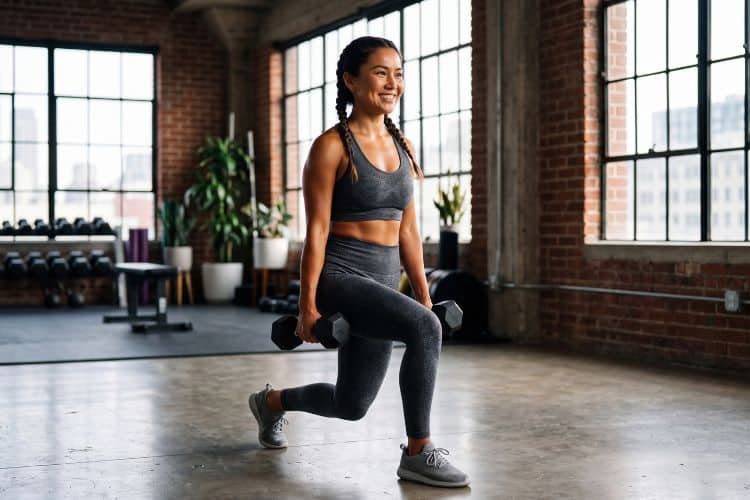
Hold the dumbbells at your sides, step one foot backward, and lower your body under control. Keep most of your balance over the front foot. Push through the front foot to return to standing, then repeat on the other side. Count a repetition each time one leg steps back, and aim for the same number on both sides.
You can use a shorter step and shallower depth if your knees or balance need it. Holding one hand against a wall and using only one dumbbell is a sensible way to build confidence. If lunges do not feel good, substitute supported split squats with a small range of motion or perform another set of goblet squats. A controlled variation beats struggling through an awkward one.
Bring two light-to-moderate dumbbells near shoulder height with palms facing inward or slightly forward. Stand with your feet planted, gently brace your abdomen, and press upward through a comfortable path. Lower the weights slowly to shoulder level. Keep your ribs from flaring and avoid leaning far backward to move a weight that is too heavy.
If pressing both arms together is difficult, alternate arms while keeping the total repetitions even. You may also press from a stable seated position with back support. If overhead motion causes discomfort, switch to another round of floor presses or use a light front raise within a pain-free range.
The last strength circuit revisits your posterior chain and upper back while challenging your core to resist leaning. Perform 10 to 15 weighted glute bridges, 8 to 12 single-arm supported rows per side, and a suitcase carry for 30 to 45 seconds per side. Repeat the sequence until the ten-minute timer ends. If you have limited space, hold the weight still for the same time instead of walking.
Lie on your back with your knees bent and feet planted about hip-width apart. Place one dumbbell across the front of your hips and steady it with both hands. Exhale and press through your feet to lift your hips until your torso and thighs form a comfortable line. Pause briefly, then lower under control.
Keep the movement in your hips rather than trying to arch your lower back for extra height. Move your feet a little closer or farther away until you feel your glutes working without discomfort. If balancing the dumbbell is distracting, perform the first round without weight and add it only after your position feels secure.
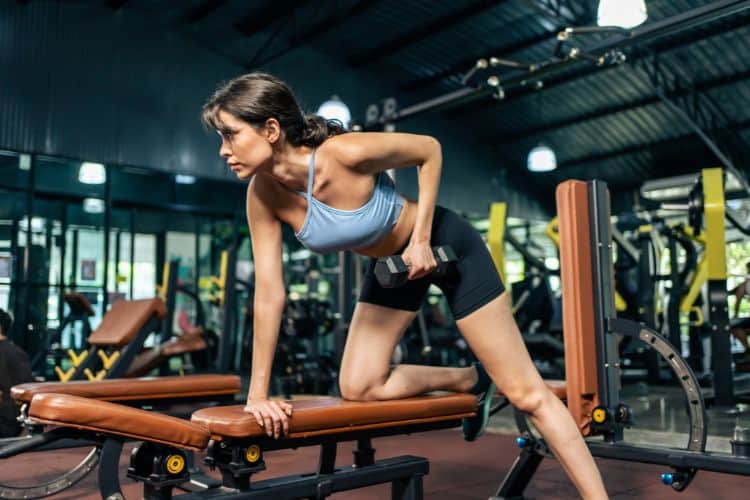
Place one hand on a stable chair, bench, or countertop and step your feet apart for balance. Hold a dumbbell in the opposite hand. With your shoulders roughly level, draw the weight toward your hip, then lower it slowly. Complete your repetitions and switch sides. Avoid twisting your torso just to lift a heavier weight.
This version lets you focus on each side separately and may be easier on your lower back after the Romanian deadlifts. If you notice one side is weaker, start with that side and match its repetitions on the stronger side. Do not add extra reps on one side simply because you can.
Hold one moderately heavy dumbbell at your side as though carrying a suitcase. Stand tall with your shoulders level and walk slowly around your space for 30 to 45 seconds. Switch hands and repeat. Keep the weight close to your leg without resting it against your body, and resist the urge to lean away from it.
In a small room, march gently in place or stand still and hold the dumbbell. You should feel your trunk working to keep you upright. Begin with 20 seconds per side if the full interval makes your posture slip. Set the weight down deliberately, using your hips and knees, rather than bending and twisting at once.
Use five rounds of 40 seconds of work followed by 20 seconds of recovery. Alternate between a dumbbell squat to calf raise on rounds one, three, and five, and a standing dumbbell march on rounds two and four. A timer with interval alerts makes this section easy to follow.
For the squat to calf raise, hold one or two manageable dumbbells, squat to a comfortable depth, stand, and then lift your heels before lowering them again. Move deliberately; there is no jump. For the march, hold weights at your sides, stand tall, and alternate raising one knee at a time without swaying. Use lighter weights or bodyweight if your grip is already tired. Keep the pace lively enough to feel engaged but slow enough to control every repetition.
The finisher adds some extra work without turning the whole session into frantic cardio. It is also optional if you are new to lifting or short on energy. If you omit it, spend those five minutes walking slowly and cooling down so the overall session still fits your schedule.
Walk around slowly for one minute while your breathing settles. Spend the next minute gently stretching your calves and quads, using a wall for support. Use the third minute for a comfortable standing hip hinge or seated hamstring stretch, without forcing your knees straight. During the fourth minute, relax your chest and shoulders with gentle arm movements. Finish with one minute of calm breathing and easy walking.
A cooldown does not erase muscle soreness, but it gives you a chance to check how you feel after training. Drink water according to thirst and eat a regular meal or snack that fits your day. If you pushed hard, plan some recovery time before another demanding strength session for the same muscle groups. Mild effort and fatigue are expected; sharp pain, dizziness, or a sudden loss of control are reasons to stop the workout.
Pick a weight that lets you complete the low end of the recommended range with clean form and a sense that you could do roughly two or three more repetitions. You do not need to lift to failure to make the session useful. Because the workout is timed, the number of rounds will also depend on the rest you take. More rounds are only an improvement when the repetitions stay controlled.
For example, if you can perform 12 goblet squats easily and feel ready for many more, try a heavier weight on your next session. If eight overhead presses make you lean backward or rush, use a lighter pair. Record the weights, repetitions, and rounds you complete. Those notes are more useful for choosing your next workout than guessing based on how sweaty you felt.
If you have only one light pair, slow the lowering phase to about three seconds, pause briefly where the movement feels most challenging, or work toward the higher end of the repetition range. If you have only one heavy pair, use a single dumbbell for goblet squats and glute bridges, reduce reps for presses, and take extra rest. Never force a weight into a movement you cannot control.
For a shorter training day, try this 30 Minute Full Body Dumbbell Workout At Home or the 15 Minute Full Body Dumbbell Workout. When you want a different challenge with familiar squat, hinge, row, and press patterns, follow the Full Body Dumbbell Complex Workout. To turn individual sessions into a longer routine, explore the 4 Week Dumbbell Strength Training Plan and use the Progressive Overload Dumbbell Workout Plan to guide when you add repetitions or weight.
This 45 minute full body dumbbell workout gives every major movement pattern a place without demanding a complicated setup. Start with five minutes of preparation, use the three strength circuits to practice quality repetitions, choose the finisher intensity that fits your day, and leave five minutes to wind down. Keep a simple record of your loads and reps, then repeat the workout often enough to notice improvement. Consistent, well-controlled sessions give you a clearer path to strength than chasing exhaustion each time you train.
Stay up to date on the latest women’s health, fitness and lifestyle trends and tips.
