


Sign up for workout ideas, training advice, reviews of the latest gear and more.

A 30 minute full body dumbbell workout can give every major muscle group meaningful attention without requiring a complicated setup. With a pair of dumbbells, a little floor space, and a timer, you can train a squat, a hip hinge, a push, a pull, and your core in a single session. The key is choosing exercises that work well together and leaving enough time to perform them with control.
This workout uses three short strength blocks, a brief warm-up, and a cool-down. It suits women who want a straightforward home workout, but the structure works for anyone who can perform the movements comfortably. You can adjust the weight, pace, range of motion, and rest to match your experience. There are no jumps, and you do not need to race through repetitions to make the session count.
Set out one or two pairs of dumbbells, a stable chair or bench if you want an incline for push-ups or support for rows, water, and a timer. A lighter pair can help with overhead pressing while a heavier pair may feel appropriate for squats, deadlifts, and rows. If you own only one pair, use the same weights throughout and adjust the repetitions or rest as needed. Choose a clear patch of floor where you can step backward and lower the weights without hitting furniture.
For your first attempt, pick loads that let you finish each set with roughly two or three sound repetitions still possible. The last few reps should take effort while your position remains steady. A weight that pulls your shoulders forward, changes your balance, or forces you to rush is too heavy for this session. Conversely, if every set feels effortless, you can build up gradually over future workouts.
The timer is a guide, not a contest. The training blocks use a simple repeating pattern: perform the two listed movements in order, rest briefly, and repeat until the block ends. You can pause the clock while learning a new exercise. Quality repetitions are more useful than squeezing in one more hurried round.
Spend minutes 0–4 warming up. Work through Block A from minutes 4–11, Block B from minutes 11–18, and Block C from minutes 18–25. Use minutes 25–28 for the optional carry and core finisher, then minutes 28–30 to slow down and cool off. Each seven-minute block contains two exercises. Aim for two to three rounds, allowing approximately 20–45 seconds of rest after each pair. If you complete two rounds with excellent technique, use the remaining time to recover or practice the movements slowly. Starting the next block on schedule keeps the entire session at 30 minutes.
A rep range makes this format flexible. In each block, perform eight to ten repetitions of the first move, then eight to ten of the second. When an exercise is performed on one side, complete eight repetitions per side unless noted otherwise. The core exercise has its own prescription. Transition calmly and rest longer whenever your breathing or form requires it. If a block takes you longer than seven minutes, finish your current set and shorten the finisher rather than rushing the main work.
Begin with one minute of easy marching or walking around the room while swinging your arms naturally. Follow with approximately 30 seconds each of shoulder circles and comfortable arm reaches. For the next minute, practice slow bodyweight squats, lowering only as far as you can keep your feet planted and torso steady. Spend another minute on unloaded hip hinges: soften your knees, send your hips back, and stand tall by pressing through your feet. Finish with several gentle torso rotations and a few practice repetitions of your first dumbbell squat.
The warm-up should make the first working set feel familiar. It is not supposed to exhaust you. If you feel stiff, add time to the movements that need attention and reduce the finisher at the end. If you are returning to exercise, begin with lighter weights and use the first round of each block to learn the motion.
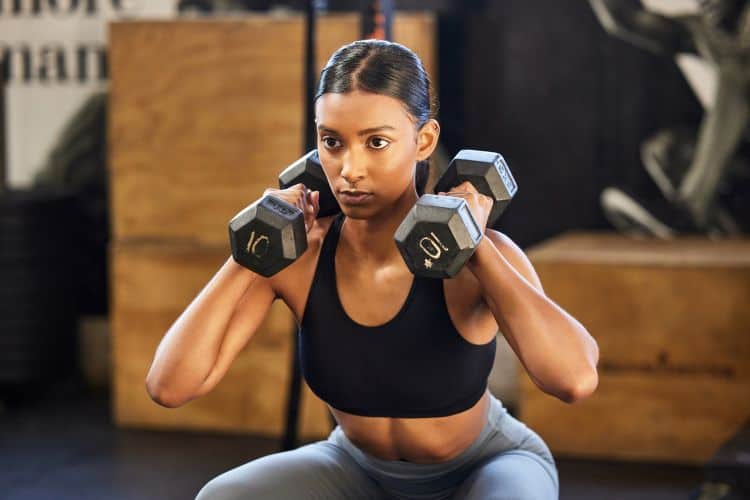
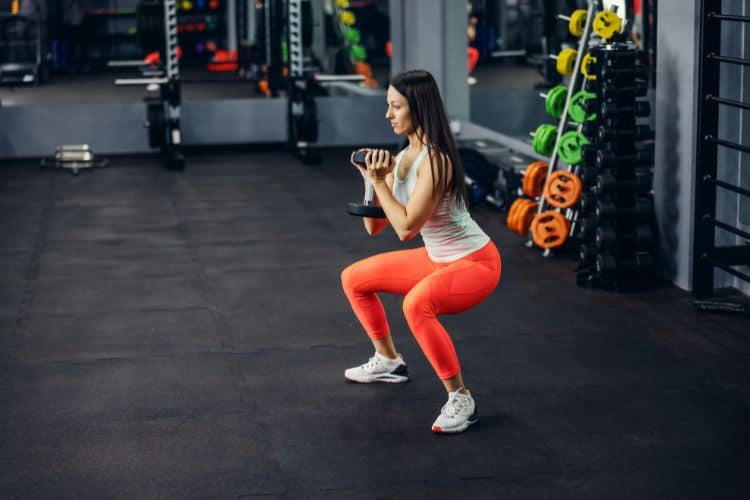
Hold one dumbbell vertically against your chest with both hands. Place your feet about shoulder width apart, or a little wider if that feels more natural. Take a breath, brace your middle, and bend at the hips and knees to sit between your legs. Lower as far as you can while keeping your heels down and the weight close to your body. Push the floor away to stand and exhale near the top.
Your knees can move forward during a squat; focus on keeping them tracking comfortably in line with your feet. Avoid collapsing inward or lifting your heels to chase a deeper position. If depth is difficult, squat toward a sturdy chair and lightly touch it before standing. If the goblet hold tires your arms before your legs, hold a dumbbell at each side instead. The squat provides the main knee-dominant lower-body movement in this full body dumbbell workout, training the thighs and glutes while your trunk stabilizes the load.
Hold one dumbbell in each hand and stand with your feet hip width apart. Bend your knees slightly and hinge at your hips until your torso tips forward and the weights hang beneath your shoulders. Keep your back in a comfortable, steady position. Draw your elbows toward your back pockets, pause briefly, and lower the weights under control. Imagine moving your upper arms rather than shrugging the weights toward your ears.
If holding the hinge position is the limiting factor, place one hand on a stable chair or bench and row one dumbbell with the other arm. Perform eight repetitions on each side, then switch. Avoid rotating your torso to heave the weight upward. The row complements the pushing work later in the session and trains your upper back and arms. Rest after both exercises, then repeat the pair until the seven-minute block ends.
Stand tall with a dumbbell in each hand in front of your thighs. Keep a slight bend in your knees and slide your hips backward as the weights travel close to your legs. Stop when you feel a manageable stretch through the back of your thighs or when maintaining your trunk position becomes difficult. Press through the floor and bring your hips forward to stand. You should feel your hamstrings and glutes working; you do not need to lower the dumbbells all the way to the floor.
The hip hinge differs from the squat in Block A. Your hips move farther back and your knees bend only a little, shifting more work to the back of your legs. Do not round your back to gain extra depth or lean backward at the top. Start with light weights and rehearse the pattern without weights if it feels unfamiliar. If gripping two dumbbells feels awkward, hold one dumbbell with both hands in front of you.
Sit on the floor with the dumbbells close to your thighs. Bring them into position carefully as you lie back, knees bent and feet planted. Hold the weights near your chest with your upper arms resting lightly on the floor. Keep your wrists stacked above your elbows. Press upward until your arms are straight without forcing your elbows to lock, then lower slowly until your upper arms contact the floor again. Let the floor provide a consistent stopping point rather than bouncing off it.
You can turn your palms toward each other for a neutral grip if that feels better on your shoulders. Pressing one arm at a time with a lighter weight is another option, but keep your torso stable as the working arm moves. The floor press emphasizes the chest and triceps while limiting the depth of the lowering phase. Sit up safely between rounds before moving to the deadlift; do not stand suddenly while holding weights above you. Complete the pair two or three times within the allotted seven minutes.
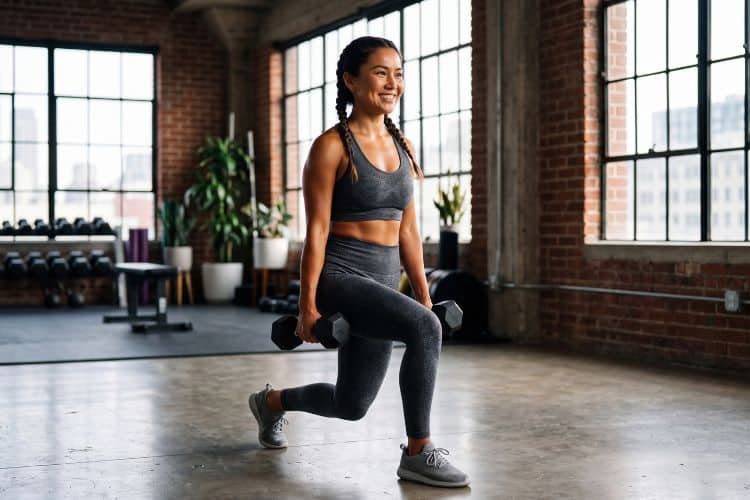
Hold one dumbbell in each hand at your sides, or start without weights. Stand tall, step one foot backward, and lower until your front leg bends as far as you can control. Press through the front foot to return to standing and alternate sides. Keep enough distance between your feet that you do not feel as if you are balancing on a tightrope. Your back knee can move toward the floor without touching it.
A reverse lunge trains each leg independently and adds balance work to the routine. If stepping backward bothers your balance, hold a stable chair with one hand and use a single dumbbell in the other. You can also perform a split squat by keeping your feet planted throughout each set. A shorter, more comfortable range is fine. Keep your chest steady and avoid pushing off the back foot so forcefully that the front leg stops doing the work.
Bring two lighter dumbbells to shoulder height with your palms facing inward or slightly forward. Stand with your feet comfortably apart, knees soft, and ribs positioned over your pelvis. Press the weights upward through a path that feels natural, then lower with control to shoulder height. Avoid leaning far backward to lift the weights. If the pair feels too heavy, press one dumbbell at a time or use a single weight with both hands.
Overhead work should feel controlled in your shoulders, without sharp pain or the need to arch your back. If overhead pressing does not suit you, replace it with an incline push-up against a sturdy counter or bench. If you prefer to keep your heart rate steadier, take extra rest after the lunges before pressing. Alternate these two exercises for the remaining seven minutes, aiming for deliberate repetitions rather than a particular number of rounds.
For the last three working minutes, hold one dumbbell at your side and walk slowly for 30 seconds. Set the weight down, switch hands, and walk for another 30 seconds. This is a suitcase carry: stand tall, keep your shoulders level, and resist leaning toward or away from the weight. Repeat once if space and time allow. If your room is too small for walking, march gently in place or simply stand still and maintain an upright posture.
Use the remaining minute for a dead bug. Lie on your back with your knees above your hips and your arms reaching toward the ceiling. Breathe out as you slowly extend one leg away from you while lowering the opposite arm behind you. Return to the start and alternate sides for four to six smooth repetitions per side. Shorten the movement if your lower back starts to lift noticeably or your breathing becomes strained. You do not need to hold a dumbbell for this exercise.
This finisher is optional because the main blocks already cover the major movement patterns. If your joints or grip need a break, use these three minutes to walk and recover. A workout remains complete when you skip an accessory drill that does not fit your current capacity.
Walk slowly for about a minute and allow your breathing to settle. Then gently move through any comfortable stretches for your calves, hips, chest, or upper back. Do not force a deep stretch while your muscles feel tired. Notice which movements felt strong, which were challenging, and whether you could have completed another clean repetition. Record your dumbbell weights and the number of rounds you completed. These notes make the next workout easier to plan.
Different exercises may call for different loads. Your legs can often handle more weight in a squat or deadlift than your shoulders can during a press. Start conservatively when testing a new movement, especially if you are learning to hinge or press overhead. You should be able to control the lowering phase, keep your chosen range of motion consistent, and finish without holding your breath for the entire set.
Use a simple progression over several weeks. First, learn each movement and complete two steady rounds per block. Next, work toward the top of the suggested rep range while maintaining the same weight and rest periods. Once all sets feel controlled and you could do a few additional reps, increase the weight by the smallest available step for that exercise. Expect your pressing weights to rise at a different pace from your squat or deadlift weights. Changing only one variable at a time helps you see what is working.
If a pair of dumbbells is your only option and the weights become too light, slow the lowering phase to about two or three seconds, add a short pause, or perform an extra controlled round where time permits. Do not combine every difficulty increase at once. Conversely, on a day when you are tired, do fewer rounds, use a lighter pair, or take longer breaks. Progress depends on repeatable training, not on making every single session harder.
If you are new to strength training, one or two rounds per block is plenty for an initial session. Rehearse the squat and hinge without weight, try a supported row, and perform lunges while holding a chair. Keep the pressing weight light enough that your ribs and shoulders stay comfortable. You can also replace reverse lunges with sit-to-stands from a chair while you build balance and confidence.
Set your timer to pause while you change positions. Moving from floor presses to standing work can take more time than expected, and there is no benefit in scrambling between exercises. The suggested seven-minute blocks give you structure; completing fewer high-quality repetitions is still productive. If you have a condition, recent injury, or restrictions from a clinician, ask a qualified professional how to adapt the workout to your circumstances. Stop an exercise if you experience sharp pain, dizziness, or symptoms that feel unusual for you.
You can start with two sessions per week on nonconsecutive days, then add a third if your schedule and recovery allow. Rotate this workout with walking or another activity you enjoy. The CDC recommends muscle-strengthening activity involving all major muscle groups on at least two days each week; its aerobic activity recommendations are a separate part of an overall routine. A 30-minute strength workout does not automatically replace your weekly aerobic activity goal. The American College of Sports Medicine’s 2026 guidance likewise emphasizes training major muscle groups at least twice weekly and building gradually over time.
Repeating the same basic exercises is useful when you are learning. Keep notes for two to four weeks so you can see whether your technique, repetitions, or chosen loads improve. If your legs remain very sore when the next strength day arrives, allow more recovery or scale back the sets. Your training frequency should be sustainable within the rest of your week, including sleep, work, and other exercise.
It can contribute to muscle growth when the sets are challenging enough, you repeat the routine consistently, and you gradually increase the work over time. A 30-minute session can include useful strength training without cramming in every exercise you have seen online. Keep your focus on improving a few basic movement patterns. Food and rest also matter, but you do not need a perfect routine to begin building strength.
If you are learning the movements in this session, use the Beginner Dumbbell Workout Plan For Women to build a weekly routine. For a longer progression, follow the 4 Week Dumbbell Strength Training Plan. On days when you want more leg work, try the 30 Minute Beginner Lower Body Dumbbell Workout. For a faster paced, joint-friendly option, explore the 20 Minute Low Impact HIIT Workout With Dumbbells. Once the basic squat, hinge, row, and press feel familiar, the Full Body Dumbbell Complex Workout For Women offers another way to combine them.
Put the dumbbells where you can reach them, set a timer, and begin with the warm-up. Work through squat and row, deadlift and floor press, then reverse lunge and shoulder press. Use the optional carry and dead bug only if you have time and energy left, and finish by bringing your breathing down. Your aim is a session you can repeat, measure, and gradually improve. Thirty minutes is enough to practice the fundamentals of a full body dumbbell workout when the movements are chosen carefully and performed with attention.
Stay up to date on the latest women’s health, fitness and lifestyle trends and tips.
