




Sign up for workout ideas, training advice, reviews of the latest gear and more.

The SplitLean workout is an 8-day strength training cycle built around four focused lifting days, two lower-intensity movement days, and two rest days. “Split” describes how the lifting sessions divide upper- and lower-body work. “Lean” describes a practical approach to improving strength and body composition through training, recovery, and sustainable eating habits. It does not promise that a particular split will melt fat from one area or create a specific look in eight days.
An eight-day cycle gives you more room to recover than a crowded seven-day schedule while still training every major movement pattern twice. You will perform an upper-body strength day, a lower-body strength day, an upper-body volume day, and a lower-body volume day. The first pair emphasizes challenging, controlled sets; the second pair adds practice and moderate-repetition work. Walking and mobility sessions help you stay active between workouts without turning every day into another hard session.
This program suits someone who knows the basics of squatting, hinging, pushing, and pulling, including a beginner who can choose suitable loads and modify exercises. You need dumbbells and a sturdy bench or chair. A barbell, cable station, and resistance bands are optional. If you have a medical condition, recent injury, pregnancy-related concern, or pain that changes your movement, seek individualized guidance before starting. Stop a set if you feel sharp pain, dizziness, or a loss of control.
Day 1 is upper-body strength. Day 2 is lower-body strength. Day 3 is active recovery. Day 4 is upper-body volume. Day 5 is lower-body volume. Day 6 is easy cardio and mobility. Day 7 is full rest. Day 8 is a brief reset and planning day, with an optional easy walk. Start the next cycle on Day 9. The reset day matters: review your log, note which weights felt manageable, and decide whether to add repetitions or load in the next round.
Treat these as consecutive days in a repeating cycle, regardless of the weekdays. If life interrupts the schedule, pick up where you left off instead of squeezing two demanding workouts into one day. Aim for roughly 45 to 60 minutes for the lifting sessions, but keep your first week shorter by using two working sets per exercise. The goal is steady improvement across several cycles, not exhaustion by the end of the first one.
Begin with five minutes of comfortable walking, cycling, or marching. Then move through a few shoulder circles and easy bodyweight squats on upper days, or hip hinges, glute bridges, and unloaded squats on lower days. Make the warm-up specific to the session: before your first heavy set, perform one or two lighter practice sets of that exercise. A warm-up should prepare you to lift with control, not leave you winded.
Rest approximately two to three minutes between harder compound sets and 60 to 90 seconds between smaller movements. If your breathing or technique has not recovered, take longer. Use a weight that lets you finish the target repetitions with about two or three more good repetitions in reserve. That margin helps you learn the movements and repeat quality work through the cycle.
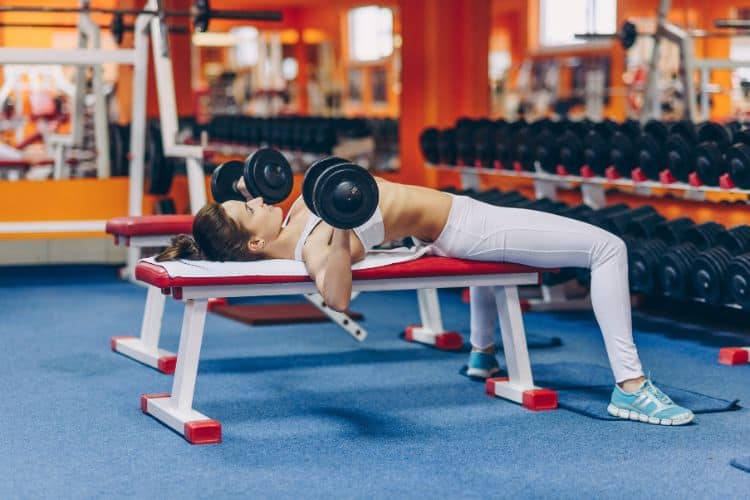
Start with a dumbbell bench press for three sets of six to eight repetitions. Set your feet firmly, keep your wrists above your elbows, and lower the weights under control. A floor press works if you do not have a bench. Next, perform a one-arm dumbbell row for three sets of eight repetitions per side. Support your free hand on a sturdy surface, pull your elbow toward your hip, and resist twisting your torso. These two movements anchor the session with a horizontal push and pull.
Follow with a standing dumbbell overhead press for three sets of six to eight repetitions. Brace your trunk, press without leaning backward, and choose a seated press if standing bothers your lower back. Then do three sets of eight to ten assisted pull-ups, lat pulldowns, or band-assisted pulldowns. Pick the option that allows your shoulders to move comfortably and your torso to remain steady. Finish with two sets of ten to twelve dumbbell curls and two sets of ten to twelve triceps extensions. Smaller arm movements are optional if time is limited; the pressing and pulling work comes first.
Record the weights and completed repetitions for each working set. A note such as “bench press: 20-pound dumbbells, 8/7/6 reps” gives you a concrete target for the next cycle. Resist the temptation to increase load when the last repetitions required bouncing or an awkward change in posture. Clean technique makes your log useful.
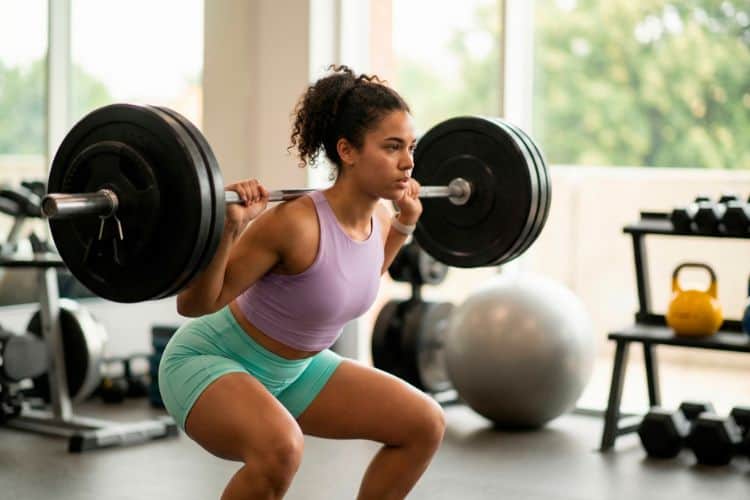
Open with three sets of six to eight goblet squats. Hold one dumbbell close to your chest, lower as far as you can while maintaining balance, and drive through your whole foot to stand. If a goblet squat becomes limited by how much weight you can hold, a front squat or another suitable squat variation can take its place. Follow with three sets of six to eight dumbbell Romanian deadlifts. Keep the weights close to your legs, bend your knees slightly, move your hips backward, and stand by driving your feet into the floor. You should feel the hamstrings working without forcing extra range at your lower back.
Next, perform reverse lunges for three sets of eight repetitions per side. Step back far enough to lower comfortably, use a wall for balance if needed, and keep the front foot planted. Add two sets of ten to twelve glute bridges or hip thrusts, pausing briefly at the top without arching your back. Finish with two sets of twelve to fifteen calf raises and two sets of a 20- to 40-second dead bug hold or another controlled core exercise. If unilateral lunges are difficult, substitute a supported split squat and build stability before adding weight.
The strength label refers to your deliberate effort on the first two lifts. It does not require maximal attempts. If you cannot keep the same general movement path from the first repetition to the last, reduce the load or shorten the set. Lower-body sessions often need longer rest than expected, so give yourself time before repeating squats and hinges.
Take a 20- to 40-minute walk at an easy pace, or choose gentle cycling or swimming. You should be able to talk in complete sentences. Spend another five to ten minutes moving through comfortable ranges for your hips, upper back, and shoulders. Try a few unweighted hip hinges, a supported deep squat if it feels good, and relaxed thoracic rotations. Nothing on this day should feel like a test of stamina.
If you are especially sore, a shorter stroll or full rest is reasonable. Soreness is not a score for workout quality, and an extra interval session can make the next lifting day less productive. Use the lighter day to eat regular meals, drink according to thirst and activity, and get enough sleep. Recovery is part of the plan because the next two lifting days ask you to train the same muscle groups again.
Use moderate weights and controlled repetitions. Perform an incline dumbbell press for three sets of eight to twelve. If you do not have an adjustable bench, repeat a floor press or do an incline push-up against a stable countertop. Pair it with a chest-supported dumbbell row or seated cable row for three sets of eight to twelve. The support helps you focus on pulling with your back instead of swinging the weight.
Continue with a dumbbell lateral raise for two sets of twelve to fifteen, keeping the motion smooth and stopping near shoulder height. Perform a push-up variation for two sets of six to twelve, leaving two repetitions in reserve. Then do a band pull-apart or reverse fly for two sets of twelve to fifteen to give the rear shoulders more attention. If time allows, finish with a hammer curl and an overhead triceps extension for two sets of ten to fifteen each.
“Volume” means a little more total practice at lighter loads, not endless sets. The second upper session lets you revisit pushing and pulling while selecting angles that complement Day 1. If your shoulders dislike overhead triceps extensions, use a cable pressdown or omit that isolation movement. Keep the first two exercises as the session priorities.
Start with a dumbbell split squat for three sets of eight to twelve repetitions on each leg. Position your feet wide enough to balance and lower under control; hold a support if needed. Next, perform three sets of eight to twelve dumbbell sumo deadlifts or regular Romanian deadlifts. Choose the hinge variation you can execute consistently and feel in your hips and hamstrings. A sumo stance is not mandatory, and you do not need to force your feet unusually wide.
Follow with step-ups onto a stable, low platform for two sets of eight to ten per leg. Step down slowly rather than dropping from the platform. Then perform two sets of twelve to fifteen banded lateral steps or side-lying hip raises. Finish with two sets of eight to twelve slow bird dogs per side, extending opposite arm and leg without rotating the pelvis. If the combination of split squats and step-ups leaves your legs too fatigued, reduce the step-up sets or swap them for a glute bridge.
This session uses more single-leg work to expose balance and strength differences that can be hidden during two-leg lifts. Work each side with the same planned repetitions, using the weaker side to guide your load. You can progress by improving stability and depth before increasing the dumbbells. Consistent range of motion is often a more meaningful win than another five pounds.
On Day 6, choose 25 to 45 minutes of easy walking, cycling, or another low-impact activity you enjoy. Add a brief mobility routine if tightness affects your preferred lifting positions. Keep the effort comfortable. This is an opportunity to build a sustainable movement habit around the strength program, not to make up for food choices or chase a calorie target.
Day 7 is full rest from structured training. Everyday activity is fine, but there is no required step count. If you feel energized, let that be a sign that the schedule is working rather than a reason to add a fifth hard workout. Your next cycle will give you more chances to train.
On Day 8, look at your training log for ten minutes and plan the next cycle. An easy walk is optional. Note which lifts reached the top of their repetition ranges with steady technique, which lifts need the same weight again, and whether any exercise caused discomfort. Check your schedule, prepare equipment, and make a simple adjustment if necessary. For example, if your second lower day felt rushed, trim one accessory movement next round. A flexible program you can repeat will serve you better than an elaborate plan you abandon.
Progressive overload means gradually increasing the work your body can handle while preserving sound technique and enough recovery. In this program, use double progression for the main exercises. Choose a weight you can lift for the bottom of the stated repetition range across your prescribed sets. Keep that weight as you gradually add repetitions. Once all sets reach the top of the range with about two good repetitions left, increase the load by the smallest practical increment at the next appearance of that exercise. Your repetitions may drop toward the bottom of the range again, which is expected.
Suppose you bench press two 20-pound dumbbells for three sets of six to eight repetitions. Your first cycle might be 8, 7, and 6. A later cycle might be 8, 8, and 8 with consistent control. Then try the next available dumbbells and work back toward three sets of eight. Because the same workout appears once every eight days, compare each exercise with its last appearance, not with an unrelated session or calendar week.
If your dumbbells jump too sharply in weight, progress by adding one repetition, slowing the lowering phase slightly, or improving range and stability. Do not make every variable harder at once. When a load feels unexpectedly heavy, repeat it at the next opportunity. After three or four cycles, you may be ready to add a set to one priority exercise, but only if your recovery and schedule support it. More work is useful when it produces better practice and adaptation.
Consider a lighter cycle if several workouts in a row feel unusually difficult, your usual loads decline, or soreness lingers into the next session. Keep the exercise pattern but reduce the load or total sets for one eight-day cycle. A planned easier stretch can help you return to productive training. A single tired workout, however, does not mean the program has failed; sleep, stress, and daily demands all affect performance.
For your first cycle, err toward a manageable load. The final two repetitions should require attention while remaining smooth. If you could complete many additional repetitions, increase weight at the next session; if you cannot reach the low end of the range, use a lighter option. On unilateral exercises, count each side separately and stop before balance becomes the limiting factor. A stable supported variation is a sensible starting point.
Training at home without a bench? Replace bench presses with floor presses, incline presses with countertop push-ups, and chest-supported rows with one-arm rows. No pull-up bar or cable station? Use a resistance-band pulldown anchored safely overhead or add another row variation. If you have only one light pair of dumbbells, emphasize controlled repetitions and single-leg movements. Eventually you may need heavier equipment to keep progressing on the larger lifts.
If four lifting days are too much right now, use two sessions per eight-day cycle: Day 1 upper strength and Day 2 lower strength during one cycle, followed by Day 4 upper volume and Day 5 lower volume in the next. You can also begin with two sets instead of three on the main lifts. Build consistency first, then add work gradually. A program fits your life when you can recover from it and return to the next scheduled session.
Strength training helps preserve or build muscle, but changes in body fat also depend on your overall eating pattern and energy balance over time. Avoid treating the word “lean” as a demand for aggressive restriction. Eat enough to support your workouts, include protein-rich foods across meals, and make room for fruits, vegetables, fiber-rich carbohydrates, and satisfying fats. If fat loss is your goal, a modest, sustainable calorie deficit is generally easier to pair with strength gains than severe dieting.
Protein can come from yogurt, eggs, fish, poultry, tofu, beans, or other foods you enjoy. A meal with protein and carbohydrate after lifting can be convenient, especially if your next meal is several hours away, but there is no need to race a stopwatch. Drink water during the day and adjust for heat and sweat. Most people will get more from consistent meals and sleep than from a complicated supplement stack.
Aim to protect a regular sleep schedule. Recovery also includes managing total stress and recognizing that a demanding job, caregiving, and travel can change what is realistic. If your available time shrinks, keep the first two lifts in each session and trim optional accessories. A shorter high-quality workout still moves the plan forward.
The most common mistake is treating each session as a challenge to failure. Going to failure on every squat, press, and hinge makes it difficult to repeat quality work two or three days later. Leave a small reserve on most sets and let the log reveal progress across cycles. Another mistake is changing exercises every time you train. Keep the main movements consistent long enough to learn them and measure improvement; swap an exercise when equipment, comfort, or progress gives you a reason.
Do not rush the lower-body workouts by shortening rest until your form breaks down. Likewise, do not turn the active recovery days into punishing cardio. The eight-day structure works because training and recovery have distinct jobs. Finally, avoid assuming that a scale change over eight days tells the whole story. Body weight fluctuates with hydration, food, and normal life. Track your lifting performance, energy, consistency, and how the plan fits your routine over several cycles.
Yes, if they learn the basic movement patterns, start with manageable weights, and use fewer sets at first. A beginner can perform two working sets per movement and focus on reliable technique for the first two cycles. Exercise substitutions and a coach’s feedback may be valuable if a movement feels unfamiliar or uncomfortable. There is no need to lift heavy on Day 1 to make the plan effective.
Give it at least four to six complete cycles, or about five to seven weeks, before judging your progress. That gives you repeated opportunities to practice each lift and apply double progression. You can keep the same framework longer if you are improving and recovering well. Adjust accessories, loads, or total sets as your needs change while retaining the core upper/lower structure.
You can add cardio if it fits your goals and does not interfere with your lower-body sessions. Begin with easy activity on Days 3 or 6. If you already run or enjoy intervals, place demanding cardio with enough space from Day 2 and Day 5, and watch how your legs recover. Adding more is not automatically better; the strength sessions remain the priority for this particular plan.
It can be part of a fat-loss plan, because lifting helps maintain muscle while you work on sustainable nutrition and activity habits. The workout itself cannot guarantee fat loss, spot-reduce an area, or dictate how quickly your body changes. Consider strength progress and how consistently you can follow the schedule alongside any body-composition goal.
Prepare your dumbbells, choose the exercise options available to you, and write down the first four lifting sessions before you begin. During the first cycle, prioritize learning the movements and recording honest results. On each repeat, add a good repetition when you can, increase weight when you have earned it, and give yourself room to recover when life demands it. The SplitLean workout works best as a repeatable strength practice: focused sessions, measurable progress, and enough flexibility to keep showing up.
For help tailoring the eight-day cycle, explore How To Choose The Best Workout Split For Women and compare it with this 4 Day Strength Training Split. To make each repeat more productive, follow the Progressive Overload Dumbbell Workout Plan or use the Step-By-Step Progressive Overload Strength Guide. If you want another structured option after several SplitLean cycles, try the 4-Week Dumbbell Strength Training Plan.
Stay up to date on the latest women’s health, fitness and lifestyle trends and tips.
