


Sign up for workout ideas, training advice, reviews of the latest gear and more.

A short workout can feel worthwhile when every minute has a purpose. This 15 minute full body dumbbell workout combines a squat, hinge, push, pull, and core exercise in a straightforward circuit. You only need a pair of dumbbells, a timer, and enough floor space to move comfortably. The format makes it easy to fit strength work into a lunch break, a busy morning, or a day when a longer session is unrealistic.
The goal is controlled, challenging repetitions. You will complete five exercises for 40 seconds each, rest or transition for 20 seconds, and repeat the circuit three times. That adds up to exactly 15 minutes. Adjust the pace, weight, or work interval to suit your experience. There is no requirement to fill every second with repetitions; a few well-executed reps are more useful than rushing through a movement you cannot control.
Below you will find the complete schedule, setup instructions, exercise cues, modifications, and a practical way to make this workout harder over time. If you are new to lifting, read the movements once before starting so the timer does not pressure you into learning technique on the fly.
Set a repeating interval timer for 40 seconds of exercise followed by 20 seconds to rest and move into position. Complete goblet squats, dumbbell Romanian deadlifts, floor presses, bent-over rows, and suitcase marches in that order. Five one-minute stations make one five-minute round. Repeat the same sequence for three rounds without adding extra time between rounds. The final 20-second interval is your transition out of the workout.
Aim for roughly six to twelve deliberate repetitions in each 40-second interval, depending on the movement and your pace. This is guidance, not a race or a quota. For the suitcase march, spend approximately 20 seconds holding the dumbbell in one hand and 20 seconds holding it in the other. Put the weight down safely before switching hands if needed. Keep the 20-second rest period fully available; it helps preserve form through the later rounds.
The five movements cover major muscle groups without requiring a bench, jumps, or complicated choreography. Squats train the legs and glutes, deadlifts emphasize the hips and hamstrings, floor presses work the chest and triceps, rows challenge the back and arms, and suitcase marches ask the trunk to resist leaning sideways. You will still need a balanced training schedule across the week if you want to improve strength consistently, but this session is a useful piece of that schedule.
Choose dumbbells you can control through the full range of motion. A single weight can work for the entire circuit, but many people will prefer a lighter pair for presses and a heavier pair for deadlifts and rows. Holding one dumbbell for goblet squats and suitcase marches makes switching simple. Place any extra weights outside your movement area so you will not trip during a transition.
Use the first round to check effort. By the end of each work interval, you should feel that the exercise required attention while still being able to perform another couple of clean reps. If you cannot keep your back position, stop short of your intended range, or have to swing a weight, lighten it. If every round feels easy and your technique remains steady, choose a slightly heavier weight next time or add a few controlled reps. There is no single dumbbell size that suits every woman or every exercise.
If you can spare two or three minutes, walk in place, circle your shoulders gently, practice several unloaded squats, and make a few slow hip hinges. Perform a light practice rep of each exercise before you start the clock. A warm-up is especially helpful first thing in the morning or when transitioning from a long stretch of sitting. The timed circuit itself remains exactly 15 minutes; any warm-up or cool-down takes additional time.
When you truly have only 15 minutes, make the first 40-second interval of each new movement a little lighter and slower. Start with an easy weight, ease into your comfortable range, and increase effort as you settle in. This does not replace a full warm-up for someone who needs one, but it is a sensible way to avoid sprinting into the first repetition.
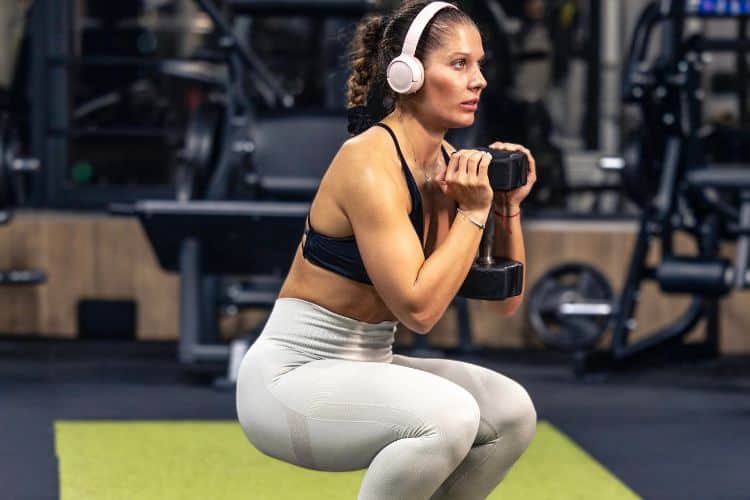
Hold one dumbbell vertically close to your chest with both hands around one end, or cradle it securely in both palms. Stand about hip to shoulder width apart with your feet positioned so your knees can travel comfortably in line with your toes. Bend your hips and knees to lower as far as you can without losing balance or rounding your lower back. Press through your feet to stand tall, breathing out as you rise.
Allow your knees to move naturally; they do not need to stay behind your toes. Think about sitting between your legs and keeping the weight close to your body. Your best depth depends on your mobility and control. A squat to a sturdy chair is a useful beginner variation: gently touch the chair, then stand without dropping onto it. If one heavy dumbbell strains your grip, use a lighter one and slow the lowering phase.
For this workout, keep each squat deliberate enough that your heels stay grounded and your torso does not collapse forward. If your form changes near the end of the interval, pause for a breath and finish with fewer reps. The squat should feel primarily like leg work, with your trunk helping you stay upright.
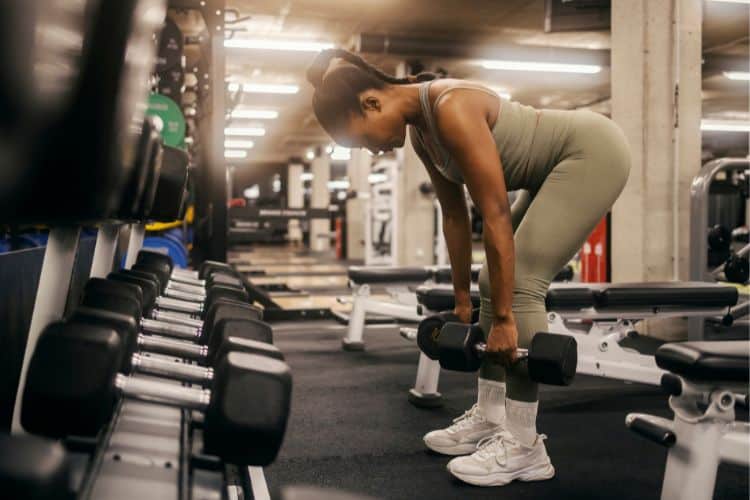
Stand tall with a dumbbell in each hand in front of your thighs, palms facing your body. Soften your knees slightly, then push your hips back as the weights travel down close to your legs. Keep your spine in a comfortable neutral position and stop when you feel a stretch through the backs of your thighs or before your back begins to round. Drive through your feet and bring your hips forward to stand, without leaning backward at the top.
The key is to hinge at the hips rather than turn the exercise into a deep knee bend. Imagine closing a car door behind you with your hips. Your shins stay relatively upright, and the dumbbells follow a path close to your body. You may reach only to knee height, or a little lower; the floor is not the goal. Keep your neck relaxed and look toward a spot on the floor a few feet ahead.
Start with a lighter pair if you have not practiced this movement. An unloaded hip hinge can help you learn it before adding weights. You should notice work in your glutes and hamstrings, not a sharp sensation in your lower back. If the position feels uncomfortable, shorten the range and reassess your technique.
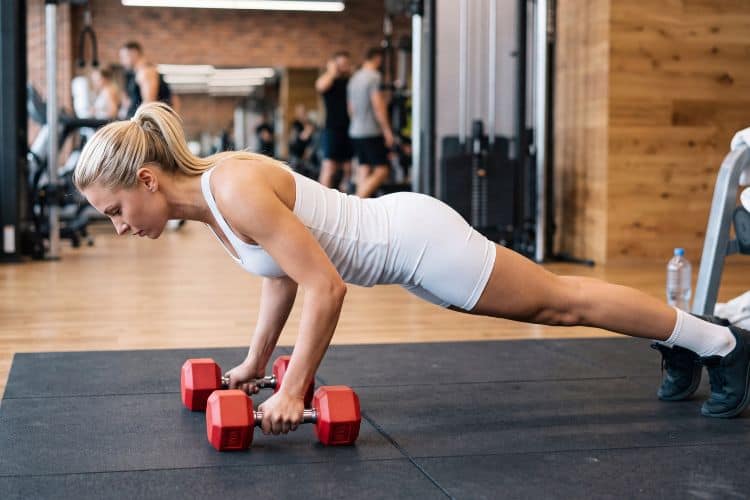
Sit with two dumbbells close to your hips, carefully roll onto your back, and bring the weights beside your chest with your elbows resting lightly on the floor. Bend your knees and plant your feet. Keep your wrists stacked over your forearms. Press the dumbbells upward until your arms are extended without aggressively locking your elbows, then lower with control until the backs of your upper arms gently touch the floor.
The floor limits how far your elbows travel behind your body, which can make this a convenient home pressing option. Keep your upper arms at a comfortable angle away from your torso rather than flaring them straight out to the sides. Exhale on the press and avoid bouncing your elbows off the floor. You can press with palms facing each other if that feels more comfortable for your shoulders.
If handling two weights feels awkward, use one dumbbell at a time, pressing with one arm while the other arm rests on the floor. Switch sides at about 20 seconds. If getting to and from the floor is difficult, use a stable bench with appropriate technique, or substitute a standing wall push-up. Allow some of your transition interval to set up safely; do not rush to lie down with heavy weights.
Stand with a dumbbell in each hand, soften your knees, and hinge your hips back until your torso is comfortably angled forward. Keep your core braced and arms hanging beneath your shoulders. Pull your elbows toward your hips, bringing the weights alongside your torso. Lower them slowly until your arms are extended again without letting your shoulders jerk forward.
Try to keep your torso still instead of using a quick bounce to lift the weights. A row does not need to end with the dumbbells pressed high into your ribs; stop where you can move your shoulder blades and arms under control. Keep your neck in line with your torso. If your lower back tires before your upper back, reduce the weight or support one hand on a sturdy chair or bench and row one side at a time.
For the supported version, put the unused dumbbell down, brace one hand on the support, and complete about 20 seconds per arm. Take a moment to switch sides carefully. This option is often easier to learn because you can focus on drawing your elbow back without holding the unsupported hinge for the entire interval.
Hold one dumbbell at your side as though carrying a suitcase. Stand tall with your shoulders level and your ribs stacked over your pelvis. March slowly in place, lifting one knee a little at a time without leaning away from or toward the weight. After about 20 seconds, place the dumbbell down and switch hands for the remaining time. Your free arm can move naturally to help with balance.
This exercise challenges your grip and the muscles that keep your trunk steady. The goal is quiet, controlled movement, not high knees or a fast cardiovascular burst. If lifting a foot makes you wobble, widen your stance, take smaller steps, or simply hold the dumbbell while standing still. If you prefer to walk, carry it along a clear, unobstructed path and turn carefully.
From minute zero to minute one, do goblet squats for 40 seconds and rest for 20. Minute one to two is Romanian deadlifts; minute two to three is floor presses; minute three to four is bent-over rows; and minute four to five is suitcase marches. Follow this five-minute order again from minutes five to ten, then once more from minutes ten to fifteen. Keep the work and rest intervals consistent even if your repetition count changes.
The first round is for finding your rhythm. In round two, aim to repeat the same controlled range of motion. In round three, focus on technique as fatigue rises; you can do fewer reps without losing the purpose of the workout. If you need more than 20 seconds to move safely from the floor press to the row, shorten the next work interval. Safety and smooth setup matter more than hitting a perfect timer.
If 40 seconds of work is too much at first, use 30 seconds of exercise and 30 seconds of rest at each station. The full workout still takes 15 minutes over three rounds. Choose lighter weights, practice the chair squat, shorten your hinge depth, and substitute standing suitcase holds for marches. A supported single-arm row may feel more stable than holding two dumbbells in a bent-over position.
To raise the challenge while retaining the 15-minute format, first improve the quality and consistency of your reps. When you can complete all three rounds with steady form and the final reps feel manageable, increase one or two dumbbells by the smallest available increment. You do not have to increase all five movements at once. Squats and deadlifts may be ready for more load before floor presses.
Two or three full body strength sessions per week, with recovery time between demanding sessions, can be a practical starting rhythm for many people. You might do this circuit on Monday and Thursday, then add a longer session on the weekend if your schedule allows. If you already train regularly, use it as a quick session when time is tight, adjusting the weights and effort so it fits with your other workouts.
Progress comes from repeating good work and gradually asking your body to do more. Record the dumbbell weights you used, an approximate rep count for each exercise, and how difficult the final round felt. After several sessions, look for a small improvement: cleaner squats, an extra controlled row, or a slightly heavier deadlift. A short routine is easier to build into a habit when you can see those changes.
Rushing is the most tempting mistake. A timer can make it feel as though you must keep moving for all 40 seconds, but you can pause briefly between reps. Fast squats that lose depth, deadlifts that become jerks, or rows driven by momentum reduce the quality of the work. Pick a pace that lets you control both the lifting and lowering portions.
Another common problem is using the same weight for every movement without checking whether it suits each one. Legs and back may handle more weight than the shoulders and arms during a press. If you own two pairs, arrange them before starting; if you own one pair, adjust the number of reps or use one dumbbell where appropriate. Weight selection should serve the movement rather than force you into poor positions.
A consistent 15-minute session can contribute to strength, particularly if you are starting out or fitting sessions around a busy schedule. What matters is whether the exercises are challenging enough for you, whether you practice them regularly, and whether you increase the demand gradually as they become easier. More training time can allow additional sets and exercises, but a shorter session is a useful way to get meaningful practice.
This circuit is designed primarily as strength training. The repeated intervals may raise your breathing rate, especially with short rests, but the aim is to lift with control and use weights that make the exercises challenging. If you move so fast that you cannot maintain technique, slow down. You can add separate aerobic activity elsewhere in your week according to your goals and schedule.
Yes. Hold one dumbbell for goblet squats and Romanian deadlifts. For floor presses and rows, work one side for roughly 20 seconds and then switch sides, keeping your transition controlled. Finish with the suitcase march as written. One dumbbell can be enough to start, although a second weight makes the deadlift and row setup more convenient.
Replace the floor press with a standing wall push-up or, if available and appropriate, a press on a stable bench. A wall push-up changes the resistance, so adjust how far your feet stand from the wall until the movement feels manageable. Choose the variation that lets you set up securely and work without discomfort.
This 15 minute full body dumbbell workout gives you a repeatable plan: five simple movements, 40 seconds of work, 20 seconds of rest, and three rounds. Squat, hinge, press, row, and carry with attention to form. Start with weights you can manage, track how the session feels, and make small changes as you get stronger. When time is limited, an organized quarter-hour can help you keep showing up for your training.
If you are learning the basics, start with our Beginner Dumbbell Workout Plan For Women for more practice with foundational lifts. When you have a little more time, try the 20 Minute Full Body Dumbbell Workout For Beginners or the 30-Minute Full Body Dumbbell Workout At Home. To turn short sessions into a longer training schedule, follow the 4 Week Dumbbell Strength Training Plan, and use these Dumbbell Back Workouts For Women to explore more rowing variations.
Stay up to date on the latest women’s health, fitness and lifestyle trends and tips.
