


Sign up for workout ideas, training advice, reviews of the latest gear and more.

A busy schedule does not mean you need to skip strength training. This 35 minute full body dumbbell workout gives your legs, glutes, back, chest, shoulders, arms, and core a purposeful session with just a pair of weights and a little floor space. It is built around familiar movement patterns, so you can focus on quality reps instead of memorizing a complicated routine. You can do it at home or at the gym, and you can make it easier or harder by changing the dumbbells, range of motion, or pace.
The structure is straightforward: warm up for five minutes, complete five five-minute training blocks, then cool down for five minutes. Each block pairs two exercises. Perform the first for 40 seconds, transition for 20 seconds, perform the second for 40 seconds, and rest for 20 seconds. Repeat that two-minute sequence twice, then use the final minute to recover and set up the next block. The five blocks add up to 25 minutes exactly. You will get enough work to challenge your muscles without turning each set into a race.
A full body session is useful when you have room for only a few workouts each week. Instead of dedicating one day solely to arms and another solely to legs, you practice major movement patterns in one visit: squat, hinge, push, pull, single-leg work, and trunk control. Dumbbells let each side of your body contribute, and they make it easy to adjust the load for a particular exercise. Your squat weights can be heavier than your shoulder press weights, for example.
Thirty-five minutes is enough time to warm up, perform focused strength work, and finish without rushing through your cool-down. The timed format also removes guesswork: you know when to work, when to change exercises, and when to rest. It does not require you to complete a fixed number of repetitions within 40 seconds. A controlled set of six or eight reps can be more valuable than a frantic set of twenty. The goal is to make your muscles work through a comfortable range of motion while keeping your form consistent.
This workout is especially convenient if you own one or two pairs of dumbbells. A moderately challenging pair will cover most movements. If you have a lighter pair, keep it nearby for overhead pressing and lateral raises. If you have only one pair, slow the lowering phase of an exercise that feels too easy, and use fewer reps or a shorter range of motion when an exercise feels too difficult. Your effort should be noticeable by the end of each interval, with enough control to keep your next rep clean.
Choose dumbbells you can lift safely for repeated sets, a stable floor surface, water, and a timer that shows work and rest intervals. A mat is optional for the floor press and cool-down. If you do not want to lie down, the floor press can be replaced by a standing dumbbell chest press with a sturdy resistance band, if you have one, or by incline push-ups against a stable counter. Keep the dumbbells within reach but out of the path of your feet.
Start with a weight that allows roughly six to twelve deliberate repetitions during a 40-second interval, depending on the movement. You should be able to finish a set without holding your breath, twisting, or losing your balance. For a beginner, learning the movement with light weights is a worthwhile first session. An experienced lifter may need heavier weights for squats and hinges, but should still use a load that permits steady technique throughout both rounds.
Minutes 0–5 are the warm-up. Minutes 5–10 are the squat and bent-over row block. Minutes 10–15 are the Romanian deadlift and floor press block. Minutes 15–20 are the reverse lunge and overhead press block. Minutes 20–25 are the glute bridge and alternating single-arm row block. Minutes 25–30 are the suitcase march and lateral raise block. Minutes 30–35 are the cool-down. Set a timer for 40 seconds of work followed by 20 seconds to transition or rest. In each strength block, alternate its two exercises twice; the remaining final minute is recovery and preparation for the next pair.
The minute of recovery between blocks is deliberate. Put the weights down, take a few normal breaths, drink water if needed, and move into the next position. If the block has a right- and left-side exercise, divide each 40-second interval evenly between sides unless otherwise noted. The aim is similar work on both sides, not a precise repetition count at any cost.
Spend the first minute marching in place and letting your arms swing naturally. Gradually increase the size of the movement, then add gentle shoulder circles. In minute two, perform slow bodyweight squats: push your hips back, bend your knees as far as feels comfortable, and stand tall. Hold a counter for balance if needed. During minute three, practice unloaded hip hinges. Keep a soft bend in your knees and move your hips backward until you feel your hamstrings engage, then stand by pressing your feet into the floor.
In minute four, alternate easy backward steps to rehearse the reverse lunge. The step can be small; concentrate on balance and control. For the last minute, combine arm reaches, gentle torso rotations, and a few easy wall push-ups or unloaded rows. By the end of the warm-up, you should feel ready to move and breathe a little faster, without feeling tired. Take a little more time if your body needs it, then begin the work intervals when you are ready; the listed 35 minutes assumes a five-minute warm-up.
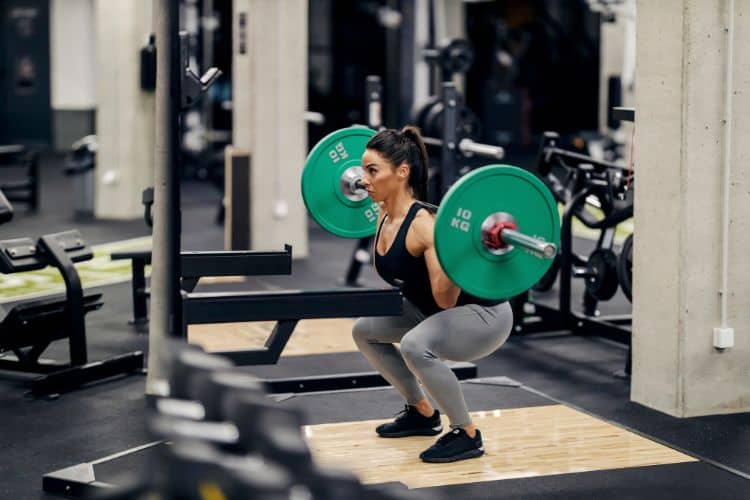
Hold a dumbbell at each side, or hold one vertically in front of your chest if that feels easier to control. Stand with feet about hip to shoulder width apart. Bend your knees and hips together, keeping your whole foot grounded. Lower only as far as you can maintain a comfortable, steady position, then stand up by pushing through your feet. Exhale as you rise. Let your knees travel naturally in the same general direction as your toes; they do not have to stay behind them.
Hold one weight in each hand, soften your knees, and hinge at your hips until your torso tips forward comfortably. Keep your back in its natural position and let the dumbbells hang beneath your shoulders. Pull your elbows back toward your hips, pause briefly, and lower the weights with control. Your torso stays relatively still; avoid standing up to throw the weights upward. Look at the floor a few feet ahead to keep your neck relaxed.
Stand tall with a dumbbell in each hand in front of your thighs. Unlock your knees slightly, then push your hips backward while the weights travel close to your legs. Stop when you feel a comfortable stretch in the backs of your thighs or when your torso reaches the lowest position you can hold without rounding your back. Press your feet into the ground and bring your hips forward to stand. Keep your arms relaxed; your hips and hamstrings perform most of the work.
Sit down carefully with the weights close to your body, then roll onto your back with knees bent and feet flat. Position the dumbbells beside your chest, with your upper arms resting lightly on the floor and palms facing forward or toward each other. Press the weights upward until your arms are comfortably extended. Lower until your upper arms touch the floor, pause, and press again. Keep your wrists stacked over your forearms rather than bent backward.
The floor limits how far your elbows travel behind you, which many people find comfortable when pressing. Keep your rib cage settled and avoid pushing your lower back into an exaggerated arch. To leave the position, bring the weights toward your chest, roll to your side, and sit up before standing. Alternate deadlifts and floor presses twice, following the same 40-second work and 20-second transition pattern. Use the last minute to rise carefully and prepare for lunges.
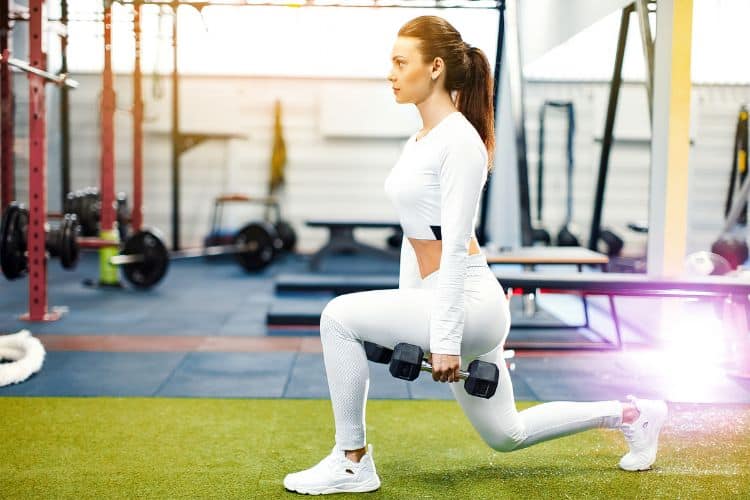
Hold the dumbbells at your sides and stand with your feet under your hips. Step one foot backward, bend both knees within a comfortable range, and press through the front foot to return to standing. Change legs on the next rep. A slightly longer backward step can give your front knee space to bend naturally. Keep your torso tall and your front foot planted. Slow down if balance, rather than leg strength, starts to determine the pace.
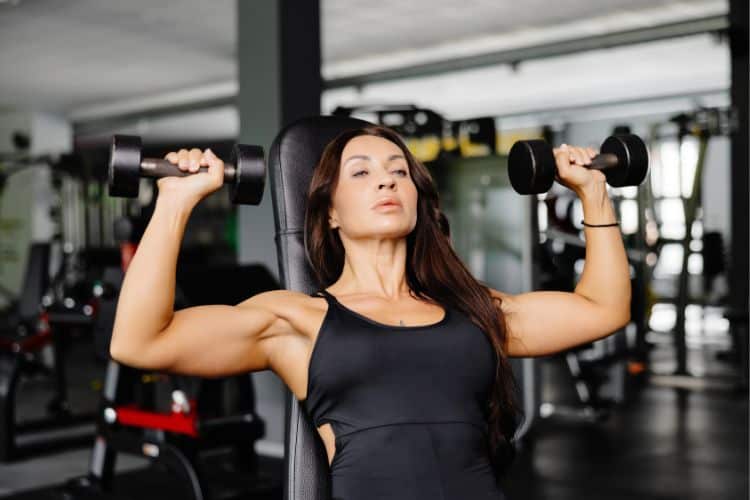
Stand with feet about hip width apart and bring the dumbbells to shoulder height. Brace your midsection gently, then press both weights overhead along a comfortable path. Lower slowly to shoulder level and repeat. Exhale on the press and avoid leaning backward to help the weights rise. If you need to arch your back dramatically, choose lighter weights or press one arm at a time while the other hand rests on your ribs.
Sit with one dumbbell across your hips and hold it securely in place, then lie on your back with your knees bent and feet flat. Position your feet where you can press through them without straining your knees. Lift your hips until your shoulders, hips, and knees form a comfortable diagonal line. Pause briefly while squeezing your glutes, then lower with control. Avoid driving your hips so high that your lower back arches. If placing a weight on your hips feels awkward, perform the bridge without it.
Place one hand on a stable chair, bench, or counter. Step your feet back enough to create room for the dumbbell to hang beneath your shoulder. With the free hand, pull the weight toward the side of your waist, then lower it slowly. Work the right side for about 20 seconds and the left for about 20 seconds. Switch sides carefully, keeping your support stable and your back comfortably positioned. If changing sides takes several seconds, that is fine; do fewer good reps.
Repeat the bridge and row pair twice, then rest for the final minute of the block. This second row gives your upper back additional practice and lets you pay attention to how each side moves. It can also reveal a weight that feels appropriate on one side but too heavy on the other. When that happens, choose the lighter load that allows both sides to work with control.
Hold one dumbbell at your side like a suitcase and stand tall. March in place slowly, lifting one knee at a time while keeping your shoulders level and torso upright. Keep the weight beside your leg; do not lean away from it. Hold the dumbbell in your right hand for the first 20 seconds and your left hand for the next 20 seconds. A slower march makes the trunk work harder to resist side bending. You can also stand still with the weight at your side if marching challenges your balance.
Choose light dumbbells and stand with your arms near your sides and elbows slightly bent. Raise your arms outward to a comfortable height, generally no higher than shoulder level, then lower them slowly. Keep your shoulders relaxed and avoid swinging your torso to lift the weights. A shorter range is fine if that helps you control the movement. Lateral raises are a small-muscle exercise, so a pair that feels light during squats may be far too heavy here.
Repeat the suitcase march and lateral raise pair once more. After the second lateral raise, the 25-minute strength portion is complete. There is no extra recovery minute after this block beyond the final minute built into its five-minute window; use that minute to set the dumbbells down, drink water, and begin easing your breathing before the cool-down. You have now trained all major areas without requiring jumps or high-speed repetitions.
Spend the first minute walking slowly around your space or marching gently until your breathing settles. For the second minute, stand near a wall and perform an easy calf stretch for about 30 seconds per side. In minute three, use a comfortable standing quadriceps stretch or simply take a slow backward step and gently lengthen the front of each hip. Hold a chair if balance is an issue.
During minute four, open your chest by bringing your hands behind your back gently, or place your forearm on a doorway and turn away slightly without forcing your shoulder. For the last minute, reach your arms forward to relax your upper back, then take a few calm breaths. Stretching should feel mild, never sharp. The cool-down is also a chance to note which exercises felt strong, which felt awkward, and which weights you might change next time.
Use light weights and treat the first workout as a technique session. You can work for 30 seconds and use the remaining 10 seconds of each 40-second interval for extra rest while keeping the timer and total session length the same. Perform a shallower squat or lunge, use one dumbbell held close to your body, and march without a weight if necessary. Practice getting safely onto and off the floor before the timer starts. You should finish feeling that you could have completed a little more, not that every set was a maximum effort.
Beginners may also find it helpful to complete one rehearsal round of each movement without weights on a separate day. That makes the transitions familiar and reduces the urge to hurry. If a particular exercise causes pain, stop it and choose a comfortable alternative for that interval. Normal muscular effort and mild breathlessness are expected; sharp pain is a reason to change or end the movement.
Select a heavier pair for the squat, deadlift, row, and bridge while keeping a lighter pair for the overhead press and lateral raise. You can also slow the lowering phase of your squat or floor press to roughly three seconds, provided the movement remains controlled. For lunges, pause briefly at the bottom of each repetition. For the suitcase march, slow each knee lift and hold your torso especially steady. These changes raise the difficulty without requiring you to add more exercises or extend the workout.
The final recovery minute in each block is there for a reason. Resist the temptation to fill every pause with extra reps, especially if the heavier weights make the next exercise harder to set up. A useful measure of progress is completing more clean repetitions with the same load and same timing over several sessions. Another is using a slightly heavier dumbbell while keeping the same controlled range of motion.
This full body dumbbell workout fits a warm-up, ten exercises, and a cool-down into a manageable session. Follow the five pairs in order, use weights that challenge you without changing your form, and respect the transitions. The next time you repeat it, you will know the movements and can focus on steadier reps, a little more range, or an appropriate increase in weight. Thirty-five focused minutes can give you a practical foundation for stronger legs, hips, back, chest, shoulders, and core.
If you are building confidence with weights, start with our Beginner Dumbbell Workout Plan For Women. For another session that fits a busy day, try the 30 Minute Full Body Dumbbell Workout At Home. You can focus on controlled, joint-friendly movements with the 15 Minute Low Impact Dumbbell Workout, explore more multi-joint lifts in the 40 Minute Full Body Dumbbell Compound Workout, or turn individual workouts into a weekly routine with the 2 Day Full Body Dumbbell Workout Plan.
Stay up to date on the latest women’s health, fitness and lifestyle trends and tips.
