


Sign up for workout ideas, training advice, reviews of the latest gear and more.



When your schedule is packed, strength training does not have to disappear from it. A 20 minute full body dumbbell workout can challenge your legs, glutes, back, chest, shoulders, arms, and core in one focused session. With two dumbbells, a little floor space, and a timer, you can train at home or in the gym without spending half your time changing equipment.
This workout uses five movements that cover the main patterns your body performs: squatting, hinging, pushing, pulling, and carrying or bracing. You will warm up for three minutes, complete two eight-minute circuits, and cool down for one minute. The movements are straightforward enough to learn, yet flexible enough to keep challenging you as you get stronger. The goal is controlled, repeatable work, not racing through as many repetitions as possible.
Choose one or two pairs of dumbbells, a timer, and a clear area where you can step backward safely. An exercise mat is optional for the floor press. If you own only one pair, that is enough: adjust your repetitions, pace, or range of motion to keep each movement comfortable and effective. People often use a heavier pair for squats, deadlifts, and rows and a lighter pair for presses, but the right weights depend on your current strength and technique.
Aim for a weight that makes the last few repetitions challenging while allowing you to keep your back position, breathing, and control. You should feel as though you could perform roughly two or three more good repetitions at the end of a work interval. Start lighter while learning the movements. If gripping two dumbbells is awkward, hold one at your chest for squats or use one hand at a time for rows.
You can do this routine two or three times per week on nonconsecutive days. If you are new to strength training, begin with two days and see how your body responds. Walking, gentle mobility work, or another enjoyable activity can fit between sessions. Recovery is part of training, especially when the same workout engages most major muscle groups.
Set a timer for the following sequence. Spend 3 minutes warming up, 8 minutes on Circuit A, 8 minutes on Circuit B, and 1 minute cooling down. Each eight-minute circuit contains four 60-second stations repeated twice. At each station, work for about 40 seconds and use the remaining 20 seconds to breathe and set up the next exercise. If you finish your planned repetitions early, rest until the next station begins.
In Circuit A, perform a goblet squat, a bent-over dumbbell row, a dumbbell Romanian deadlift, and a standing march with dumbbells, in that order. Repeat the sequence for a second round. In Circuit B, perform a dumbbell floor press, a reverse lunge, a standing overhead press, and a suitcase march, in that order. Repeat that sequence as well. On single-side movements, divide the work evenly between sides. The two circuits total 16 minutes, and the warm-up and cooldown bring the session to exactly 20 minutes.
For your three-minute warm-up, spend about 30 seconds each on marching in place, relaxed arm circles, bodyweight good mornings, bodyweight squats to a comfortable depth, alternating backward steps, and shoulder-blade squeezes. Move easily and increase your range of motion as you warm up. The warm-up prepares you to lift; it should leave you ready to train rather than tired before the first circuit.
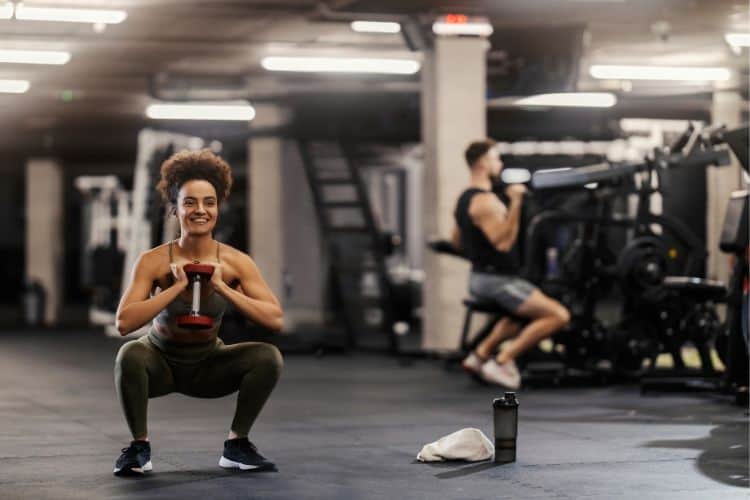
The first 60-second station is the goblet squat. Hold one dumbbell upright close to your chest and complete approximately eight to twelve smooth repetitions during the 40-second work period. Sit between your hips, keep your whole foot in contact with the floor, and stand tall without throwing your torso backward. Rest and prepare for the next station when the work period ends.
At the second station, perform bent-over dumbbell rows for approximately eight to twelve repetitions. Hold a dumbbell in each hand, soften your knees, and push your hips backward until your torso tilts forward. Draw your elbows toward your hips and lower the weights with control. Keep your trunk steady instead of jerking each weight upward. If your lower back tires before your upper back, brace one hand on a sturdy bench or chair and row one side at a time, splitting the 40 seconds evenly.
At the third station, complete about eight to twelve dumbbell Romanian deadlifts. Hold the weights in front of your thighs, maintain a gentle bend in your knees, and send your hips backward. Let the weights travel close to your legs until you feel a comfortable stretch in the backs of your thighs. Stand by pressing through your feet and bringing your hips forward. The movement comes primarily from your hips; you do not need to lower the dumbbells to the floor.
At the fourth station, stand tall with a dumbbell in each hand and march slowly in place. Lift one knee, briefly balance, lower it, and switch sides. Breathe naturally while keeping your shoulders level. This loaded march trains grip and trunk stability without adding another complicated lift. If the dumbbells pull you out of position, set them down and continue the march without weight. After 20 seconds of rest, begin the same four stations again for your second round.
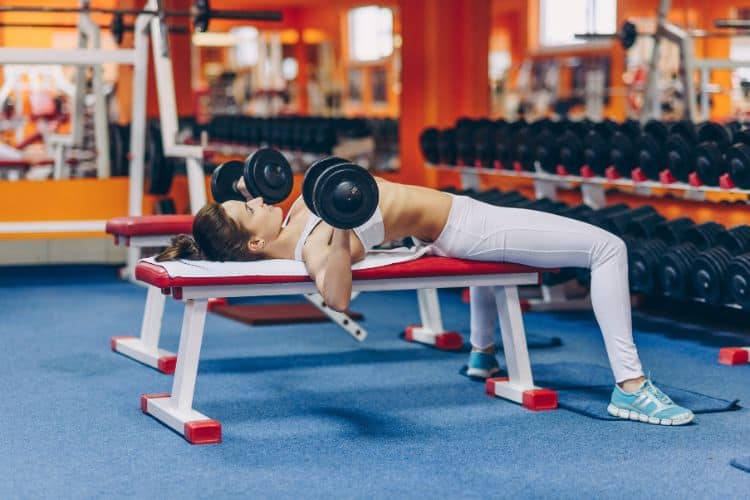
Start Circuit B with the dumbbell floor press. Lie on your back with your knees bent and feet planted. Begin with your upper arms comfortably near the floor and your elbows slightly away from your ribs. Press the dumbbells above your chest, then lower slowly until your upper arms lightly contact the floor. Complete around eight to twelve repetitions in 40 seconds. Keep your wrists stacked over your forearms. If getting down to and up from the floor is difficult, substitute a standing wall or counter push-up and use the full station for that movement.
At the second station, perform alternating reverse lunges for approximately six to ten repetitions per leg, as time allows. Step one foot back, bend both knees within a comfortable range, and press through the front foot to return to standing. Keep your stance wide enough for balance. You may hold the dumbbells at your sides, use one goblet-style weight, or work with bodyweight only. A small backward step with a shallow bend still counts as useful practice; depth is not a contest.
At the third station, perform roughly six to ten standing dumbbell overhead presses. Start the weights near shoulder height, brace your abdomen, and press upward through a comfortable path. Lower under control. Keep your ribs from flaring excessively and avoid leaning back to move a weight that is too heavy. If overhead pressing bothers your shoulders, use a neutral grip with your palms facing each other, reduce the range, or repeat the floor press instead.
Finish with a suitcase march. Hold one dumbbell at your side, stand upright, and slowly march in place for about 20 seconds. Switch the dumbbell to your other hand for the remaining 20 seconds. Resist leaning toward or away from the weight. This small change from the two-dumbbell march asks your core to manage an uneven load. Rest for the final 20 seconds, then repeat all four stations for a second round.
After Circuit B, spend one minute cooling down. Walk slowly around your space while your breathing settles, then use any remaining time for a gentle chest-opening stretch or an easy hip hinge. If you want longer mobility work, do it after the timed workout. The complete session remains 20 minutes even when your personal cooldown lasts a little longer.
Use your first round as a check on the weight you selected. If you can complete every repetition quickly and still feel that you could do many more, a slightly heavier weight may be appropriate next time. If your technique deteriorates halfway through the station, use a lighter pair or stop a few repetitions sooner. Different exercises will call for different loads, so there is no single perfect dumbbell weight for the whole workout.
The 40-second interval is a window for controlled repetitions, not a requirement to lift continuously. For a squat, you might take about two seconds to lower and one or two seconds to rise. A Romanian deadlift, take time to feel your hips move backward. For the floor press, lower deliberately instead of bouncing your arms off the floor. Counting quality repetitions will help you compare sessions more honestly than rushing to beat the timer.
Rest whenever you need to breathe or reset your position. If you need a full 30-second break and only have time for a few repetitions, take the break. You can also change the timer to 30 seconds of work and 30 seconds of rest at each station. The stations and overall 20-minute structure stay the same. Your workout should fit your current ability rather than demand that you meet an arbitrary pace.
If this is your first full body dumbbell workout, rehearse every exercise without weights before starting the clock. During the timed session, perform six to eight deliberate repetitions at each strength station, then rest. Use a chair as a depth guide for squats, do supported rows, and make reverse lunges shallow or replace them with alternating backward toe taps. Hold a single light weight for the suitcase march, or march without weight while you practice staying tall.
Another option is to complete the first round of each circuit with light dumbbells and the second round with bodyweight whenever fatigue changes your form. That still provides a complete session. The best starting workout is one you can repeat comfortably enough to build confidence and consistency over the next several weeks.
If you already lift regularly, choose weights that make the last repetitions of each station demanding while preserving clean technique. Pause briefly at the bottom of each squat, lower the weights for three seconds during the Romanian deadlift, and make your marches slower. You can also aim to complete one more good repetition within the same 40-second window next time, provided you do not shorten the range or lose control.
Avoid piling every challenge onto the workout at once. Adding weight, slowing the lowering phase, extending a pause, and reducing rest all increase difficulty. Pick one adjustment, keep the other conditions similar, and notice how you recover before changing another variable.
Think about where you feel the work. A row should primarily challenge your upper back and arms rather than turn into a full-body swing. A Romanian deadlift should feel like your hips moving back and the backs of your legs working. The floor press should feel stable through your upper body, with your forearms supporting the dumbbells. If a position feels awkward, reduce the load and shorten the range until you can control it.
Exhale through the harder part of a repetition and inhale as you return. You do not need to hold your breath through a long set. During the marches, keep your gaze forward, move your feet slowly, and prevent the dumbbells from pulling your shoulders downward or sideways. Simple cues are most useful when they help you make an immediate adjustment; you do not need to perfect every detail at once.
Stop an exercise if you feel sharp pain, dizziness, or unusual symptoms. Muscle effort and breathing harder are expected; pain is a reason to change the movement or end the set. If you are returning to exercise after an injury, pregnancy, or a medical condition, ask an appropriate clinician for guidance on movements or loads that need individual adjustment.
For the first week, learn the order of the exercises and find loads that allow consistent form. Record the weights you used and the approximate repetitions you completed in each 40-second station. You do not need an elaborate tracking app; a note on your phone is enough. Pay attention to whether the second round feels similar to the first or whether your form changes substantially.
In the second week, keep the same weights and try to make your repetitions more consistent across both rounds. Perhaps you manage nine good squats in each round instead of ten in the first and six in the second. Better control and more even effort are forms of progress. If the first week felt quite easy, you can add one or two repetitions to a station while staying inside its work period.
In the third week, consider increasing the dumbbell weight for one or two exercises where you can already perform your target repetitions cleanly. A small increase for squats or deadlifts may be enough. You do not have to increase every exercise together. When a heavier weight reduces your repetitions, that is normal; build them back gradually with good form.
In the fourth week, repeat the workout and compare it with your first session. Check whether you used a heavier weight, performed more controlled repetitions, moved through a better range, or needed less time to set up each station. Any of those improvements can show that the routine is becoming more manageable. If you feel unusually tired, use lighter weights for a session rather than forcing a personal best.
It can be, especially when you train consistently and choose exercises that cover your major movement patterns. This routine offers two rounds of squatting, hinging, pulling, pressing, lunging, and bracing within a manageable window. The results you get depend on your starting point, effort, progression, recovery, and the rest of your training week. A short session performed regularly is useful even if you sometimes have time for longer workouts.
Most people will do better starting with two or three sessions per week and allowing recovery between full body strength days. Your muscles and connective tissues need time to adapt, particularly when the weights or total repetitions increase. On other days, you can walk, do easy mobility work, or choose an activity that uses a different level of effort. Listen to lingering soreness and adjust your schedule accordingly.
No. A lighter pair can work while you learn the exercises or when you slow the lowering phase and focus on control. As you become stronger, heavier weights may be helpful for movements such as squats, deadlifts, and rows. The right choice is a load that creates a challenge without changing your technique. If your available dumbbells eventually become too easy, increase the difficulty thoughtfully or consider a heavier pair.
Yes. The floor press replaces the need for a bench, and every other movement can be performed standing. You need enough room to hinge and take a backward step. If your space is very small, replace reverse lunges with split squats performed in place, and replace loaded marches with a stationary one-leg balance while holding a light weight. Keep your setup stable and clear of obstacles.
This 20 minute full body dumbbell workout gives you a clear plan for a busy day: warm up, complete two rounds of four stations in Circuit A, complete two rounds of four stations in Circuit B, and cool down. Choose weights you can control, use the timer as a guide, and leave room to improve from week to week. Consistency with a focused plan is what turns a brief session into a dependable strength habit.
If you are building your strength routine, start with the Beginner Dumbbell Workout Plan For Women for a weekly schedule, or try the 15 Minute Beginner Full Body Dumbbell Workout when time is even tighter. When you can spare a longer session, follow the 30 Minute Full Body Dumbbell Workout at Home. For help selecting weights, read How Heavy Women Should Lift, then use the Progressive Overload Dumbbell Workout Plan to keep building on this 20 minute workout over time.
Stay up to date on the latest women’s health, fitness and lifestyle trends and tips.
