



Sign up for workout ideas, training advice, reviews of the latest gear and more.
The holidays can make even a dependable fitness routine feel difficult to maintain. Workouts compete with travel, shopping, family events, cooking, shorter daylight hours, and a calendar filled with celebrations. At the same time, rich meals, desserts, and less predictable sleep can leave you feeling sluggish. A 20 minute holiday damage control workout offers a practical way to keep moving without expecting perfection during one of the busiest times of the year.
Despite its catchy name, “damage control” should never mean exercising to punish yourself for eating. One holiday meal does not erase your progress, and no workout needs to earn or cancel food. The real purpose of this routine is to protect the habits that help you feel strong, capable, and energized. Twenty focused minutes can raise your heart rate, challenge your major muscle groups, improve your mood, and make it easier to return to your normal schedule when the holiday season ends.
This full-body workout requires little space and no equipment, although you can add dumbbells if you want more resistance. It combines strength-focused movements with low-impact cardio so you can train your legs, glutes, chest, back, shoulders, arms, and core in one efficient session. You can complete it in a living room, hotel room, guest bedroom, or any quiet corner with enough space to move safely.
When time is limited, it is tempting to skip exercise unless you can complete a full-length session. That all-or-nothing mindset can turn a few busy days into several inactive weeks. A short workout keeps the habit alive. Getting changed, warming up, and completing a purposeful circuit reminds you that fitness still belongs in your day, even when your routine looks different.
Twenty minutes is also long enough to deliver a meaningful training stimulus when you use the time well. Compound exercises such as squats, lunges, push-ups, hinges, and plank variations recruit several muscle groups at once. Moving between them with controlled rest creates a cardiovascular challenge without requiring long bouts of running or complicated equipment.
The emotional benefit matters too. Holiday stress often comes from trying to meet too many expectations at once. Exercise creates a brief period in which you can focus on breathing, movement, and what your body can do. You may finish feeling clearer and more energetic, which can make the rest of your responsibilities seem more manageable.
Most importantly, a quick holiday workout supports consistency. Fitness progress is built over months and years, not decided by a few festive meals. Maintaining a flexible version of your routine helps prevent the frustrating feeling that you must start over in January.
You only need comfortable clothing, supportive shoes, water, and a safe surface. An exercise mat is useful for floor movements but not required. Keep a sturdy chair or countertop nearby if you want additional balance support or need an elevated surface for push-ups.
The bodyweight version is challenging enough for many people. If you regularly strength train, use one or two dumbbells to make the squats, rows, reverse lunges, and Romanian deadlifts more demanding. Choose a load that allows you to maintain good form for the entire work period. The final repetitions should feel challenging, but you should not need to rush or sacrifice control.
Use an interval timer set for 40 seconds of work and 20 seconds of transition or rest. The workout includes a three-minute warm-up, three five-minute circuits, and a two-minute cooldown. If you are a beginner, use 30 seconds of work and 30 seconds of recovery while keeping the same exercise order.
The session begins with a three-minute dynamic warm-up. You will then complete three five-minute circuits. Each circuit contains five exercises performed for 40 seconds followed by 20 seconds to recover and prepare for the next movement. You will finish with two minutes of easy movement and stretching.
Move at a pace you can control. The goal is not to accumulate sloppy repetitions; it is to perform consistent, purposeful work. A smooth squat with full-foot pressure is more valuable than three rushed squats with collapsing knees. During cardio movements, increase speed only if you can land softly, breathe rhythmically, and remain aware of your surroundings.
The routine should feel moderately hard to hard, but not maximal. On a perceived exertion scale from one to ten, aim for approximately a seven during most work intervals. You should be breathing faster while still able to say a short sentence. Adjust the intensity immediately if you feel dizzy, unusually breathless, or experience sharp pain.
Begin by marching in place and gradually lifting your knees higher. Reach both arms overhead, then bring them back down as you continue marching. Keep your ribs stacked over your hips rather than arching your lower back. This movement warms your shoulders and hips while slowly increasing your heart rate.
If you have been sitting or traveling, start gently. Use the first 20 seconds to find your rhythm, then increase the arm swing and knee height. Breathe normally and let your body transition into exercise instead of trying to create intensity immediately.
Stand with your feet about hip-width apart and place your hands behind your head or across your chest. Push your hips back with a soft bend in your knees, keeping your spine long. Squeeze your glutes to stand, then lower into a comfortable squat. Alternate one good morning with one squat for the full minute.
The hinge wakes up your hamstrings and glutes, while the squat prepares your knees, ankles, and hips. Keep your weight balanced across your whole foot. Make the range of motion smaller if your back rounds or your heels begin to lift.
Perform a low-impact jumping jack by stepping one foot out as your arms travel overhead, returning to center, and repeating on the other side. After four step jacks, plant your feet and rotate your torso gently from side to side. Continue alternating these patterns for one minute.
This combination warms the outer hips, shoulders, core, and upper back. Keep the movement relaxed rather than forcing a deep twist. By the end of the minute, you should feel warmer and ready to begin the first circuit.
Complete each exercise for 40 seconds, then rest or transition for 20 seconds. This first circuit emphasizes controlled compound movements. Concentrate on technique and create tension through the muscles instead of racing the timer.
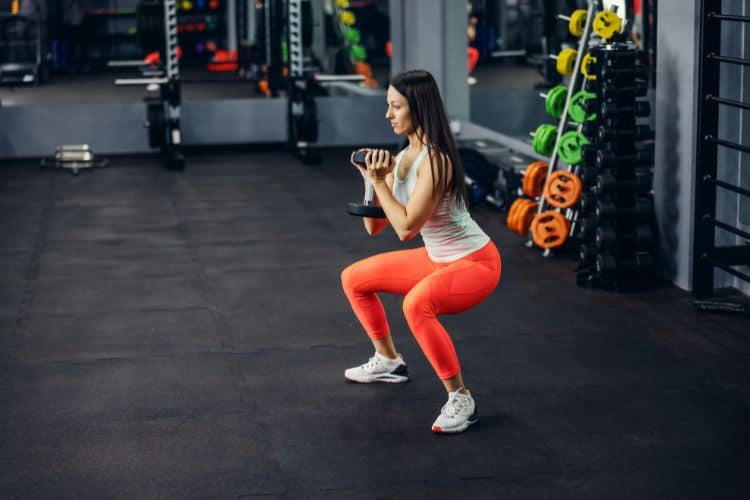
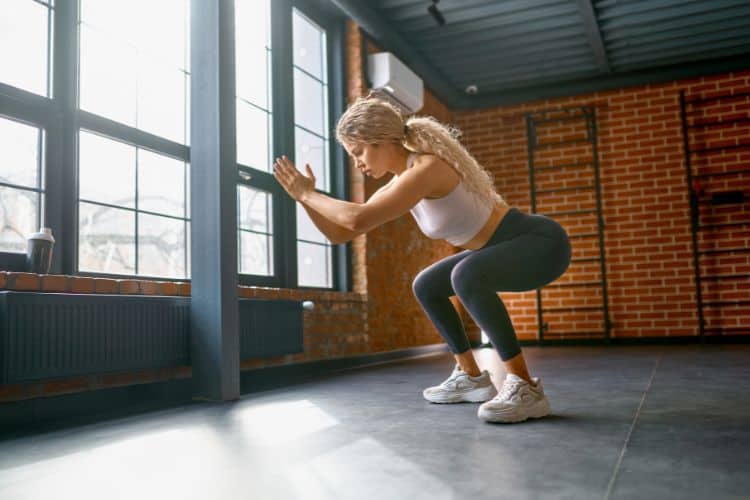
Stand with your feet around shoulder-width apart and your toes turned slightly outward. Sit your hips down and back as if lowering toward a chair. Keep your chest lifted and your knees tracking in the same direction as your toes. Drive through your feet to stand, then lift your heels and balance briefly on the balls of your feet.
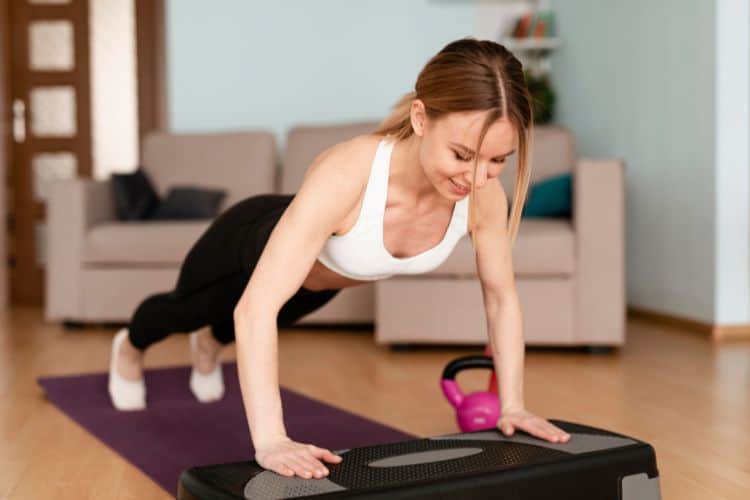
Place your hands slightly wider than shoulder-width on the floor, a sturdy bench, or a countertop. Form a straight line from your head through your hips, bend your elbows, and lower your chest toward the surface. Press the surface away until your arms are straight without locking your elbows aggressively.
Stand tall and step your right foot backward. Bend both knees until you reach a comfortable depth, then push through your front foot to return to standing. Repeat on the left side and continue alternating. Keep most of your pressure through the front foot and maintain a tall torso.
Begin in a high plank with your hands beneath your shoulders and your feet slightly wider than hip-width. Brace your core and tap your left shoulder with your right hand. Return your hand to the floor, then switch sides. Try to keep your hips facing the floor rather than rocking from side to side.
Finish the first circuit with a cardiovascular interval. Drive one knee upward as the opposite arm swings forward, then switch sides. Choose a quick, grounded march for a joint-friendly option or transition to light high-knee running if you want more impact.
The second circuit blends resistance patterns with faster full-body movements. Fatigue will begin to build, so shorten your range of motion or slow down before allowing your form to deteriorate.
From standing, step your right foot diagonally behind your left leg and lightly tap the floor. Bend the front knee slightly, return to center, and switch sides. For more intensity, lower into a deeper curtsy lunge while keeping the front knee aligned with your toes.
Stand with your knees softly bent. Hinge at your hips, place your hands on the floor, and walk them forward until you reach a strong high plank. Pause, then walk your hands back and stand tall. Move deliberately and keep your abdominal muscles engaged as your hands travel.
Hold a dumbbell in each hand or make fists if you are training without weights. Push your hips backward until your torso leans forward with a neutral spine. Hold the hinge, pull your elbows toward your ribs as though performing a row, extend your arms, and squeeze your glutes to stand.
Stand with your feet under your hips, bend your knees, and place your hands on the floor or an elevated surface. Step or hop your feet backward into a plank. Step or hop forward again, then stand and reach overhead. Unlike a burpee, a squat thrust does not require a push-up or jump.
Step your right foot to the side and bring your left foot behind it in a light tap. Push across to the left and repeat. Swing your arms naturally as if skating. Make the side-to-side step wider and faster for more intensity, or turn it into a lateral bound if you are comfortable with impact.
The final circuit brings the entire workout together. Focus on steady effort rather than treating every interval as an all-out sprint. Finishing with good mechanics will leave you feeling accomplished instead of depleted.
Step your right foot backward into a staggered stance. Bend both knees into a split squat, then press through your front foot and bring your back knee forward toward your chest. Continue on the same side for 20 seconds, then switch legs for the remaining 20 seconds.
Begin on your hands and knees with your wrists beneath your shoulders and your knees beneath your hips. Brace your abdomen and lift your knees one or two inches from the floor. Hold this bear plank, or take small controlled steps forward and backward while keeping your back flat.
Lie on your back with your knees bent and your feet flat. Hold dumbbells above your chest if available. Press through your feet and lift your hips until your body forms a diagonal line from shoulders to knees. As you hold or repeat the bridge, perform chest presses by lowering your elbows toward the floor and pressing the weights upward.
Start in a high plank and draw one knee toward your chest, then switch sides. Step your feet for a low-impact mountain climber or run them more quickly for a vigorous interval. Keep your hands rooted beneath your shoulders and press the floor away.
Stand tall with your hands near your temples or extended overhead. Drive your right knee toward your left elbow as you rotate through your torso, return to center, and switch sides. Continue alternating with a strong, rhythmic pace.
Spend the first minute walking slowly around the room or marching in place. Let your arms relax and take longer, calmer breaths. Inhale through your nose if comfortable, then exhale slowly as your heart rate begins to settle.
During the second minute, stand with your feet wide and shift gently from side to side to stretch your inner thighs. Bring your feet closer, clasp your hands behind your back or hold a towel, and open your chest without forcing your shoulders. Finish by reaching your arms overhead, lowering them slowly, and taking one final deep breath.
A two-minute cooldown is a practical minimum, not a strict limit. Continue with gentle stretches for your calves, hip flexors, glutes, chest, and upper back if you have additional time.
You do not need to jump to make this holiday workout effective. Replace high knees with a strong march, lateral bounds with skater steps, and hopping squat thrusts with alternating step-backs. Use an elevated surface for push-ups, planks, walkouts, and mountain climbers. These changes reduce impact while still training your muscles and cardiovascular system.
Beginners can use 30-second work intervals and 30-second rest periods. Another option is to complete only the first two circuits, cool down, and add the third circuit after a week or two. Experienced exercisers can hold dumbbells during lower-body exercises, choose harder push-up variations, or increase the work interval to 45 seconds while reducing rest to 15 seconds.
Intensity is personal. A modification is not a lesser workout when it helps you move with better alignment and consistent effort. Choose the version that fits your current energy, experience, joint comfort, and recovery.
Keep your momentum going throughout the festive season with more time-efficient routines from Women’s Fit Club. Try this 20 Minute Winter Workout at Home when cold weather keeps you indoors, or add resistance with a 20 Minute Dumbbell HIIT Workout For Women. On especially busy days, these 15 Minute Strength Workouts For Women make it easier to stay consistent. For a gentler option, follow the 20 Minute Full Body Low Impact Workout, or build a longer seasonal routine with the 2 Week No Equipment Home Workout Challenge.
Yes. A focused 20-minute workout can train all major muscle groups and challenge your cardiovascular system, especially when it uses compound exercises and structured intervals. It may not replace every longer training session, but it is a valuable option for maintaining consistency and fitness during busy periods.
It is neither necessary nor realistic to match a workout to a specific meal. Energy balance is influenced by patterns over time, and the value of exercise extends far beyond calorie expenditure. Use this routine to support health and maintain momentum, not to compensate for enjoying holiday food.
Absolutely. Every exercise has a bodyweight version. Create more challenge by using a slower tempo, pausing in the hardest part of a movement, increasing your range of motion, or maintaining steady effort throughout each interval.
Beginners can use the low-impact alternatives, elevate floor exercises, and follow 30 seconds of work with 30 seconds of rest. Start with two circuits if needed. Anyone with an injury, medical condition, or recent surgery should seek personalized guidance from a qualified healthcare professional before beginning a new workout.
Two to four sessions per week can work well during a busy holiday period, depending on your current fitness level and other activities. Allow recovery when your muscles feel unusually sore, and balance harder sessions with walking or gentle mobility work.
The most useful holiday workout is not the one that leaves you exhausted. It is the one that fits your life well enough to complete. This 20 minute holiday damage control workout gives you a clear plan for training your entire body when your schedule is full and your normal routine is harder to follow.
Approach the workout as an investment in energy, strength, and consistency. Warm up, move with intention, select modifications confidently, and finish feeling better than when you started. A few short sessions, regular walks, satisfying meals, and reasonable rest can help you enjoy the season while keeping your healthy habits intact.
When the holidays end, you will not need a dramatic restart. You will already have proof that your fitness routine can bend without breaking—and that 20 focused minutes can be enough to keep moving forward.
Stay up to date on the latest women’s health, fitness and lifestyle trends and tips.
