


Sign up for workout ideas, training advice, reviews of the latest gear and more.

A busy day does not have to push exercise off your schedule. With the right combination of strength movements, short work intervals, and carefully planned recovery periods, 20 minute dumbbell HIIT workouts can train your entire body without requiring a long gym session. You can build strength, challenge your cardiovascular fitness, and finish feeling accomplished with just a pair of dumbbells and a small area to move.
The key is not simply to perform exercises as quickly as possible. A productive dumbbell HIIT workout combines controlled resistance training with purposeful intensity. You should feel challenged, but you should also be able to maintain safe technique from the first interval to the last. This full-body routine uses compound exercises that involve several muscle groups at once, helping you get more from every minute.
This 20-minute workout includes a dynamic warm-up, a 12-minute strength and conditioning circuit, and a short cooldown. It works well at home or in the gym, and nearly every movement can be adjusted to match your current fitness level. Choose dumbbells you can control, clear your training space, and prepare for an efficient session that strengthens your legs, glutes, back, chest, shoulders, arms, and core.
High-intensity interval training alternates challenging work periods with brief recovery periods. Adding dumbbells turns those intervals into more than a cardio session. The external resistance asks your muscles to produce force while your heart and lungs work to support repeated full-body efforts.
Twenty minutes is long enough to create a meaningful training stimulus when the session is organized well. It is also short enough to fit before work, during a lunch break, or between other responsibilities. Because the routine has a defined ending, it may feel easier to start on days when motivation is low.
The workout uses compound movements such as squats, rows, presses, and lunges. These exercises train multiple joints and muscle groups, which makes them practical for a time-efficient session. Moving between lower-body, upper-body, and full-body exercises also distributes fatigue instead of repeatedly exhausting one area.
HIIT does not mean every interval must be an all-out sprint. With dumbbells, quality repetitions are more valuable than frantic repetitions. Think of the work periods as vigorous, focused efforts. You should be breathing hard while still controlling the weights and maintaining a stable posture.
You need one pair of dumbbells, supportive shoes, water, and enough floor space to step forward, backward, and to each side safely. An exercise mat is optional. If your dumbbells have fixed weights, choose a load based on your weakest movement, which will often be the overhead press or renegade row.
For many beginners, light dumbbells allow enough resistance to learn the movements without sacrificing technique. More experienced exercisers can use moderate weights, but this is not the ideal workout for testing a maximum load. You will perform several exercises with limited rest, so the weight should feel challenging while remaining controllable.
Before beginning, make sure the floor is dry and clear of obstacles. Place the dumbbells where you can pick them up without rushing. If you have a health condition, are pregnant or recently postpartum, are returning after an injury, or have concerns about high-intensity exercise, ask a qualified healthcare professional whether this style of training is appropriate for you.
The full session is divided into three parts. Spend four minutes warming up, twelve minutes completing the main circuit, and four minutes cooling down. For the main workout, perform each exercise for 40 seconds and rest or transition for 20 seconds. Six exercises create a six-minute round. Complete two rounds for a total of twelve minutes.
Use a timer that provides audible interval cues so you do not have to watch the clock. During each work period, aim for smooth, consistent repetitions. Stop a few seconds early if you need time to place the dumbbells down safely before the next movement.
Rate your effort on a scale from one to ten. Most work intervals should feel like a seven or eight: hard, but not uncontrolled. The final seconds may be uncomfortable, yet your form should remain recognizable. If technique breaks down, reduce the weight, slow your pace, or use the easier variation.
Do not skip the warm-up simply because the workout is short. A few minutes of progressive movement can prepare your joints, raise your body temperature, and give you a chance to assess how you feel that day. Perform each movement for 40 seconds, using the remaining 20 seconds to transition.
Stand tall and march in place while allowing your arms to swing naturally. Gradually lift your knees higher and increase the pace. Keep your ribs stacked over your pelvis rather than leaning backward. This first minute should feel easy and help you settle into a steady breathing rhythm.
Place your fingertips behind your head or cross your arms over your chest. Soften your knees and push your hips backward while keeping your spine long. When you feel tension in your hamstrings, squeeze your glutes and stand tall. This movement rehearses the hip hinge used later in the deadlift row.
Step one foot backward and lower only as far as you can control. As you descend, reach both arms overhead without flaring your ribs. Push through the front foot to stand, then switch sides. Use a short range of motion if your balance or knees need a gentler start.
Sit your hips down and back into a comfortable squat, keeping your knees aligned with your toes. Stand and reach toward the ceiling. Begin slowly, then build a little speed while maintaining full-foot pressure. You should feel warmer and more mobile, not fatigued, when the warm-up ends.
Perform the following six exercises for 40 seconds each, followed by 20 seconds of rest. After exercise six, begin the sequence again. If you are new to HIIT, take an additional 30 to 60 seconds between rounds and accept that the workout will last slightly longer. Safety and good repetitions matter more than finishing at an exact second.
Hold the dumbbells near your shoulders with your palms facing inward. Stand with your feet about hip- to shoulder-width apart. Brace your core, sit your hips down into a squat, and keep your chest lifted. Drive through your feet to stand. As you reach full standing position, press the dumbbells overhead without arching your lower back. Lower the weights to your shoulders before beginning the next squat.
This exercise combines a lower-body squat with an upper-body press, so it raises the heart rate quickly. Your knees should track in the same direction as your toes, and your heels should remain grounded. If the overhead press makes the movement too demanding, perform a goblet squat while holding one dumbbell at your chest. If shoulder mobility is limited, squat and then press the weights forward at chest height instead of overhead.
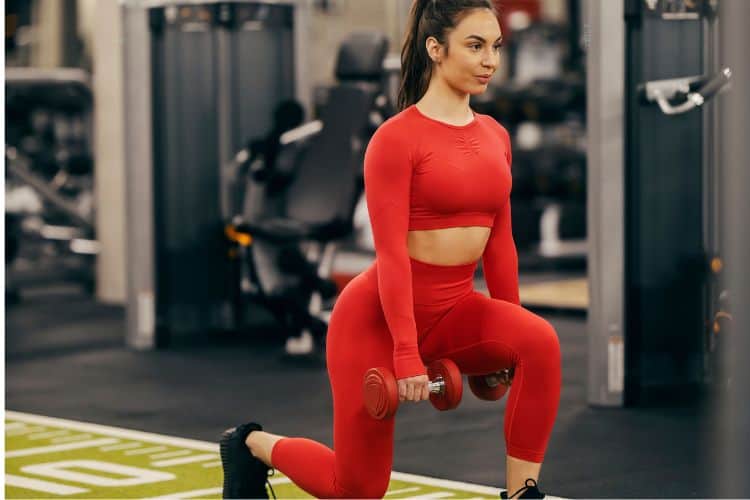
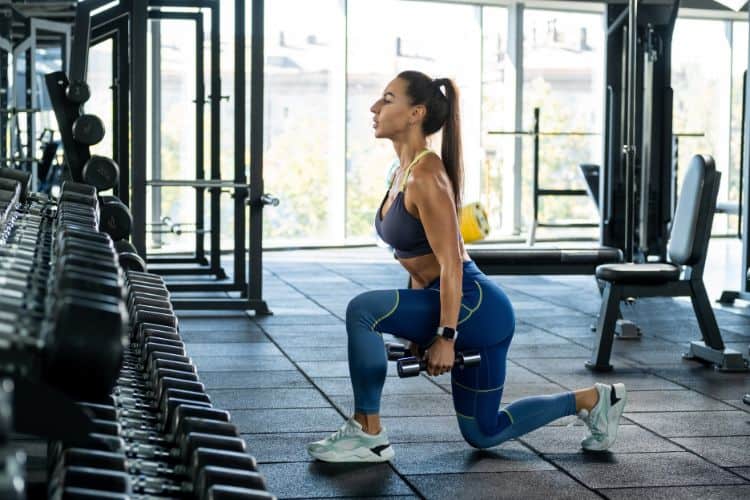
Hold a dumbbell in each hand with your arms at your sides. Step your right foot backward and lower your back knee toward the floor while keeping most of your pressure through the front foot. Push through the front leg to return to standing, then repeat on the other side. Keep your torso tall and take a long enough step that your front heel stays down.
Reverse lunges are often easier to control than forward lunges because you step away from the working leg. To modify the exercise, hold one dumbbell at your chest, use no weights, reduce the depth, or lightly touch a wall for balance. For a low-impact workout, continue alternating at a deliberate pace rather than adding a hop.
Stand with a dumbbell in each hand, palms facing your thighs. Soften your knees and push your hips backward, allowing the weights to travel close to your legs. Stop when your torso is inclined and your hamstrings feel loaded, while keeping your spine neutral. Hold the hinged position, pull both dumbbells toward your ribs, and squeeze your shoulder blades gently together. Lower the weights, then drive your hips forward to stand.
This combination trains the glutes, hamstrings, back, arms, and core. Avoid turning the hinge into a squat or jerking the weights toward your body. If your lower back tires, alternate a deadlift repetition with a standing supported row, or place one hand on a sturdy bench while rowing one dumbbell at a time.
Lie on your back with your knees bent and feet planted. Hold the dumbbells above your chest with your palms facing forward or slightly inward. Press through your feet and lift your hips until your body forms a straight line from shoulders to knees. Keep the bridge as you lower the dumbbells with control until your upper arms gently touch the floor. Press the weights back above your chest and repeat.
This movement trains the chest, triceps, glutes, and hamstrings while giving you a break from standing. Keep your ribs controlled and avoid lifting your hips so high that your lower back arches. For an easier option, lower your hips to the floor and perform only the chest press. Move slowly when getting into position, and never drop dumbbells beside your head.
Begin in a high plank with one dumbbell on the floor outside your right hand. Place your feet wider than hip-width for stability. With your left hand, reach across, grip the dumbbell, and drag it along the floor to the left side. Return your left hand to the floor, then use your right hand to drag the weight back. Keep your hips as level as possible and press the floor away through your supporting arm.
The goal is resisting rotation, not moving the weight quickly. Use a lighter dumbbell if your torso twists excessively. To modify, place your knees on the floor or perform the exercise with your hands elevated on a sturdy bench and the dumbbell on the bench surface. If getting onto the floor is not suitable, stand in a split stance and perform alternating one-arm rows.
Hold one dumbbell horizontally at your chest or hold two light dumbbells at your sides. Stand tall and drive one knee toward hip height, then switch legs. Move briskly while keeping your torso upright and your landing quiet. Brace your abdominal muscles as if preparing for a gentle push to your midsection.
This final interval delivers a cardio-focused finish without requiring jumping. Increase the pace if you can remain controlled, or slow the march and reduce the height of each knee for a lower-impact version. To make it harder without running, hold one dumbbell overhead only if you can keep your ribs down and shoulders comfortable. Switch the overhead arm halfway through the interval.
After the second round, place the weights on the floor and walk slowly around your space for about one minute. Let your breathing settle gradually rather than stopping abruptly. Inhale through your nose if comfortable and use a longer, relaxed exhale.
Spend the next minute in a gentle hip-flexor stretch. Step one foot back, keep the rear heel lifted, and softly tuck your pelvis until you feel the front of the rear hip lengthen. Switch sides after 30 seconds. Avoid forcing a deep lunge when your muscles are still tired.
For the third minute, clasp your hands behind your back or place one hand against a wall and gently turn away to open the chest. Keep your shoulder down and stop if you feel pinching. Switch sides halfway through.
Finish with a supported hamstring stretch. Place one heel slightly in front of you, bend the opposite knee, and hinge forward with a long spine. Switch legs after 30 seconds. The cooldown should feel calming. Deep stretches are not necessary immediately after a demanding workout.
Choose a load that allows you to complete the first interval with confidence but makes the final ten seconds feel challenging. You should still be able to control the lowering portion of every repetition. If momentum takes over, your shoulders shrug, your back arches, or your range of motion changes dramatically, the dumbbells are probably too heavy for that exercise.
One pair may not be perfect for every movement. If you own several pairs, use lighter weights for presses and plank drags and heavier weights for squats, deadlifts, and lunges. If you have only one pair, adjust the exercise rather than forcing the load. You can hold one dumbbell with both hands, shorten the interval, slow the tempo, or perform part of the exercise with body weight.
The best weight can also change from day to day. Sleep, stress, soreness, hydration, and previous workouts affect performance. Selecting a lighter load when needed is smart training, not lost progress.
Beginners can use a 30-second work period followed by 30 seconds of recovery. This creates the same six-minute round but provides more time to reset. Complete one round the first time you try the routine, then add the second round when the movements feel familiar.
Keep every exercise low impact by stepping instead of jumping and maintaining contact with the floor. The workout as written does not require burpees, jump squats, or high-impact running. You can further reduce intensity by moving more slowly, using lighter dumbbells, decreasing your range of motion, or replacing loaded movements with bodyweight versions.
If a particular exercise causes pain rather than ordinary muscular effort, stop and choose an alternative. Joint pain, sharp pain, chest pain, severe shortness of breath, or dizziness are not signs that an interval is working. End the session and seek appropriate medical guidance when symptoms warrant it.
Progress should be gradual. First, improve your technique and complete all twelve work intervals consistently. Then consider increasing the dumbbell load by a small amount. You can also add repetitions by moving slightly faster, but only if the movement remains controlled.
Another option is to increase the work-to-rest ratio from 40 seconds of work and 20 seconds of rest to 45 seconds of work and 15 seconds of rest. This substantially raises the conditioning demand, so do not combine it immediately with heavier weights. Change one training variable at a time so you know what your body is adapting to.
You can also make strength-focused intervals harder by slowing the lowering phase. Take three seconds to descend into the squat, lunge, deadlift, or floor press, then return with control. A slower tempo may reduce the number of repetitions while increasing muscular tension, which is often more useful than racing the clock.
For many adults, two or three dumbbell HIIT workouts per week are enough. Leave recovery time between demanding full-body sessions, especially if you are new to resistance training. On other days, consider walking, mobility work, traditional strength training, or easier aerobic exercise.
Your ideal schedule depends on your experience, goals, and other workouts. If this routine is your primary strength training, focus on gradually increasing resistance and pair it with at least one longer, less rushed strength session when possible. If you already follow a lifting program, use dumbbell HIIT as occasional conditioning rather than adding it after every workout.
Recovery is part of the program. Regular sleep, sufficient food, hydration, and protein support adaptation. Persistent soreness, declining performance, unusually elevated fatigue, or a lack of enthusiasm for training may indicate that you need an easier week or fewer high-intensity sessions.
Twenty minutes can be an effective workout, particularly when you train consistently and choose exercises that involve the entire body. Whether it is “enough” depends on your weekly activity, health needs, and goals. Use short HIIT sessions alongside regular movement and a balanced strength and cardio routine.
Yes, beginners can reduce the work interval, increase the rest period, use light dumbbells, and complete only one circuit round. Learn the exercises individually before combining them if necessary. A session should challenge your current ability without overwhelming it.
You can perform the routine with one dumbbell. Hold it at your chest for squats and lunges, switch hands halfway through rows and presses, use it for the plank drag, and hold it securely during the high-knee march. Begin each new round with the opposite side when an exercise is unilateral.
A useful workout does not need to be long or complicated. These 20 minute dumbbell HIIT workouts combine foundational strength movements with short recovery periods to challenge your whole body efficiently. The routine is demanding enough to raise your heart rate, yet flexible enough to adapt for beginners, low-impact training, or progressive strength goals.
Start with weights you can control, respect the 20-second transitions, and let technique determine your pace. Repeat the workout two or three times per week if it fits your broader plan, and progress one variable at a time. The real value of this session comes from making it repeatable. Twenty focused minutes performed consistently can become a strong building block for better fitness, greater confidence, and a sustainable exercise routine.
For more ways to build strength and improve conditioning, try this joint-friendly 20-Minute Low-Impact HIIT Workout With Dumbbells or increase your training time with a 30 Minute Dumbbell Density Workout For Women. If you are new to weights, begin with this Beginner Dumbbell Workout Plan For Women to develop proper form and confidence. You can also explore these 30 Minute HIIT Workouts For Beginners at Home or use a Quick 15 Minute Full Body Dumbbell Workout when you need an even shorter strength session.
Stay up to date on the latest women’s health, fitness and lifestyle trends and tips.
