



Sign up for workout ideas, training advice, reviews of the latest gear and more.

If you have 40 minutes and a pair of dumbbells, you have enough time to train your entire body. A well-designed full-body session does not require dozens of moves or a frantic pace. It needs a squat pattern, a hip hinge, a push, a pull, and enough attention to core stability to help you control the weights. This 40 minute full body dumbbell workout brings those pieces together in a schedule that you can follow without guessing how long each section should take.
The routine includes a five-minute warm-up, three nine-minute strength blocks, a five-minute finisher, and a three-minute cool-down. That is exactly 40 minutes. You will alternate exercises so that one muscle group can recover while another works. The goal is controlled, challenging repetitions, rather than rushing through as many movements as possible. Whether you train at home or at the gym, the same plan works with a clear patch of floor and a set of dumbbells.
This session covers your quads and glutes with squats and reverse lunges, your hamstrings and glutes with Romanian deadlifts, your chest and triceps with floor presses, and your upper back with rows. Overhead presses bring in the shoulders, while loaded carries and a core finisher ask your trunk to resist unwanted movement. Together, these movements make the workout useful for general strength and everyday tasks such as lifting, carrying, and getting up from the floor.
Training all major muscle groups is a practical way to organize a full-body day. The CDC recommends muscle-strengthening activity for adults on at least two days each week, involving the major muscle groups. This one session can be part of that weekly routine; you can repeat it on another nonconsecutive day or alternate it with a different strength workout. The exercises and loads should fit your experience and recovery, not an arbitrary idea of what a 40-minute workout must look like.
Use one or two pairs of dumbbells if you have them. A heavier pair often suits deadlifts, squats, and carries, while a lighter pair may make overhead presses easier to control. If you own only one pair, shorten your rep range when a movement is difficult and add a pause or a slower lowering phase when it feels easy. You will also need enough space to step back into a lunge and lie on the floor for a press. A mat is optional.
Choose a weight that lets you finish each work interval with steady form and the sense that you could perform roughly two more good repetitions. This is a useful starting point, not a rule that every set must follow. On your first round, use a conservative load and learn the movement. Keep a timer visible so your recovery does not disappear between exercises.
Start with five minutes of easy movement. Then complete three nine-minute blocks. In each block, perform three exercises for 40 seconds each, allowing 20 seconds to transition or rest after each exercise. Repeat that three-minute sequence three times. Take the scheduled transition inside each 20-second interval, including after the third exercise; do not add extra minutes between blocks unless you intentionally extend the workout. Finish with a five-minute interval and three minutes of easy stretching or breathing.
The clock runs as follows: minutes 0–5 are the warm-up; 5–14 are Block A; 14–23 are Block B; 23–32 are Block C; 32–37 are the finisher; and 37–40 are the cool-down. The strength blocks add up to 27 minutes because each contains nine one-minute slots. If 40 seconds is too long for your current form, stop at a clean rep count and use the remaining seconds as rest. Your technique takes priority over filling the timer.
Spend the first minute marching briskly in place while swinging your arms naturally. For the second minute, alternate bodyweight squats with a brief reach overhead, using a comfortable depth. In the third minute, hinge at your hips without weights, pushing your hips back while keeping your spine in a comfortable, neutral position. During minute four, perform alternating reverse steps or small reverse lunges while holding a wall or chair for balance if needed. For the final minute, make slow arm circles, then practice a few unloaded rows by drawing your elbows toward your ribs.
The warm-up should make you feel ready, not exhausted. Move through ranges that feel comfortable and rehearse the patterns you will use once the weights are in your hands. If your joints feel stiff, give yourself additional preparation time and adjust the session accordingly. The written timing assumes you are ready after five minutes.
Perform goblet squats for 40 seconds, rest or transition for 20 seconds, perform bent-over dumbbell rows for 40 seconds, transition for 20 seconds, then perform dumbbell floor presses for 40 seconds and rest for 20 seconds. Repeat this three-exercise sequence three times. A sensible target is about 8–12 controlled reps per exercise, but your range of motion and tempo decide the actual count.
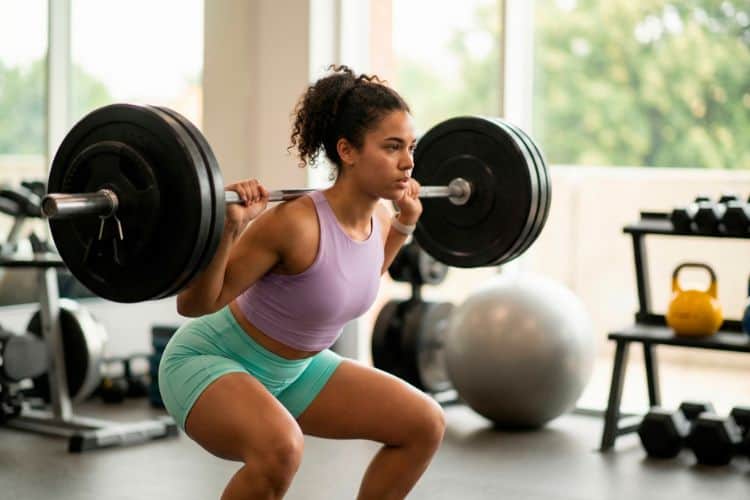
Hold one dumbbell vertically in front of your chest with both hands. Stand with your feet approximately shoulder-width apart, adjusting your stance for comfort. Bend your knees and hips together and lower between your legs as far as you can without losing control. Press through your whole foot to stand, and exhale as you rise. Keep the dumbbell close enough that you do not have to lean forward to counterbalance it.
Do not force your knees or hips into a textbook position. A shorter squat to a stable chair is a useful option if you are learning the movement. If a single goblet weight becomes too light, hold a dumbbell at each side and use the same squat pattern. Avoid bouncing off the bottom just to increase your rep count.
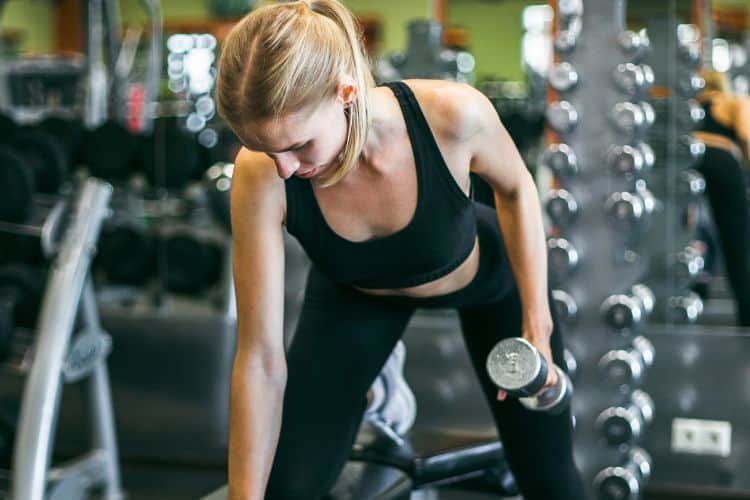
Hold a dumbbell in each hand, soften your knees, and push your hips back until your torso leans forward. Let the weights hang under your shoulders. Pull your elbows toward your back pockets, briefly feel your shoulder blades move, and lower the weights under control. Your torso should stay mostly still while your arms do the rowing.
If the position is uncomfortable for your lower back, support one hand on a sturdy bench or chair and row with the other arm. Divide the 40-second interval between sides, then start with the opposite arm on the next round. Reduce the load if you need to jerk your upper body to lift the weights.
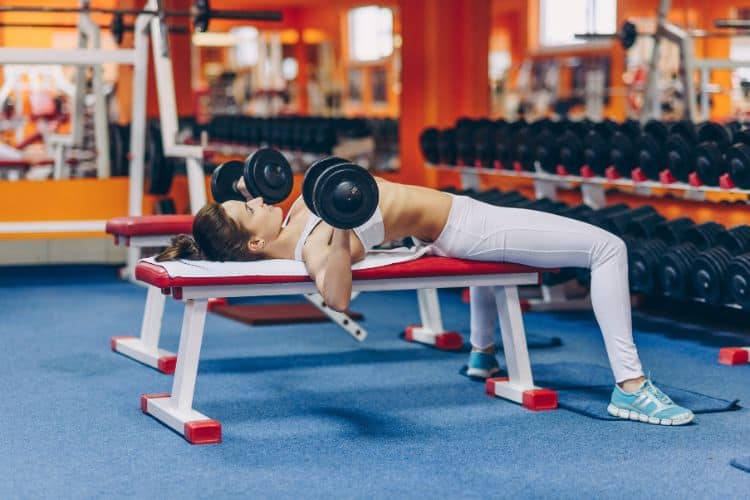
Sit down with the dumbbells close to your torso, then roll onto your back with your knees bent and feet planted. Position your elbows a little below shoulder height rather than directly out to your sides. Press the weights toward the ceiling until your arms are nearly straight, then lower until the backs of your upper arms lightly meet the floor. Keep your wrists stacked over your forearms and avoid dropping your elbows into the ground.
The floor limits the bottom range, which can make this press approachable when a bench is unavailable. If you need a lighter option, press one dumbbell with both hands, holding it securely over the center of your chest. At the end of the interval, bring the weights toward your chest before sitting up.
Block B follows the same 40-second work and 20-second transition pattern. Perform Romanian deadlifts, then standing dumbbell overhead presses, then alternating reverse lunges. Repeat the sequence three times. You have already squatted and pressed horizontally; this block adds a stronger hip hinge, a vertical push, and single-leg work.
Stand tall with a dumbbell in each hand and your palms facing your thighs. Soften your knees, slide your hips backward, and let the weights travel near your legs. Lower until you feel a manageable stretch in the backs of your thighs while maintaining a steady trunk. Drive your feet into the ground and bring your hips forward to return to standing. Think of the move as closing and reopening a door with your hips, rather than reaching the weights as low as possible.
The weights may stop around your knees or mid-shins; depth is individual. Avoid rounding your back to chase the floor or leaning backward at the top. If both dumbbells are too heavy to control, use one held with both hands. Keep your breathing smooth instead of bracing so hard that you hold your breath through the whole interval.
Bring the weights to shoulder height with your palms facing forward or inward, whichever feels more comfortable. Stand with your feet steady, keep your ribs from flaring upward, and press the weights overhead in a smooth path. Lower them to shoulder height under control. You can press both arms together or alternate arms to make a lighter pair feel more manageable.
If pressing overhead bothers a shoulder, use a comfortable partial range or substitute another set of floor presses. Do not push through sharp pain. A split stance may help you keep your balance, and a seated position can be useful if standing stability is the limiting factor. For most people, this movement will require less weight than a squat or deadlift.
Hold the dumbbells at your sides, step one foot behind you, and bend both knees as far as you can control. Push through the front foot to return to standing, then change sides. Keep your front foot planted and take a long enough step to make space for the back knee. Aim for even repetitions on both legs, even if that means you stop before the timer ends.
Balance is part of the challenge. Hold one dumbbell in the hand opposite your working leg, use a chair for support, or perform a stationary split squat if stepping back repeatedly feels awkward. A smaller bend still counts when you control it. If lunges do not suit you, substitute alternating step-ups onto a stable, low platform or another squat variation.
The final nine-minute strength block repeats the same timing: 40 seconds of dumbbell glute bridges, 20 seconds to transition, 40 seconds of a supported single-arm row, 20 seconds to transition, and 40 seconds of a suitcase march, followed by 20 seconds of rest. Complete three rounds. This block lets you keep working your hips and upper back while finishing with a loaded core and grip challenge.
Lie on your back with your knees bent, feet roughly hip-width apart, and one dumbbell resting securely across the front of your hips. Hold it in place with both hands. Push through your feet and lift your hips until your torso and thighs form a comfortable line. Pause briefly, lower with control, and repeat. Keep your ribs settled rather than arching your lower back to lift higher.
If positioning the dumbbell is awkward, perform the bridge without weight or place a folded towel between the dumbbell and your hips. You can make a light weight more demanding by pausing for two seconds at the top. Avoid driving through your toes if doing so causes your heels to lift.
Brace one hand on a sturdy bench, chair, or countertop and row a dumbbell with the other arm. Keep your shoulders roughly level and pull your elbow toward your hip. Switch arms halfway through the 40 seconds. Start with the opposite side each round so neither arm always takes the fatigued half of the interval.
This second rowing variation gives your back additional work without asking you to hold an unsupported hinge for the whole block. A stable support matters; do not rely on furniture that might slide. If switching sides takes too long, do one side in the first round, the other in the second, and split the third round evenly.
Hold one dumbbell at your side as if carrying a suitcase. Stand tall and march slowly in place, lifting one foot at a time without leaning away from the weight. Switch hands at 20 seconds. Keep your shoulders level and your breath moving. You should feel the muscles around your trunk resisting the pull of the dumbbell while your grip and legs continue working.
Choose a weight you can hold securely. If marching affects your balance, simply stand with the weight at one side for 20 seconds and switch hands. If you have a safe, clear walking route, turn this into a suitcase carry and walk slowly instead. The aim is posture and control, not a fast step count.
Set a timer for five rounds of 40 seconds of work followed by 20 seconds of rest. Alternate between a farmer march and a dead bug. Round one is the farmer march, round two the dead bug, and so on, ending with a farmer march in round five. Keep the dumbbells moderate; you should still be able to breathe and move deliberately after the earlier strength work.
For the farmer march, hold a dumbbell in each hand, stand tall, and lift your feet a few inches off the ground one at a time. Keep the weights steady by your sides rather than swinging them. If you have a clear, safe path, walk instead of marching. Use a lighter pair if your grip is exhausted. For the dead bug, set the weights aside, lie on your back, bend your hips and knees to about 90 degrees, and point your arms toward the ceiling. Slowly extend one leg and the opposite arm toward the floor, return, and alternate sides. Make each reach small enough that your lower back remains comfortable and your ribs do not flare. You can keep both feet on the floor and slide one heel outward if the full move is too demanding.
This finisher adds a little movement density without turning the workout into a sprint. If you feel winded, slow your march and use the rest intervals. Your final repetition should look as controlled as your first.
Walk slowly or march gently for about one minute while allowing your breathing to settle. Spend the next minute stretching your chest and shoulders lightly, without forcing your arms behind you. Use the last minute for a comfortable hip flexor stretch or a gentle standing hamstring hinge, changing sides halfway through. You can take longer if you want, but this three-minute sequence closes the planned 40-minute session.
Begin with a weight that lets you learn the shapes of the exercises. During each 40-second work period, perform six to eight deliberate reps and rest for the remaining time. Use a chair for squat depth, a hand support for lunges, and a lighter weight for overhead pressing. You do not need to chase muscle failure to make a beginner session productive. Repeating clean movement across all three rounds gives you a baseline to improve next time.
If the full session feels like too much initially, perform two rounds of each strength block and stop after the cool-down. That shorter version will take less than 40 minutes, which is a reasonable way to build up to the complete plan. Add the third round when your technique and recovery support it.
Select loads that make the last few controlled repetitions of each work interval challenging. Use the first round to settle into the movement and the later rounds to maintain steady output. If your dumbbells are light, slow the lowering portion of squats, presses, and rows to about three seconds, or add a brief pause at the hardest point. Keep the 20-second transitions intact so you can compare the same session from week to week.
You can also record the reps you complete in each 40-second interval. When you consistently reach the upper end of a comfortable range with clean form, move to the next available weight and let your reps fall slightly. This is a straightforward way to progress without changing the entire workout every week. If a heavier pair makes the overhead press awkward, progress that movement separately from the lower-body exercises.
The first mistake is choosing a pace that makes every lift sloppy. The timer tells you when to work; it does not require nonstop reps. Pause briefly when you need to reset your stance or breathing. Another common mistake is using the same weight for every exercise even when the loads feel very different. A goblet squat and an overhead press often call for different dumbbells. When you have only one pair, change the rep count or tempo to match the movement.
Watch your hinge on both rows and deadlifts. If fatigue makes you round or swing, lighten the weights, shorten the range, or choose the supported row option. During lunges, keep your balance and foot placement ahead of speed. In floor presses, lower the weights with control and set them down safely before standing. These small choices help the session remain strength-focused from start to finish.
Avoid treating soreness as the measure of success. A better sign is that you can repeat the workout, complete the planned movements, and gradually improve your technique, reps, or loads. Some days the same weights will feel harder because of sleep, stress, or other activity. Adjusting the effort on those days helps you keep the habit consistent.
For many adults, twice a week with at least a day between full-body sessions is a practical starting schedule. You might train Monday and Thursday, for example, and walk or do other activities on the days between. If you already lift regularly, this session can replace one of your existing full-body workouts. Coordinate it with your other training so your legs, shoulders, and back have time to recover.
After two to four weeks, review what happened. Did the same weights become easier to control? Can you perform more clean reps in the same interval? Are you recovering before your next session? If so, increase one variable at a time: a small weight increase, an extra clean repetition, or a slightly more deliberate lowering phase. Keep your notes simple. Writing down the dumbbells used for each exercise and your approximate reps gives you enough information to make the next workout purposeful.
Yes. The plan needs dumbbells, floor space, and a stable surface for the supported row if you choose that option. The floor press replaces a bench press, and marching in place replaces a walking carry. Clear trip hazards before you start, especially if you will step backward for lunges.
Forty minutes can be enough for a meaningful strength session when you work the major muscle groups, use a challenging load, and repeat the workout consistently. Results depend on your starting point, total weekly training, recovery, and how the workout progresses over time. More minutes alone are not a substitute for good repetitions and a repeatable plan.
Use that pair and adjust the exercise around it. Hold one dumbbell for goblet squats and glute bridges, perform fewer reps of challenging presses, and slow down easier deadlifts and rows. For the suitcase march, carry one weight and switch hands halfway through. You can get a useful full-body workout before you invest in additional equipment.
You do not need to race through the finisher. March and perform the dead bug at a speed that lets you keep your posture and breathing controlled. Calorie use varies from person to person, and a faster pace can compromise the movements when you are already tired. Let the strength blocks remain the main purpose of the session.
The best version of this 40 minute full body dumbbell workout is the one you can complete with solid form and repeat next week. Follow the exact clock for an efficient session, choose weights appropriate to each movement, and adjust the reps before your technique breaks down. Over time, a few extra controlled reps or a modest increase in load can turn this simple routine into a reliable strength-building staple.
If you are just getting started, use our Beginner Dumbbell Workout Plan For Women to organize your first weeks of training. For help with the rows in this session, review these Dumbbell Back Workout Form Tips. When you are ready to track your weights and reps more closely, explore the Progressive Overload Dumbbell Workout Plan. You can also rotate in this 35 Minute Progressive Full Body Dumbbell Routine for variety, or read the Full Body Dumbbell Workout Guide for more exercise ideas.
Stay up to date on the latest women’s health, fitness and lifestyle trends and tips.
