


Sign up for workout ideas, training advice, reviews of the latest gear and more.


A workout can leave you feeling stronger without leaving you stiff. This strength and mobility superset workout for women pairs resistance exercises with controlled movements that help you use a comfortable range of motion. You will squat, hinge, push, pull, and carry while giving your hips, shoulders, and upper back time to move between sets.
You need a pair of dumbbells, a sturdy chair or bench, and about 35 to 45 minutes. The plan works at home or in a gym. If you are new to strength training, use light weights and complete fewer rounds. If you already lift regularly, choose weights that make the final repetitions challenging while allowing you to keep good form.
The goal is steady, purposeful movement. Your strength exercise should demand effort; your mobility exercise should help you move with control. Neither needs to be rushed.
A superset places two exercises together before a longer rest. In this workout, each pair includes one strength exercise and one mobility exercise. For example, you might perform a set of goblet squats, follow it with a gentle hip mobility movement, and then rest before repeating the pair.
This arrangement makes it easier to give both parts of your training attention. The strength exercise provides resistance for your muscles. The mobility exercise lets you practice moving through a range that feels useful and manageable. Pairing them also gives the muscles you just trained a brief break without requiring you to stand still.
Mobility is more than stretching a muscle and holding a position. It involves moving a joint with control. A hip rotation, for instance, asks you to guide the leg through a comfortable path instead of forcing it into the largest position possible. You may feel a light stretch, but you should also feel able to direct the movement.
This full-body workout is suitable for women who want to combine strength training with regular movement practice. It can be especially useful if you spend much of the day sitting, find that your shoulders or hips feel restricted during exercise, or want a structured routine that does not rely on jumping.
You do not need exceptional flexibility to begin. The exercises include ways to shorten the range of motion, use a chair for support, and adjust the weight. Start where you can move comfortably today. With practice, you can improve your control before asking for a larger range or heavier dumbbells.
If you are returning after an injury, have a condition that affects exercise, or experience pain during a movement, get guidance appropriate to your situation. Stop or change any exercise that causes sharp pain, dizziness, or symptoms that feel unusual for you.
Choose dumbbells you can lift for approximately eight controlled repetitions without holding your breath or changing your posture to finish the set. You may want one lighter pair for upper-body work and a heavier pair for lower-body exercises. A single dumbbell can also work for several movements.
Keep a sturdy chair, bench, or countertop nearby. It can provide support during balance work and serve as a target for squats. Clear enough space to step back, extend your arms, and lie on the floor if you plan to do the optional floor-based movements.
For each superset, complete exercise A and then exercise B. Rest for 45 to 75 seconds before starting the next round. Complete two rounds if you are a beginner or short on time, and three rounds if you want the full workout. Move slowly enough that you can tell which muscles are working and maintain control from the first repetition to the last.
Begin with one minute of easy marching or walking. Let your arms swing naturally and gradually pick up a comfortable pace. Next, make small shoulder circles for about 30 seconds in each direction. Keep your neck relaxed rather than lifting your shoulders toward your ears.
Spend one minute alternating gentle hip hinges and standing tall. With your knees slightly bent, move your hips backward until you feel a mild stretch along the backs of your legs, then stand again. Follow with one minute of bodyweight squats to a chair or another comfortable depth. Finish with one minute of alternating step-backs and easy upper-body turns.
The warm-up should leave you ready to move, not tired. If the first loaded set still feels awkward, use that set to practice with a lighter weight before increasing the challenge.
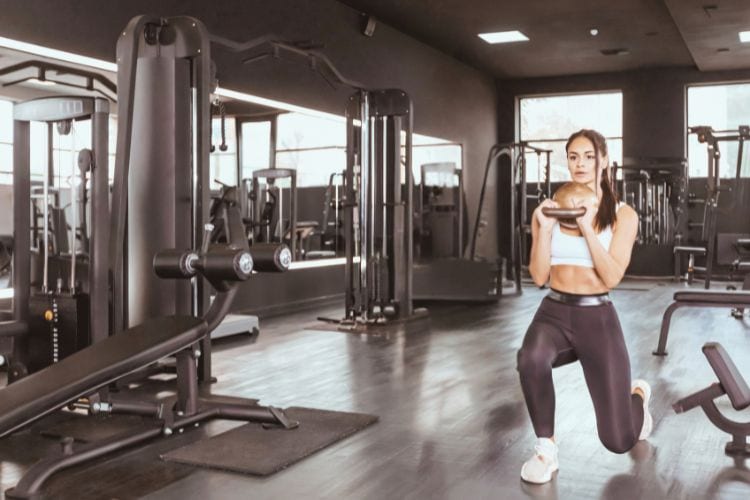
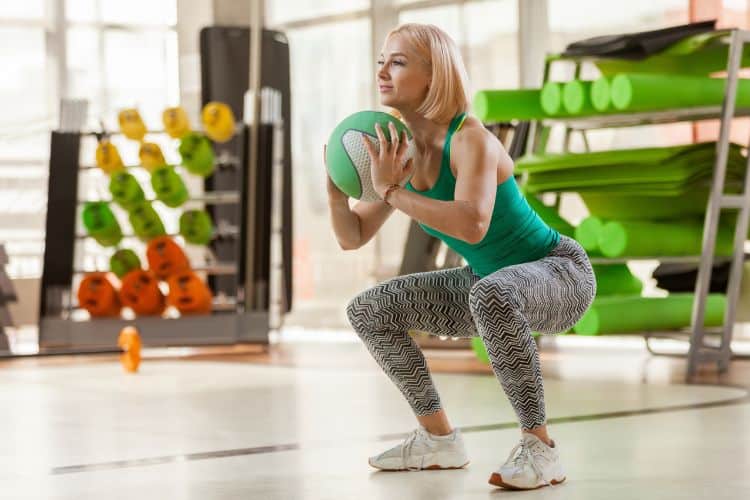
Hold one dumbbell vertically in front of your chest. Place your feet about hip to shoulder width apart, with your toes turned out slightly if that feels natural. Bend your knees and hips to lower into a squat, keeping the weight close to your body. Press through your feet to stand.
Lower only as far as you can while keeping your heels grounded and your movement controlled. A chair behind you can give you a consistent target. Touch it lightly, then stand without dropping your weight onto the seat. Exhale as you rise, and avoid trying to force your knees or feet into a position that feels uncomfortable.
Your quadriceps, glutes, and core all contribute to the squat. Choose a weight that lets you finish the set without collapsing your chest or rushing upward. If a weighted squat feels too difficult today, practice the same movement without the dumbbell.
Stand beside a chair or countertop and hold it lightly for balance. Lift one knee to a comfortable height, guide it outward, and lower the foot to the floor. Reverse the path if you can do so smoothly. Complete five slow repetitions, then change legs.
Keep your torso fairly still as the hip moves. A small, controlled circle is more useful than a large circle that pulls your whole body along with it. If standing on one leg feels unsteady, keep the moving foot close to the floor and let it touch down between repetitions.
After both sides, rest before repeating the pair. The squat challenges your lower body, while the hip rotation lets you explore movement around the joint without adding another demanding strength set.
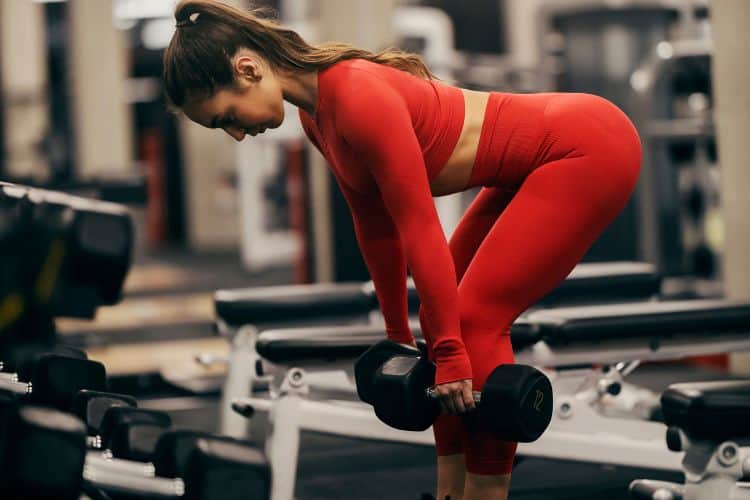
Hold the dumbbells at your sides or in front of your thighs. Soften your knees and push your hips backward while the weights travel close to your legs. Lower until you feel a comfortable stretch in the backs of your thighs and can still keep your back in a steady position. Drive through your feet and bring your hips forward to stand tall.
Think of this as a hip movement rather than a reach toward the floor. You do not need to lower the dumbbells to your ankles. Keep your shoulders relaxed, your ribs stacked over your torso, and your gaze slightly ahead of the floor. Avoid leaning backward at the top; simply return to an upright stance.
Start light enough to feel the pattern. As your technique becomes more consistent, increase the dumbbells gradually. The last few repetitions can feel demanding, but they should look much like the first few.
Place one knee on a folded towel or exercise mat and put the other foot in front of you. Gently shift your hips forward until you feel a mild stretch at the front of the hip on the kneeling side. Reach the arm on that same side overhead and take five comfortable breaths.
Keep the reach easy. You should be able to breathe normally and avoid arching your lower back to create a bigger stretch. If kneeling is uncomfortable, perform a standing version: step one foot back, bend the front knee slightly, and reach the arm on the back-leg side overhead.
Switch sides before resting. This mobility movement can feel welcome after a hip hinge, but there is no need to push deeper each round. Aim for a position you can control.
Lie on your back with your knees bent and feet on the floor. Hold a dumbbell in each hand with your elbows resting lightly near the floor. Press the weights upward until your arms are nearly straight, then lower with control. Keep your wrists stacked over your forearms.
The floor gives you a clear stopping point for each repetition. Lower until your upper arms touch it gently rather than letting your elbows drop or bounce. Keep your ribs comfortable against the floor and avoid lifting your hips to drive the weights upward.
If getting down to the floor is difficult, use a stable bench or substitute a standing wall push-up. For a wall push-up, place your hands slightly wider than shoulder width, bend your elbows to bring your chest toward the wall, and press away. Choose the version that lets you work through a smooth, pain-free motion.
Lie on one side with your knees bent and stacked. Extend both arms in front of your chest, palms together. Slowly lift the top arm and rotate your upper body to open toward the other side, then return. Let your eyes follow your moving hand if that feels comfortable.
Keep your knees together and make the movement gentle. You do not have to bring the top hand all the way to the floor. Move within the range your upper back and shoulders allow today, without twisting aggressively through your lower back.
If lying on your side does not suit you, sit upright in a chair and rotate your upper body slowly from side to side. In either version, pause briefly where the movement feels comfortable and continue breathing.
Place one hand on a sturdy bench, chair, or countertop. Step your feet into a balanced stance and hold a dumbbell in the other hand. Let the weighted arm extend toward the floor, then pull the dumbbell toward your hip. Lower it slowly and complete your repetitions before changing sides.
Keep your torso steady instead of twisting to lift the weight. Think about moving your elbow back while allowing your shoulder blade to move naturally. Choose a weight that lets you feel your upper back working without jerking the dumbbell upward.
If supporting yourself with one arm is uncomfortable, perform a two-arm bent-over row with lighter weights. Maintain the same controlled pull and lower. For either version, give yourself enough room that the dumbbells do not strike the chair or your legs.
Stand with your back near a wall and your feet a short distance in front of you. Bring your arms into a comfortable bent position, then slowly slide them upward and back down. Your hands and elbows do not need to remain pressed against the wall throughout the movement.
Keep your ribs from flaring upward as your arms rise. Stop before the motion becomes a strain in your neck or shoulders. If the wall position feels awkward, stand freely and raise your arms in a wide, gentle arc while keeping your shoulders relaxed.
This pair trains a pulling pattern and gives your shoulders a chance to move overhead without a weight. The wall slide is a practice movement, so favor an easy, repeatable path over the highest reach possible.
Stand tall with a dumbbell in each hand, one dumbbell held at your chest, or no weight at all. Step one foot backward and bend both knees to a comfortable depth. Press through your front foot to return to standing. Alternate legs or finish one side before switching.
Keep the step long enough to give your front knee room to bend comfortably. You can hold a countertop or chair with one hand if balance limits your movement. A shorter lowering distance is fine, especially when you are learning the exercise.
If a reverse lunge bothers your knees or feels too unstable, replace it with a supported split squat. Set your feet in a staggered stance, hold on for balance, and bend your knees slightly without stepping between repetitions. Practice control first; add weight only when the pattern feels secure.
Face a wall or countertop and place one foot slightly forward. Keep the heel down as you bend the front knee toward the toes, then move back. Repeat slowly eight times before switching sides.
Allow the knee to travel in the same general direction as the toes. Do not force it forward or let the heel lift just to make the movement look larger. You are looking for a gentle motion around the ankle, not a deep stretch that feels painful.
Ankle movement can influence how comfortable your squat and lunge feel. Practice within an easy range and notice whether one side moves differently from the other. You do not need to make both sides identical during one workout.
If you have another five minutes, finish with a carry and reach. Hold a dumbbell in each hand and walk for 30 to 45 seconds with an upright posture. Set the weights down, then perform five slow standing side reaches per side. Rest briefly and repeat for two or three rounds.
During the carry, let your arms hang naturally and keep your steps controlled. Choose weights that challenge your grip without pulling your shoulders down or making you lean from side to side. If you lack walking space, march slowly in place.
For the side reach, stand tall, lift one arm overhead, and gently reach toward the opposite side. Return to center before changing arms. Keep the movement small enough that you can breathe easily and avoid turning it into a lower-back bend.
A useful starting weight makes the prescribed repetitions feel manageable at first and noticeably harder near the end. You should still feel capable of performing a few more repetitions with good technique when the set ends. If every repetition feels effortless, try a slightly heavier dumbbell next time. If you have to swing, hold your breath, or shorten the movement dramatically, use less weight.
You can use different weights for different exercises. Your Romanian deadlift may call for more resistance than your floor press or row. A lighter load is also appropriate when you are learning a new movement. Consistency matters more than matching someone else’s dumbbell size.
For mobility exercises, effort is measured differently. Move slowly, maintain control, and avoid forcing a joint into a position. You may gradually notice that a comfortable range becomes larger, but range alone is not the target.
During week one, complete two rounds of each superset with light to moderate weights. Learn the order of the exercises and find a range of motion you can repeat comfortably. Rest as long as needed to begin each strength set with good form.
During week two, add a third round to the supersets if your schedule and recovery allow. Keep the weights the same while you adjust to the added work. If the full session feels too long, add a round to only the first three supersets and build from there.
During week three, look at your strength sets. If you have been completing the top end of a repetition range with consistent technique, increase the dumbbell weight slightly for that exercise. Return to the lower end of its repetition range with the new weight. Continue to move deliberately during the mobility portions.
During week four, aim to make your sets more consistent. You might perform one additional controlled repetition with the same weight, use a steadier lowering phase, or feel more balanced in a supported movement. Progress does not have to mean increasing every weight at once.
Complete the workout two or three times per week, with time between sessions for recovery. On other days, you can walk or practice a few of the mobility movements on their own. If you feel unusually tired or sore, reduce the rounds or take an extra rest day.
The most common mistake is treating the mobility exercise as a race to the next strength set. Move through it slowly enough to notice your position and breathing. If you rush, the movement loses much of its purpose and may leave you more tired for the following round.
Another mistake is selecting weights based on what you think you should lift. Let your current technique guide the choice. A controlled set with an appropriate dumbbell gives you a clearer starting point for future progress than a heavier set completed with repeated compensations.
Finally, avoid forcing a stretch because it seems as though more range must be better. Your hips, shoulders, and ankles may feel different from one day to the next. Work within a comfortable range and let practice build confidence in the movement.
Yes. Begin with two rounds, use light dumbbells or bodyweight, and take longer rests. Keep a sturdy support nearby for hip rotations, lunges, and ankle rocks. Learn the strength movements at a comfortable depth before trying to increase the weight or range.
It includes both strength work and controlled mobility practice. The dumbbell exercises provide the main resistance challenge. The movements between them give you time to practice moving your joints through comfortable ranges. You can adjust the emphasis by changing the weights, rounds, and rest periods.
Allow about 35 to 45 minutes for the warm-up, five supersets, and normal rests. Two rounds with lighter weights may take closer to 25 to 30 minutes. The optional carry finisher adds approximately five minutes.
You may feel a mild stretch during some movements, but it is not required. Focus on smooth motion, steady breathing, and control. Stop short of pain or a position you have to force.
Yes. A few gentle repetitions can fit into a short movement break. Keep them easy on rest days so they support how you feel rather than becoming another demanding session.
This strength and mobility superset workout gives you a clear way to train your whole body while making room for controlled movement. Start with the versions you can perform well, record your weights and repetitions, and notice how each exercise feels from week to week.
As your technique becomes steadier, add a round, a repetition, or a small amount of weight to the strength sets. Let the mobility movements remain patient and comfortable. Over time, those simple choices can help you build a routine you can return to regularly.
For more ways to build on this strength and mobility superset workout, try the 35-Minute Full-Body Dumbbell Superset Workout for another strength session or the Strength And Core Superset Workout to add focused core work. The Full-Body Kettlebell Strength And Mobility Workout offers a different equipment option, while the 30-Minute Strength And Pilates Workout emphasizes controlled movement. When you’re ready for a longer plan, follow the 4-Week Superset Workout Routine.
Stay up to date on the latest women’s health, fitness and lifestyle trends and tips.
